
It is the night before a sunrise kayak trip and you fire off the usual reminder: “Meet at the boat ramp, 6:15am, wear shoes that can get wet.” Eleven people booked. Next morning, four stroll up late and confused, because the text never reached their phones. You got no error. Your software said “sent.” The carriers quietly dropped it, along with weeks of your confirmations and reminders. The reason has a clumsy name, A2P 10DLC, but once you get it the fix is permanent. This is the plain version: what it is, the steps to register, what it costs, and the wording that makes your texts land.
What blocked texts are quietly costing you
Here is the part that makes operators furious: there is no alarm. Your booking tool reports the message as sent, your dashboard looks normal, and the text is simply gone. You only find out when a guest shows up at the wrong meeting point, or a no-show you could have saved costs a seat you cannot resell.
Put a number on it. On a twelve-person boat at $75 a head, two no-shows you could have caught with a reminder is $150 off that departure, and reminders are one of the cheapest ways to protect a booking. If no-shows are a sore spot, our guide to cutting tour no-shows has the mechanics, but none of it works if the message is dropped at the carrier.
This is not a slow decline you can ignore. Since February 3, 2025, carriers block unregistered application-to-person traffic altogether, not just throttle it. (Telnyx) That is any text your software sends for you, even one you typed by hand, so texts through a booking tool, a CRM, or GoHighLevel are all in scope.
Beyond the saved seats, direct booking is where the growth is: the US Bureau of Labor Statistics projects 6% job growth for tour and travel guides through 2035, against 0% for travel agents. (BLS, guides) (BLS, agents) More travelers want to deal with the operator directly, and the ones who win them have texts that show up on time. Registration keeps that channel open.
What A2P 10DLC actually is, in plain English
Strip away the jargon and A2P 10DLC is a registry. “10DLC” means a 10-digit long code, which is just a normal local phone number, the kind most small operators text from. “A2P” means application-to-person, business texting sent through software. Spammers used to blast marketing from ordinary local numbers and carriers could not tell a real tour reminder from a scam. So through The Campaign Registry, carriers now require every business texting from a local number to register who they are and what they send. Registered senders get delivered; unregistered senders get filtered or blocked.
You register two separate things, and the names trip people up:
- Your brand. Your business identity: legal name, address, and either an EIN or, for a sole operator, your own details as a Sole Proprietor. The “who is sending” layer.
- Your campaign. The “what you send” layer: a use case like booking confirmations, reminders, and review requests, backed by sample messages.
That is the whole idea: a one-time setup plus a small monthly fee, not a yearly renewal, and the hardest part is answering the questions honestly. Most operators who text from GoHighLevel or a similar platform register right inside it, which walks you through both layers in one flow.
The six steps to get registered and stay registered
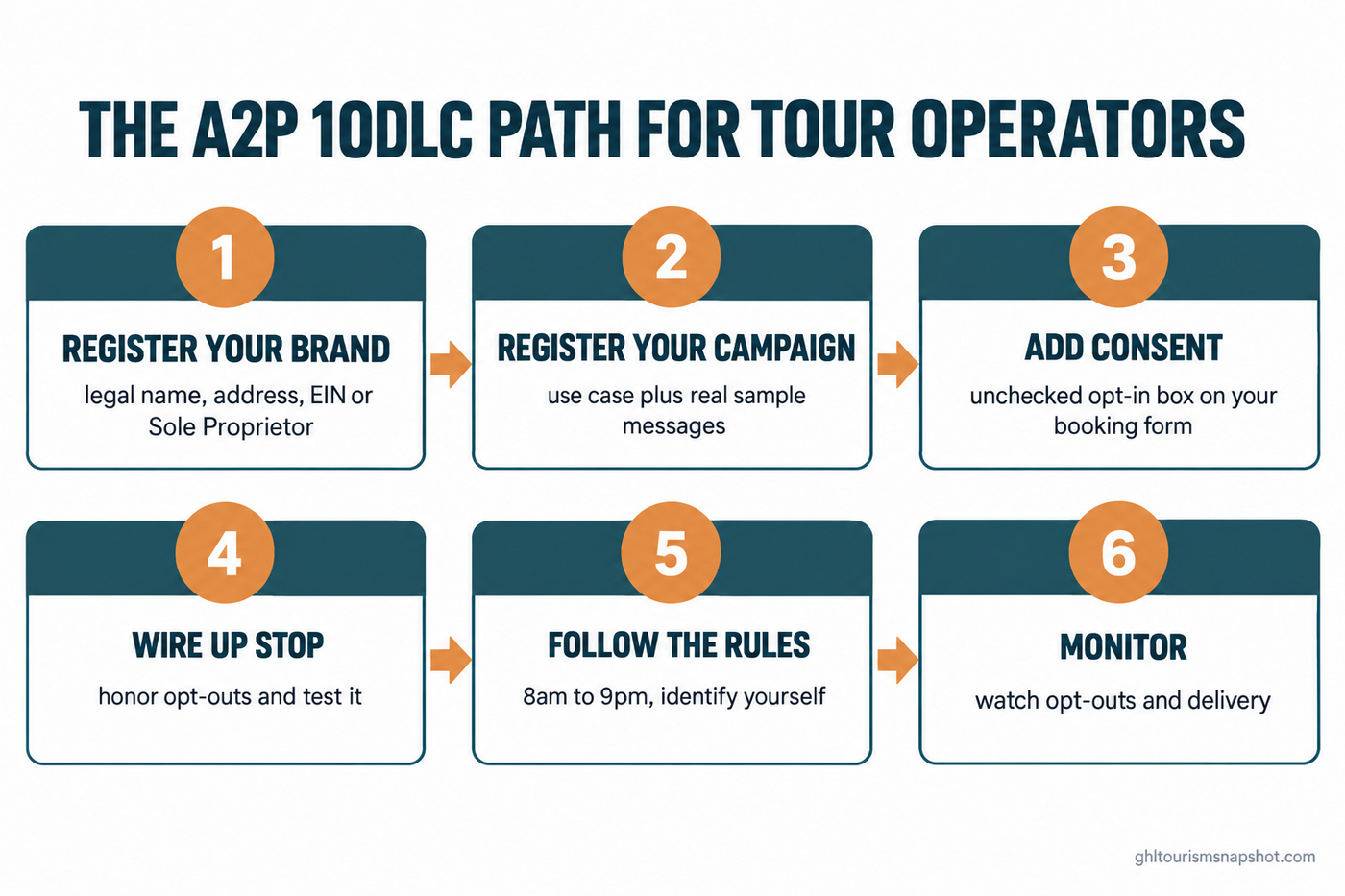
The path is the same whether you run one kayak or a fleet. Six steps: register your brand, register your campaign, fix your consent, wire up STOP, follow the content rules, and keep an eye on it. Below is each one, with what to put in the boxes and the mistake that gets you rejected.
Step 1: Register your brand
This is where you tell the registry who you are: your legal business name exactly as it appears on your tax paperwork, your address, your website, and your EIN. A one-person shop without an EIN registers as a Sole Proprietor using personal details instead, a real, accepted path for small operators.
The Sole Proprietor path has lower daily sending limits, so if you plan to grow, get an EIN. For a single operator texting confirmations and reminders, those limits are usually plenty, and a sole prop is the fastest, cheapest way to get legal this week.
Step 2: Register your campaign (the use case)
Now you describe what you send: pick a use case, write a short description, and provide sample messages plus how people opt in. For a tour operator the honest use case is a mix of booking confirmations, reminders, and customer care, often filed as “mixed” or “low volume mixed.” The vetting team reads your samples and opt-in description closely, and both have to be specific and true.
Notice that every sample names the business, includes “Reply STOP,” and says texting is not a condition of buying. Reviewers look for exactly that, and samples that do not match what you actually send, or leave out STOP, get rejected. Submit samples word-for-word matching your automation, and file an honest use case, since a marketing label when you really send reminders invites higher fees. For the copy of every message you send once approved, our tour booking message templates post has all seven booking moments.
Step 3: Put real consent on your booking form
Registration proves you are a real business; consent proves the person agreed to hear from you, and you need both. Under the Telephone Consumer Protection Act you need the recipient’s prior express consent to text, and marketing texts need written consent. The simple way to capture it is an unchecked checkbox on your booking form with plain language next to it.
Keep the box unchecked so the guest actively opts in, never make texting mandatory to book, and keep a record of when and how each person consented. If a complaint ever lands, showing the timestamp and the wording they agreed to is what protects you. The rules keep shifting, too: a federal appeals court vacated the FCC’s strict “one-to-one consent” rule in January 2025, but the core TCPA requirement did not change, and a clean checkbox keeps you on the right side of it. (Morrison Foerster)
Step 4: Handle STOP and opt-outs
Every recipient can stop your texts by replying STOP, END, UNSUBSCRIBE, or CANCEL. You must then stop texting that number and may send exactly one confirmation. On GoHighLevel and most modern platforms this is automatic at the carrier level, but confirm it works and reads like a person wrote it.
The sneaky failure: a guest replies STOP, your system keeps texting because the opt-out did not register, and that is a direct violation. The opt-out must silence every message type except the single confirmation, so do not honor it only on your marketing list. The fix is to test it: reply STOP from a test phone, confirm the next message is blocked and the confirmation went out, and repeat whenever you change platforms.
Step 5: Follow quiet hours and content rules
Registration and consent get your texts delivered and legal. The content rules keep them that way. Three things matter most for a tour operator.
First, timing. The widely followed TCPA window for marketing messages is 8am to 9pm in the recipient’s local time. (Squire Patton Boggs) The FCC was taking comment in 2025 on whether consent changes that window. (Privacy World) Schedule promotional texts inside it and treat urgent logistics, like a same-morning weather cancellation, as the narrow exception.
Second, identify yourself in every message, so a guest who gets a reminder three weeks after booking is not staring at an unknown number wondering if it is a scam.
Third, mind restricted topics. Carriers filter some content hard. That rarely matters for a tour operator, but if you ever promote anything touching alcohol, like a brewery or wine tour, age-gate it. For the strategy behind the whole sequence, our SMS marketing for tour operators guide covers cadence and content.
Step 6: Monitor and keep it healthy
Registration is not set-and-forget. Carriers keep watching and can filter a sender whose traffic looks spammy even after approval. Keep three habits: watch your opt-out rate, since a spike means you are texting people who did not expect it; watch your delivery rate so you catch a drop within days, not at a meeting point; and keep your registration details current, because a mismatch that appears later can get you filtered again.
The slow killer is volume creep: you register as a low-volume sender, then a good season pushes you past your daily limit and messages start failing at the edges. If your volume grows, revisit your tier before peak season, not during it.
A2P 10DLC is one of several rules that quietly shape how a tour business can market. For the fuller picture, our tour operator compliance checklist pulls them into one place, and the Seller of Travel registration guide covers the advertising rule that catches operators in California and Florida off guard.
What it really costs
The fees are smaller than most operators fear. They come in two shapes: a one-time registration charge and a small monthly campaign fee. Through GoHighLevel, how most operators on our system register, the published passthrough fees look like this. (GoHighLevel)
For a solo kayak or food tour, the one-time cost lands around $22.50 as a sole prop or low-volume brand; the $64 tier is for high-volume senders, which most single operators are not. On top sits a monthly fee that keeps the campaign live: about $1.50 to $2.00 for a low-volume brand, around $10 for a standard use case, plus roughly $15 one-time per extra campaign.
So a solo operator’s real cost is about $22.50 once, then a couple of dollars a month. Against one saved no-show, the math is not close. The per-message send cost is separate and tiny, charged by your platform regardless of registration.
| What you pay | Sole proprietor / low volume | Standard brand |
|---|---|---|
| One-time registration | ~$22.50 | ~$64.00 |
| Monthly per campaign | ~$1.50 to $2.00 | ~$10.00 |
| Each extra campaign | ~$15.00 one-time | ~$15.00 one-time |
| Per text sent | fraction of a cent (platform fee) | fraction of a cent (platform fee) |
Three operators, one registration path
The steps are identical, but the right tier and effort differ by the shape of your business.
The solo guide or single-boat operator. You text confirmations and reminders to people who booked, plus an occasional off-season offer. Register as a Sole Proprietor, file one low-volume mixed campaign, and you are done for about $22.50 plus a couple of dollars a month. Your daily limits are lower but you will rarely touch them, and you can finish it this week.
The mid-size shop with a few tour types. You have an LLC, an EIN, a few guides, and several tour types that each want slightly different messaging. Register as a Standard brand with your EIN for higher limits, then file campaigns for your core use cases. Your automated booking and reminder flows, the kind built into a proper appointment automation setup, all run under that registration. Budget the one-time fee plus roughly $10 a month per campaign.
The multi-location or high-volume operator. You run departures across several cities or push real volume in peak season. Register as a High Volume Standard brand for the throughput, and plan campaigns so logistics and marketing stay cleanly separated. The dollars are still small against revenue, but hitting a sending ceiling mid-season is the failure that costs you, so sort your tier before the season.
Objections, answered straight
“This sounds like technical work I will never get right.” Registration is a form, not a coding project, and most platforms walk you through it. The part people get wrong is the detail work: matching your business name exactly, writing honest samples, and wiring up consent. If you would rather not touch it, our SMS automation feature handles registration and the compliant flows. Either way, the effort is an afternoon, not weeks.
“Can I not just keep texting from my personal phone?” You can text a guest one-to-one from your own phone, and that is person-to-person, not in scope. The moment you send through software, use automation, or blast a list, it is application-to-person and will be filtered if unregistered. The reminder that fires automatically the night before a trip is exactly the kind that gets blocked, and the one you most need to land.
“I already pay for a booking tool that sends texts. Am I not covered?” Not automatically. Your software can send, but registration is tied to your business identity and you usually complete it yourself inside the tool. Many operators assume it is handled, then discover months of dropped reminders. Check your messaging settings today, because “sent” does not mean “delivered.”
“What happens if I just ignore all of this?” Your automated texts keep getting blocked, silently, and you keep losing the seats reminders would have saved. There is no grace period, because blocking of unregistered traffic is already in force. (Telnyx) Ignoring it is choosing to run without your most reliable channel.
FAQ
Do I really need A2P 10DLC for a small tour business?
Yes, if you send business texts through software, a CRM, or a booking tool, including automated confirmations and reminders. Since February 3, 2025, carriers block unregistered application-to-person traffic altogether. A one-to-one text from your personal phone is not in scope, but almost any automated tour messaging is.
How much does A2P 10DLC cost for a solo operator?
Through GoHighLevel, a sole proprietor or low-volume brand pays roughly $22.50 one-time, then about $1.50 to $2.00 a month per campaign, as published passthrough fees. High-volume standard brands pay around $64 one-time and about $10 a month.
How long does registration take to approve?
Sole proprietor registrations often clear within a day or two, while standard brand and campaign vetting can take several business days. The biggest cause of delay is a rejection, usually a business name or EIN that does not match official records, so get those exactly right.
What is the difference between registration and consent?
Registration tells carriers who you are and what you send, so your texts get delivered. Consent is the recipient agreeing to hear from you, captured with an unchecked opt-in box. You need both, because being registered does not let you text people who never opted in.
Can I send tour reminders outside of 8am to 9pm?
The widely followed TCPA quiet-hours window for marketing texts is 8am to 9pm in the recipient's local time, so schedule promotional messages inside it. Urgent logistics, like a same-morning weather cancellation, are the narrow exception. The FCC was taking comment in 2025 on whether consent changes the window.
What happens if a guest replies STOP?
You must stop texting that number across all message types except a single opt-out confirmation. On most platforms, including GoHighLevel, STOP is handled automatically at the carrier level, but test it once after setup.
Does registering fix deliverability on its own?
It is the foundation, but carriers still watch your behavior. A high opt-out rate, spammy content, or texting people who did not opt in can get a registered sender filtered. Keep opt-outs low and only text people who agreed.
Booking texts are the quietest, cheapest way to protect a seat, and through 2025 a lot of operators have been losing them without knowing it. The fix is not glamorous: a form, a checkbox, and a tested STOP. Do it once and the night-before reminder lands, the four confused guests show up on time, and your most reliable channel works for you again.