
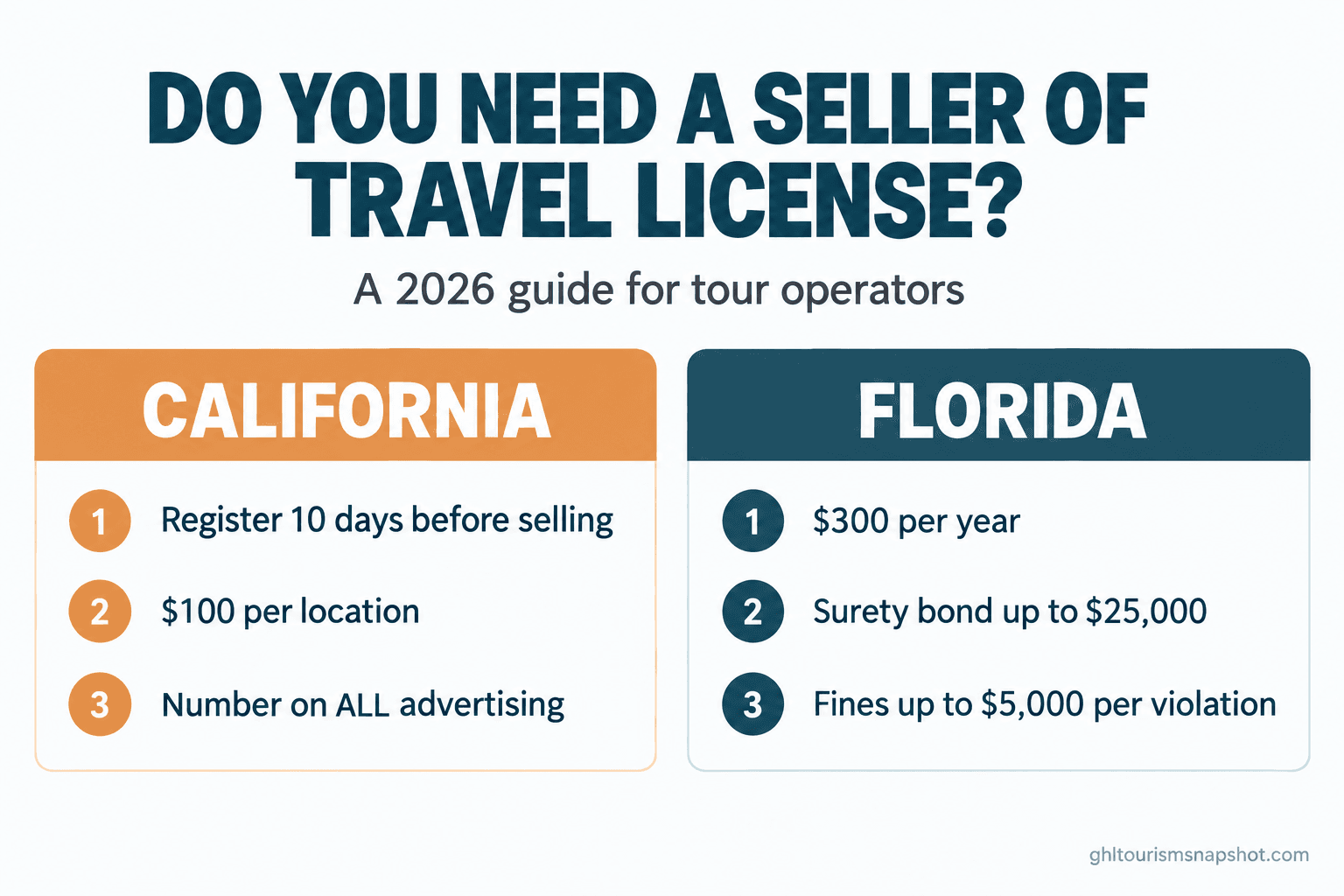
It is a Thursday in the off-season and you are finally updating your website. You add a bright new “Book Now” button, build a Facebook ad for spring departures, and queue up an email to last year’s guests. None of it feels risky. Then a friend who runs a competing kayak outfit mentions the number on the bottom of her homepage, the one that reads “CST # 20…” and asks if you have yours yet. You do not, and you did not know you needed one. Here is the short answer: if you sell tours to the public in California or Florida, or you advertise to travelers in those states, you almost certainly have to register as a Seller of Travel before you take another booking, and in California that number has to appear in every ad you run. This guide covers who has to register, how to do it in each state, what it costs in 2026, and the exact copy you need in your marketing.
What a Seller of Travel law actually is
A Seller of Travel law is a consumer-protection rule. The state’s logic is simple: you take money from a traveler now for a trip that happens later, so if you vanish or cancel, the state wants a way to get that money back. That is the whole point of the registration fee, the surety bond, and the restitution rules. It is not the state deciding you are a “real” travel agency. It is making sure a customer who paid in January for a July departure is not left stranded.Only a handful of states run one of these programs, and they are not identical. California and Florida matter most to tour operators, because they are verified, actively enforced, and big tourism markets. The part operators miss is that these laws reach past your paperwork and into your marketing: California ties your registration number to your advertising, so the moment you run an ad or publish a booking page aimed at California travelers, the rule is live.
Do tour operators count? Usually yes
The honest answer is that “seller of travel” is defined broadly on purpose, and tour operators usually land inside it. California’s statute covers sellers who sell, provide, furnish, contract for, arrange, or advertise travel. Florida’s applies to “any person or business that is a seller or promoter of travel-related services.” A guided tour, a charter, a multi-day expedition: these count.Exemptions are real but narrow, and you have to qualify for them precisely. So the practical rule is this: if you sell experiences to the public and you touch California or Florida travelers, assume you are covered until the state tells you otherwise. Guessing wrong is a per-violation problem.
California, line by line
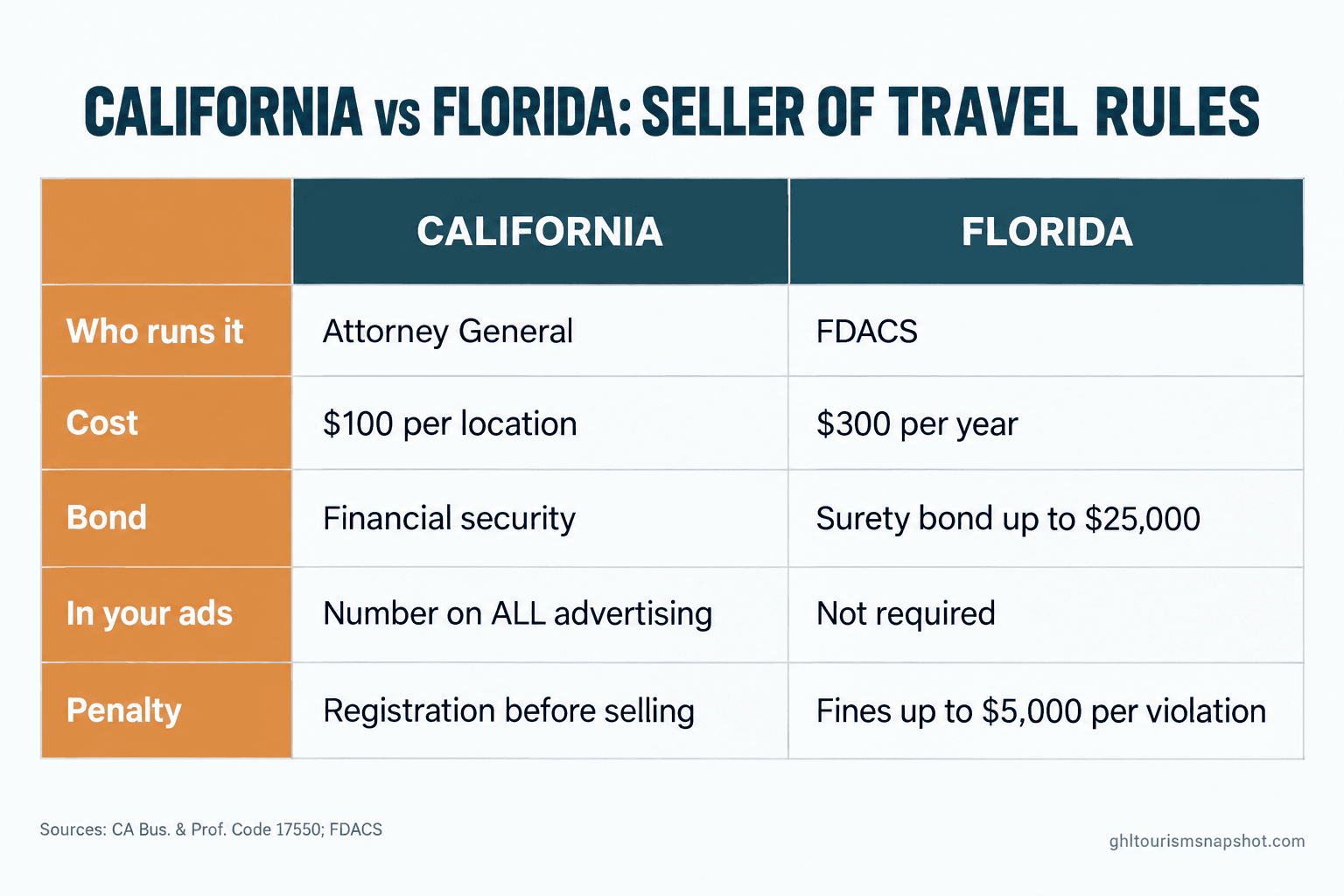
California runs its Seller of Travel program through the Attorney General under Business and Professions Code sections 17550 through 17550.59. Here is what applies to a tour operator.You register before you do business. The statute says a seller of travel shall apply for registration not less than 10 days before doing business in the state. The filing fee is $100 for each location, a late fee applies if you miss the deadline, and registration is valid for one year, so this is an annual renewal. (Bus. & Prof. Code 17550.20)
The number goes in your advertising. The Attorney General issues each registrant a separate number, usually shown as “CST # “ followed by digits, and California requires a registered seller to “display the registration number on all advertising.” (CA Attorney General) That is the part that bites: all advertising. Your homepage, booking widget, Google ad, Instagram promotion, printed rack card.
You also need a specific disclosure. Under 17550.24, advertising that uses “seller of travel” language has to carry the statement that registration as a seller of travel does not constitute approval by the State of California. That exact sentence is not optional wording you paraphrase.
California has also had a restitution fund tied to this program over the years. I am not quoting a current fund figure here, because I could not verify the 2026 number against the state directly, and a wrong dollar figure in a compliance post is worse than none. Confirm the current financial-security and fund details with California’s Seller of Travel Program before you file.
Florida, line by line
Florida runs its program through the Department of Agriculture and Consumer Services (FDACS) under Florida Statutes 559.926 to 559.939. The numbers are clean and verified.Registration is $300 a year. The fee is $300, nonrefundable, for all sellers of travel, and if you offer vacation certificates you pay an additional $100 document submission fee. (FDACS)
You post a surety bond. FDACS requires a performance bond of up to $25,000, or up to $50,000 if you sell vacation certificates. A bond is not a fee you lose. It is a guarantee an insurer backs, and you pay an annual premium for it, often a few hundred dollars. (FDACS)
The exemption is specific. Sellers with an Airlines Reporting Corporation contract for three or more years under the same ownership are exempt (five or more for vacation-certificate sellers), and exempt sellers still have to obtain a statement of exemption from FDACS. The exemptions are listed in Florida Statutes section 559.935, and nonprofit status alone does not exempt you. (FDACS)
Getting it wrong is expensive. Operating unregistered can bring civil or administrative fines of up to $5,000 per violation, plus cease-and-desist orders and injunctive relief. Each sale or attempted sale can count as a separate violation, so the math escalates fast. (FDACS)
Here is the first-year cost of doing this right, using only the official state figures.
First-year registration fees in US dollars, official state figures. Florida also requires a surety bond (premium extra). Sources: CA Bus. & Prof. Code 17550.20, FDACS.
The other states people keep citing
Search this topic and you will see Washington, Hawaii, and Iowa named as Seller of Travel states, often in the same breath as California and Florida. Treat that list with care. These programs have been created, amended, and in some cases repealed over the years, and a blog post from 2019 is not proof that a rule is live in 2026. I could not verify the current Washington, Hawaii, or Iowa requirements against a primary state source while writing this, so I will not hand you a fee or bond number and pretend it is solid. If you sell into or operate in one of those states, call the agency or check its current statute directly. For most small operators the practical exposure is California and Florida first.The rules differ by state and they move, which is why a single national checklist is not enough on its own. For the broader marketing-compliance picture, our tour operator compliance checklist covers TCPA texting, email, and waivers in the same plain-English style.
The marketing trap nobody warns you about
Most operators file the paperwork, breathe out, and forget the second half of the California rule. The number is not something you keep in a drawer. It has to appear on all advertising, read broadly: your homepage, a paid ad, a seasonal email, an Instagram promotion, a printed rack card. That turns a one-time filing into an ongoing marketing habit.If every page, email footer, and form already carries the line, you stop thinking about it. Run your marketing out of one connected system instead of five disconnected tools, set the footer once, and it rides along on every message.
How to actually register
The mechanics are not hard. The order is what people get wrong. In California, settle your “locations” (the $100 fee is per location) and file with the Attorney General’s Seller of Travel Program at least 10 days before you sell, then add your number and the disclosure to your website, ad templates, and email footer the same day. In Florida, get a surety bond quote first because it takes lead time, then file the $300 registration with FDACS (plus the $100 document fee for vacation certificates), attach your bond, and calendar the renewal. For both, keep a simple compliance folder: certificates, bond, renewal dates, and the exact disclosure language you use. This is the same discipline that makes your liability waivers and cancellation terms defensible: boring, consistent, and findable.Three operators, three answers
The same rules produce different work depending on your size.The solo operator in one state. You run a single ATV or walking tour in, say, Florida. Your job is small and finite: one $300 FDACS registration, one surety bond, one renewal date, and the disclosure habits. If you only sell locally and never advertise into California, you do not need a California registration too. The whole thing is an afternoon and a few hundred dollars a year.
The mid-size operator selling into California and Florida. You run three or four tour products, advertise in both states, and some bookings come from out-of-state travelers. Now you likely need both registrations, both renewals, and a disciplined advertising setup so the California number rides on every ad and page automatically. This is the size where a disconnected marketing stack starts to cost you, because the number has to be consistent across site, ads, and email, and chasing that by hand across tools is how a line goes missing.
The large multi-state operator. You run departures in several states and market nationally. You register where required, track renewals centrally, standardize your disclosure language across every channel, and probably involve a lawyer for edge cases, like which state’s rule applies to a traveler who books in one state for a tour in another. The principle does not change, but the coordination does, and templating your required copy once at the system level is the only sane way to keep it uniform.
Where this goes wrong
Every step has a failure mode. These are the ones I see most.You assumed you were exempt. This is the big one. An operator reads “ARC contract exemption,” decides it sounds like them, and skips registration without ever applying for the statement of exemption. The state does not see an exemption. It sees an unregistered seller, and in Florida each sale can be its own violation.
You registered and then forgot the advertising rule. You filed in California, got your number, and never put it on your ads. The filing is only half the rule. A clean registration with a naked ad is still out of compliance. Bake the number into templates the day it arrives.
Your bond lapsed. Florida’s bond is annual, like the registration. If the premium does not get paid, the bond lapses, and you are no longer properly registered even though your certificate is still pinned to the wall. Put the bond renewal on the same calendar.
You let an OTA lull you. Selling through a marketplace does not make your own direct sales someone else’s compliance problem. The moment you take a booking on your own site or over your own phone, you are the seller of travel. The point of selling direct is that you own the customer, and owning the customer means owning the compliance, including the exact California disclosure wording, which you use verbatim rather than paraphrasing into something friendlier.
Steal this copy
Replace the placeholders with your real details, and confirm the exact disclosure wording against your state before you publish.California website footer and ad line.
[Business Name] is registered with the State of California as a Seller of Travel, Registration No. CST # [your number]. Registration as a seller of travel does not constitute approval by the State of California.
Florida website footer line.
[Business Name] is a registered Seller of Travel with the Florida Department of Agriculture and Consumer Services. Registration No. [your ST number]. Visit FDACS at 1-800-HELP-FLA or fdacs.gov for more information.
Email footer block (both states, combined).
[Business Name] · Registered Seller of Travel · CA: CST # [number] · FL: ST [number]. Registration does not constitute approval by the State of California. You are receiving this because you booked or inquired about a tour with us. Reply STOP to opt out of texts, unsubscribe link below for email.
That last line matters because your booking reminders also have to follow TCPA and CAN-SPAM rules, and the opt-out language belongs right next to your registration line. Our SMS marketing guide covers the texting side, consent and A2P 10DLC included.
Objections, answered straight
“I only sell my own tours. This is for travel agencies, right?” No. The laws are written around selling travel to the public, and running your own guided experiences is selling travel. The definitions in both states are broad enough to catch tour operators, and the exemptions are specific carve-outs you have to qualify for, not a general “operators are fine” rule.“I’m not in California or Florida, so I can skip this.” Maybe not. California’s rule reaches advertising aimed at California travelers, so if you run ads or take bookings from people in these states, you can be on the hook even if your boat never leaves another state’s water.
“This sounds expensive and slow.” It is not, relative to the downside. California is $100 per location. Florida is $300 plus a bond premium. Against fines of up to $5,000 per violation in Florida, where each sale can count separately, registration is cheap insurance. The slow part is the surety bond lead time, which is why you start it first. For multi-state operators, or anyone with vacation certificates or an exemption claim, a short consult with a travel attorney is money well spent.
Compliance is the floor, not the ceiling. Once the registration and disclosures are handled, the real lever is still filling seats.
Projected employment growth, 2025 to 2035, percent. The operator model is growing while the agency model is flat. Source: BLS Occupational Outlook Handbook.
Frequently asked questions
Seller of Travel questions operators ask
Do tour operators have to register as a Seller of Travel?
In California and Florida, most do. Both states define 'seller of travel' broadly enough to include operators who sell experiences to the public. Exemptions are narrow, such as Florida's Airlines Reporting Corporation exemption, which still requires a statement of exemption from the state. Assume you are covered until the state confirms otherwise.
How much does Seller of Travel registration cost in 2026?
California charges a $100 filing fee per location, valid one year. Florida charges $300 a year, nonrefundable, plus a $100 document fee if you sell vacation certificates, plus the premium on a surety bond of up to $25,000 (up to $50,000 for vacation-certificate sellers).
Does the California registration number really have to be in my ads?
Yes. California requires a registered seller to display its registration number on all advertising, and advertising that uses 'seller of travel' language must also carry the statement that registration does not constitute approval by the State of California.
What happens if I sell tours without registering in Florida?
Operating as an unregistered seller of travel in Florida can draw fines of up to $5,000 per violation, plus cease-and-desist orders and injunctive relief. Each sale or attempted sale can count as a separate violation, so the exposure grows with every booking you took while unregistered.
Does my booking software handle this for me?
No. FareHarbor, Peek Pro, Viator, and the rest process payments and bookings. They do not register you as a seller of travel and they do not put your number on your advertising. Those are your responsibility as the business selling the travel.
The bottom line
Back to that Thursday and the “Book Now” button. The fix is not complicated. If you sell in California, file with the Attorney General, get your CST number, and put it and the state disclosure on every page and ad before you run the campaign. If you sell in Florida, post a bond, pay the $300, and keep the renewal on your calendar. If you only sell locally in a state with no program, confirm that and move on. None of it is expensive next to a $5,000-per-violation fine, and all of it is boring once your templates carry the copy automatically. Do it once, and you can get back to the part that actually fills buses: owning your bookings and keeping your departures full.
Related reading
- Tour Operator Compliance in 2026: Seller of Travel, TCPA Texts, Email & Waivers
- SMS Marketing for Tour Operators: The 2026 Text-Message Playbook
- The Liability Waiver and E-Signature Guide for Tour Operators
- How to Drive Direct Bookings and Cut Your OTA Dependence
This article is general information for tour operators, not legal advice. Seller of Travel rules change and vary by state. Confirm your obligations with the relevant state agency or a qualified travel attorney before you rely on anything here.