
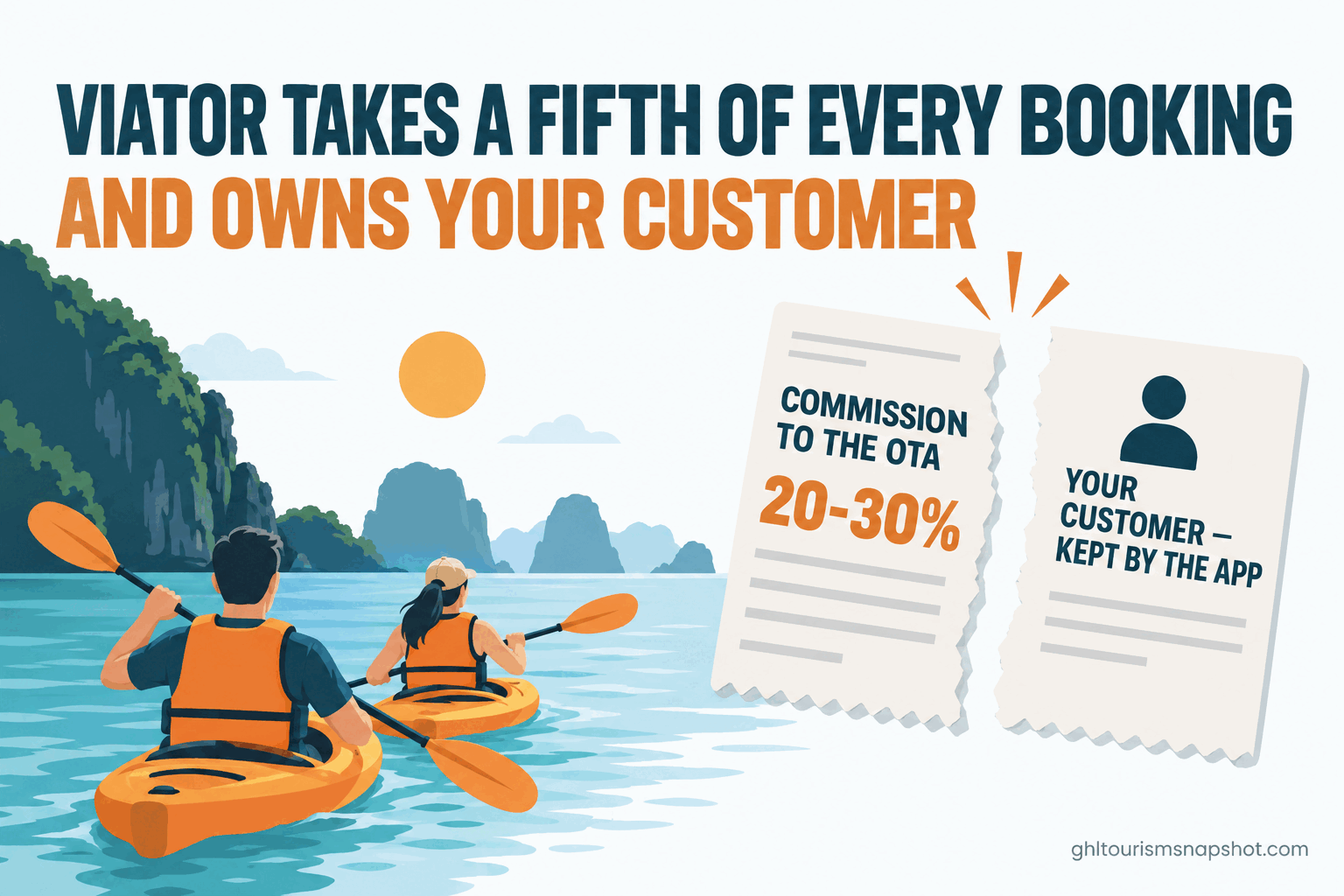
A family of four books your harbor kayak tour for Saturday at 10am. The day goes great. They tip the guide, take a hundred photos, and one of them says “we have to do this every year.” Then they drive home and you never hear from them again. Not because they did not love it. Because they did not book with you. They booked with Viator, and Viator kept the part that is actually worth money: the relationship. You got one booking minus a commission. Viator got a customer. Here is what an OTA booking really costs you, and the system to take the guest back so the next booking is free.
The two bills Viator sends you
Every operator knows the first bill. You sell a $130 booking, the commission comes off the top, and you pocket the rest. It stings, but at least you can see it. Arival, the main research body for tours and activities, puts it plainly: OTA and reseller commissions run 20% to 30%, and in many cases much higher. (Arival) A fifth of every booking is the floor, not the ceiling.
The second bill quietly bankrupts small operators, because nobody puts it on a spreadsheet. When the booking comes through an OTA, the OTA is the one with the customer: it holds the email that works, controls the pre-trip messaging, and decides what that traveler sees next time they open the app. Arival says it in one line: reseller bookings also limit operators’ ability to remarket to those customers and grow their own customer database. (Arival) You delivered the experience and ate the commission, and the customer it was meant to build went to someone else. A customer you cannot reach is a cost of sale you pay again and again.
What one OTA booking actually costs
Your tour is $65 a seat and two people book for $130. Through an OTA at a 25% commission, you net about $98. The same $130 on your own page at a roughly 3% card fee leaves about $126. That is a $28 gap on one booking, before the add-ons the OTA checkout never offered and the customer it never handed back.
OTAs surged to 37% of tour and activity bookings in 2025, the year Arival’s survey of more than 5,000 operators recorded the starkest decline yet in operators’ own direct website bookings. (Arival) The channel that keeps your customer is growing while your own list shrinks. The US Bureau of Labor Statistics projects 6% job growth for tour and travel guides through 2035, against 0% for travel agents: experiences are where travel is growing. (BLS)
The six steps to own the guest relationship
You do not have to pull your listings or pick a fight with Viator. Turn every OTA booking into a contact you own, so the second booking can come to you directly. Here are the six steps, in order, and you can start with just the first two.
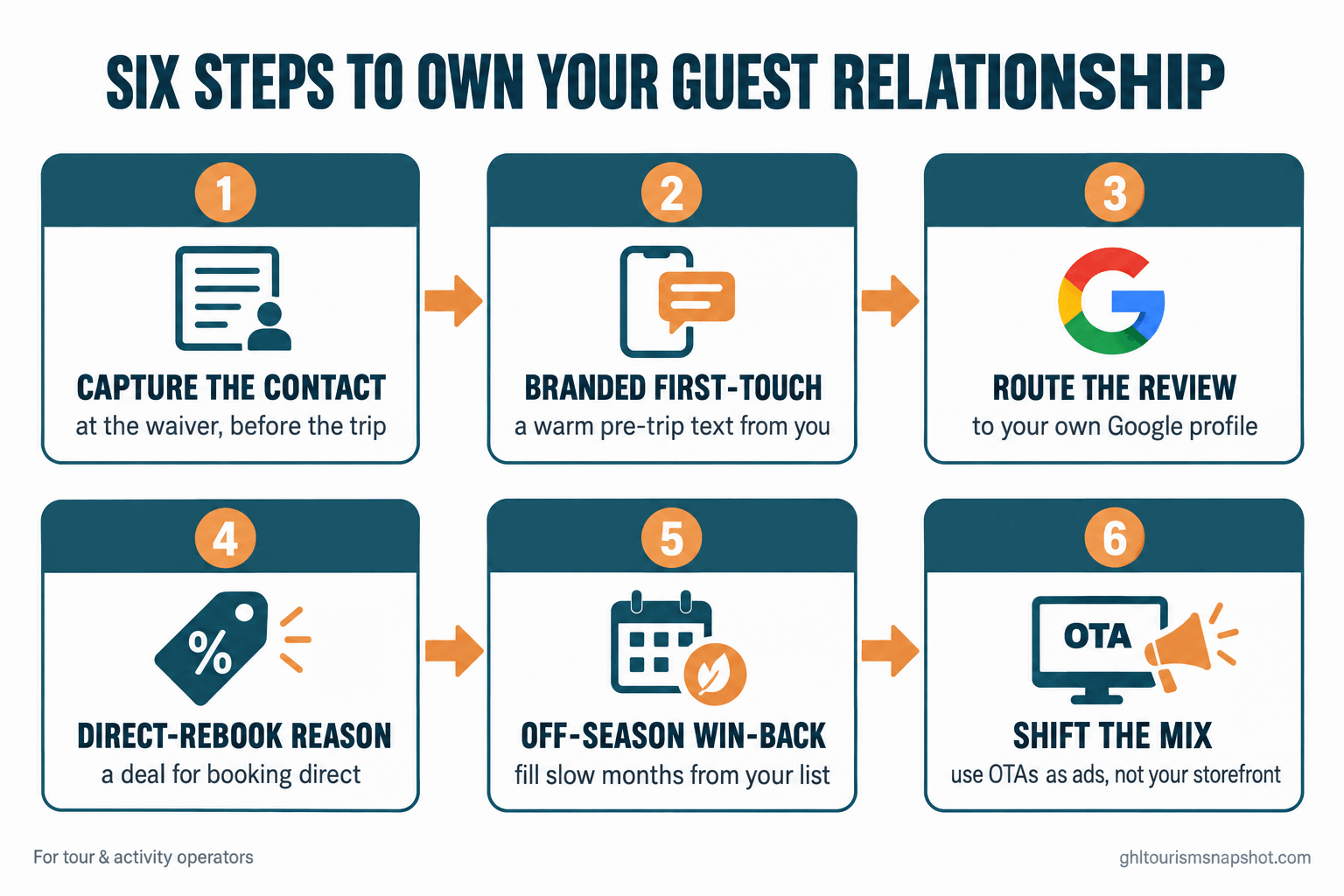
Step 1: Capture the contact on every booking
Everything downstream depends on this. OTA contact details can be thin or masked, and the traveler thinks of the trip as “the Viator thing,” not your tour. Your job is one honest moment where they hand you a real email or phone number.
The setup. You already have one unavoidable touchpoint: the trip. Put a short confirmation or waiver step every guest completes before arrival, where they enter their own contact details to get the meeting point, the what-to-bring list, and the weather call. That is logistics they want, and the moment they fill it in you have a real contact tagged by tour and date. If you run a liability waiver anyway, that is the natural place to collect it.
Where it breaks. Collecting the detail and dumping it into a form inbox no one reads. Capture only counts if the contact lands in one tagged system, ready for the next step. Keep the form to what you truly need, and be plainly yourself, not the app.
Step 2: Send a branded first-touch before the trip
If the only thing that reaches the traveler before the trip is a generic OTA confirmation, the trip stays the app’s. One warm message from you changes who they think they booked with, and cuts no-shows at the same time (see how to reduce tour no-shows).
The setup. Once the contact is captured, a single pre-trip text goes out a day or two before, from your name, with the three things that matter: where to meet, what to bring, and how to reach a human. Sign it like a person, and plant the seed that they can book directly next time.
Where it breaks. Too early and it is forgotten, too late and useless, so aim for the day-before window. Write it like a text from a friend who runs boats, not a no-reply blast, and make sure replies reach someone before the tour.
Step 3: Route the review to your own profile
Here is a leak most operators never notice. A five-star experience booked through Viator often becomes a five-star review on Viator, growing the OTA’s listing and its ability to sell your competitors to the same traveler. The same happy moment, pointed at your own Google Business Profile, builds the asset that wins you direct bookings for years.
The setup. The day after the trip, your system sends one review request that points at your own Google profile first, in one tap. If someone had a problem, route them to you privately before it becomes a public one-star. That is the engine behind getting more 5-star reviews on autopilot, and the proof belongs to you.
Where it breaks. Ask a week later and the moment is gone, so fire it the next day. Send everyone to a public link and you will eventually route an angry guest to Google, so screen for the bad experience first. And never offer money for a positive review; it violates Google’s policies and can get your reviews pulled.
Step 4: Give them a reason to book direct next time
Owning the contact does nothing if the guest has no reason to skip the app next year, and the OTA is easy. So make booking direct the obviously better deal, and say so while you still have their attention.
The setup. On your post-trip message, name the direct benefit clearly. It does not have to undercut the OTA price; it has to be a reason: a small returning-guest discount, first pick of peak dates, a free add-on next time, or “text us and we’ll sort it, no fees, no app.” You are allowed to be better to the people who save you a commission. For the full version, see repeat bookings for tour operators.
Where it breaks. A direct offer with no real benefit is just a link people ignore, so make the reason real, lead with it instead of burying it, and honor it when they take it.
Step 5: Win them back in the off-season
This is where owning the list pays for all the work. Your slow months are the OTA’s slow months too, but you have a list the app will not use for you: people who already loved your tour and gave you their number. One well-timed message to last season’s guests can fill departures that would otherwise run empty, at close to zero cost.
The setup. Tag guests by what they booked and when, then set a seasonal message to go out before your busy window opens, or into the shoulder season when you have gaps. Remind them of the trip, give them an early-bird window, and make rebooking one reply. It is the backbone of steady off-season cash flow, and only works because you captured the contact in Step 1.
Where it breaks. A generic blast reads like spam, so segment by the tour they took, and time it to your gaps, not after the calendar is full. You need consent to text these people, which the compliance section covers.
Step 6: Use OTAs as paid acquisition, not your storefront
The goal was never zero Viator. It is to change what Viator is for: a paid acquisition channel that introduces you to travelers you would never have reached, for a commission you pay once. The mistake is letting it stay your storefront, where even repeat guests and referrals funnel back through the app and cost a commission on business you already earned.
The setup. Keep your OTA listings sharp and treat the commission as a customer-acquisition cost. Then point every other channel home: your website takes direct bookings, your social bios link to your own page, and your dock signage is your URL, not the app. New faces still arrive through the OTA; everyone who has met you once comes direct. For the full view, read how to automate your tour business, or pressure-test the numbers with the OTA commission break-even calculator.
Where it breaks. Treating “go direct” as a switch you flip: pulling listings before you have a direct engine just loses bookings, so shift the mix, do not snap it. And if your own page is slow or broken on a phone, people go back to the app, so fix it first.
Three scenarios: solo guide, small shop, large operator
The six steps are the same for everyone. What you build first depends on your size.
The solo operator. A single-kayak guide, a one-van food tour, or a contractor under a host agency. Start with Steps 1 and 2 only: capture the contact at the waiver, send one branded pre-trip text. That alone moves guests out of the app’s orbit with almost no extra work. Add the review ask next, because your own Google profile is the cheapest marketing a solo operator will ever have.
The small shop (one to three staff). A couple of guides, a seasonal crew, bookings routing through you or a front desk. This is where the system earns a wage: put clean capture in place, automate the pre-trip and review messages so a busy front desk cannot forget them, and turn on the win-back. The direct-rebook offer matters most here, because shaving the commission off your repeat volume adds up fast.
The large operator. Multiple departures a day, several locations, a team. Your OTA dependence is probably your biggest controllable cost, and your list is your biggest untapped asset. The win-back and the mix-shift are where the money is: segment guests by tour, location, and season. Owning guest data compounds hardest at your scale, as argued in winning more direct bookings.
Keep it legal: consent, texts, and your state
The minute you start messaging guests, a few rules apply. None of this is legal advice, so check your own state.
Get consent before you market. A booking is not permission to send marketing texts. You need a clear opt-in, you must honor STOP and HELP, and in the US you must register business texting through A2P 10DLC or carriers block you. The TCPA allows $500 to $1,500 per non-compliant message. (FCC) The full walkthrough is in the SMS marketing playbook.
Show the real price. When guests book direct, they must see the true, all-in price before they pay. US regulators have cracked down on hidden “junk” fees: a mandatory fee is part of the price, not a surprise at checkout. (FTC)
Mind seller-of-travel rules. Some states regulate sellers of travel, and your registration number may have to appear in your advertising. Florida requires sellers of travel to register (FDACS), and California requires the number shown in all advertising. (California DOJ) The seller of travel registration guide covers who it applies to.
Objections, answered straight
“Isn’t it against Viator’s rules to poach my own customers?” You are not poaching. Giving your guest the meeting point, a safety message, and a way to reach you is normal operating, not a violation. The line to respect is not undercutting the OTA inside its own platform. Read your agreements, but building a relationship with the people you serve is allowed.
“I get most of my bookings from OTAs. I can’t just leave.” Nobody is telling you to. Step 6 is the whole point: keep the listings as paid acquisition. You are not quitting Viator, you are refusing to let it keep the customers you already paid a commission to meet. First-timers still come through the app; repeat and referral business comes to you.
“Do I need to be technical to run all this?” No. Every step here is a message that fires on a trigger, which is what a CRM does without you touching it. Wire it yourself in a tool like GoHighLevel or have it installed for you; either way the day-to-day is zero while you run trips.
“My tours are one-time tourist trips. They’re never coming back.” Some won’t. But “never” is a guess, and even one-time visitors refer friends and leave the review that wins your next customer. Owning their contact turns a one-off into a referral source worth far more than the app hands back.
FAQ
Viator commission and owning your customers: questions operators ask
How much commission does Viator take from tour operators?
Viator does not publish a public rate card, but Arival, the tours and activities research body, reports that OTA and reseller commissions typically run 20% to 30% of the booking, and in many cases higher. Rates can vary by region, category, and any visibility programs you opt into, so check your own partner portal for your exact number.
Why do people say Viator 'owns' your customer?
When a traveler books through an OTA, the OTA holds the working contact details and controls the messaging. Arival notes that reseller bookings limit operators' ability to remarket to those customers and grow their own customer database. You deliver the experience, but the relationship stays with the platform unless you capture it yourself.
Can I contact a guest who booked through Viator?
Yes, for legitimate trip operations: meeting-point details, a safety briefing, a what-to-bring list. That is a natural moment to capture their real contact details. Marketing messages are different: you need consent, you must honor STOP, and in the US you must register business texting through A2P 10DLC. Review your specific OTA agreement for what it allows inside its own platform.
What is the margin difference between an OTA booking and a direct booking?
On a $130 booking, a 25% OTA commission leaves you about $98, while the same booking on your own page at a roughly 3% card fee leaves about $126. That is nearly $30 per booking, and it repeats every time the same guest rebooks through the app instead of coming to you.
Should I stop using Viator and OTAs completely?
Usually not. Treat OTAs as a paid acquisition channel that introduces you to new travelers, then capture those travelers into your own list so repeat and referral bookings come to you directly. You keep the reach of the OTA while slowly shifting your booking mix toward higher-margin direct bookings.
A family of four finishes your sunset paddle. This time they filled in your pre-trip form, so you have their number. The next morning your system asks for a Google review, which lands on your profile. A week before next summer, a message reminds them how good last year was and holds two seats at a returning-guest rate. They book straight with you, no app, no commission, and bring another family. You did not lift a finger; the system did, while you rigged the boats. If you would rather install that system than build it, see what the Tourism Snapshot sets up for you, or run your numbers through the OTA commission break-even calculator.