
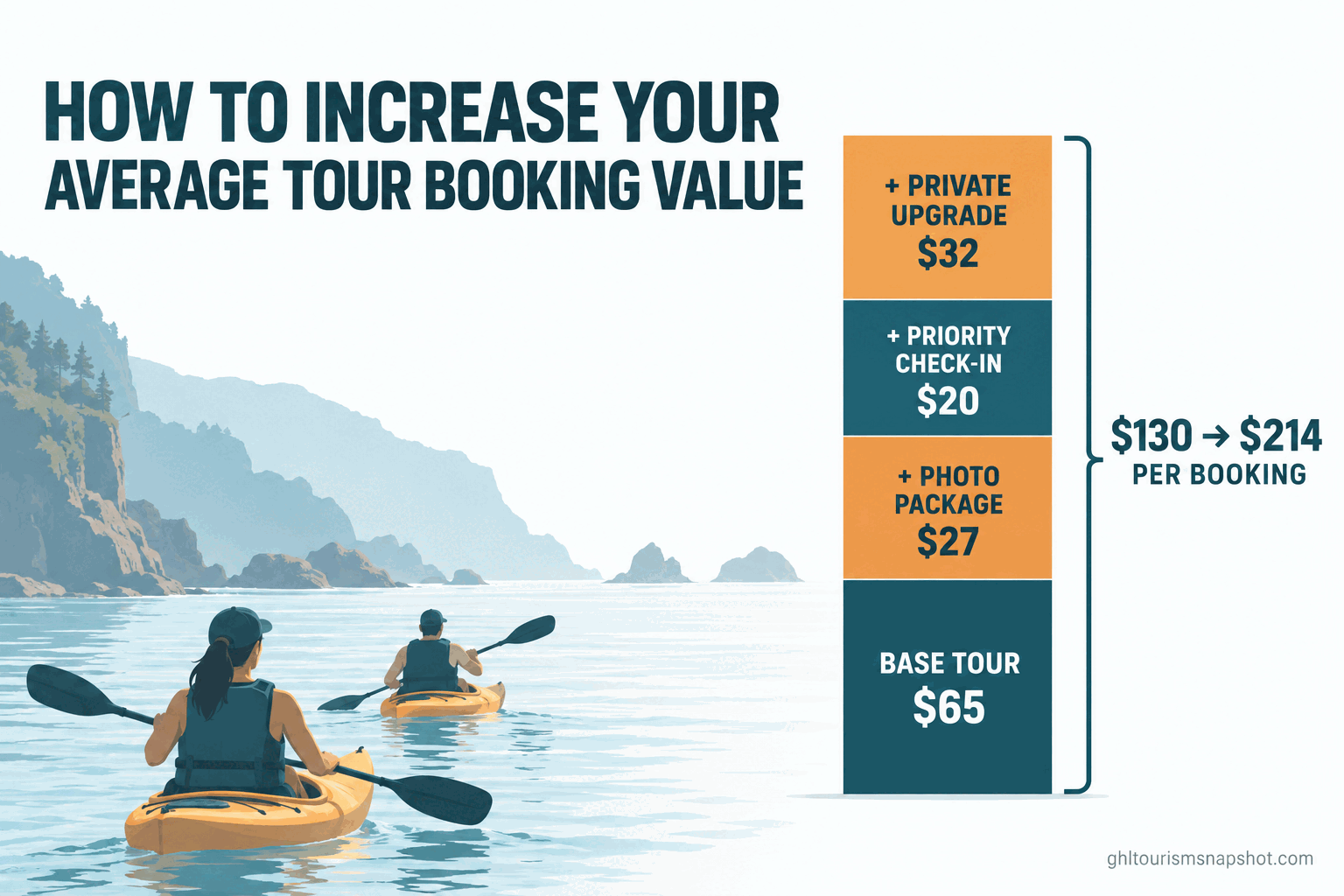
It is a slow Tuesday and you just took a booking for two seats on your 10am kayak tour. Sixty-five dollars a seat, so $130 minus the booking fee, then back to loading boats. Here is the part most operators miss: those two people would have happily paid more. Not because you squeezed them, but because you never offered anything else. No photos, no dry bag, no faster check-in, no upgrade to a quieter private paddle. They wanted to spend more on their day out, and you left it on the dock. This is the system operators use to raise what every booking is worth: the offers to steal, the timing, and where it goes wrong.
Why one more dollar per booking beats one more lead
Most operators pour their energy into the top of the funnel: more ads, more Instagram, more OTA listings. All of it costs money and time, and a chunk of every booking goes straight back out the door, because Viator and GetYourGuide commissions typically run 20% to 30% of the booking value, with GetYourGuide telling some operators in mid-2025 their rate was rising to 30%. (Arival) Lifting what each existing booking is worth carries no new ad spend and no commission on the extra, so a $27 photo package is almost all margin, and the fastest profit you have is sitting inside customers you already won.
There is a bigger shift underneath this. The US Bureau of Labor Statistics counts 61,500 travel agent jobs and projects 0% growth through 2035 (BLS), while tour and travel guides number 62,200 and are projected to grow 6%. (BLS) People are buying experiences, and the winners make each one worth more.
First, know what a booking is actually worth to you
You cannot lift a number you have never measured. Average booking value is simple: total booking revenue over a month, divided by the number of bookings. If you did $18,000 across 200 bookings, your average booking is worth $90. Then do the harder version: what you actually keep after the OTA cut, the payment fee, and per-head costs. That real margin is almost always lower than operators guess.
Here is why that matters. Your kayak tour is $65 a seat. A visitor books two seats through an OTA for $130, the platform keeps 25%, and you net about $98. Now the same travelers add a $27 photo package and a $20 priority check-in. The booking is $177, the add-ons are yours at close to full margin, and you just earned more on one booking than three new leads would clear. Not a bigger crowd, a bigger basket.
The six levers that raise your average booking
You do not need all six at once. Start with the one that fits how you already sell, prove it against your baseline, then add the next.
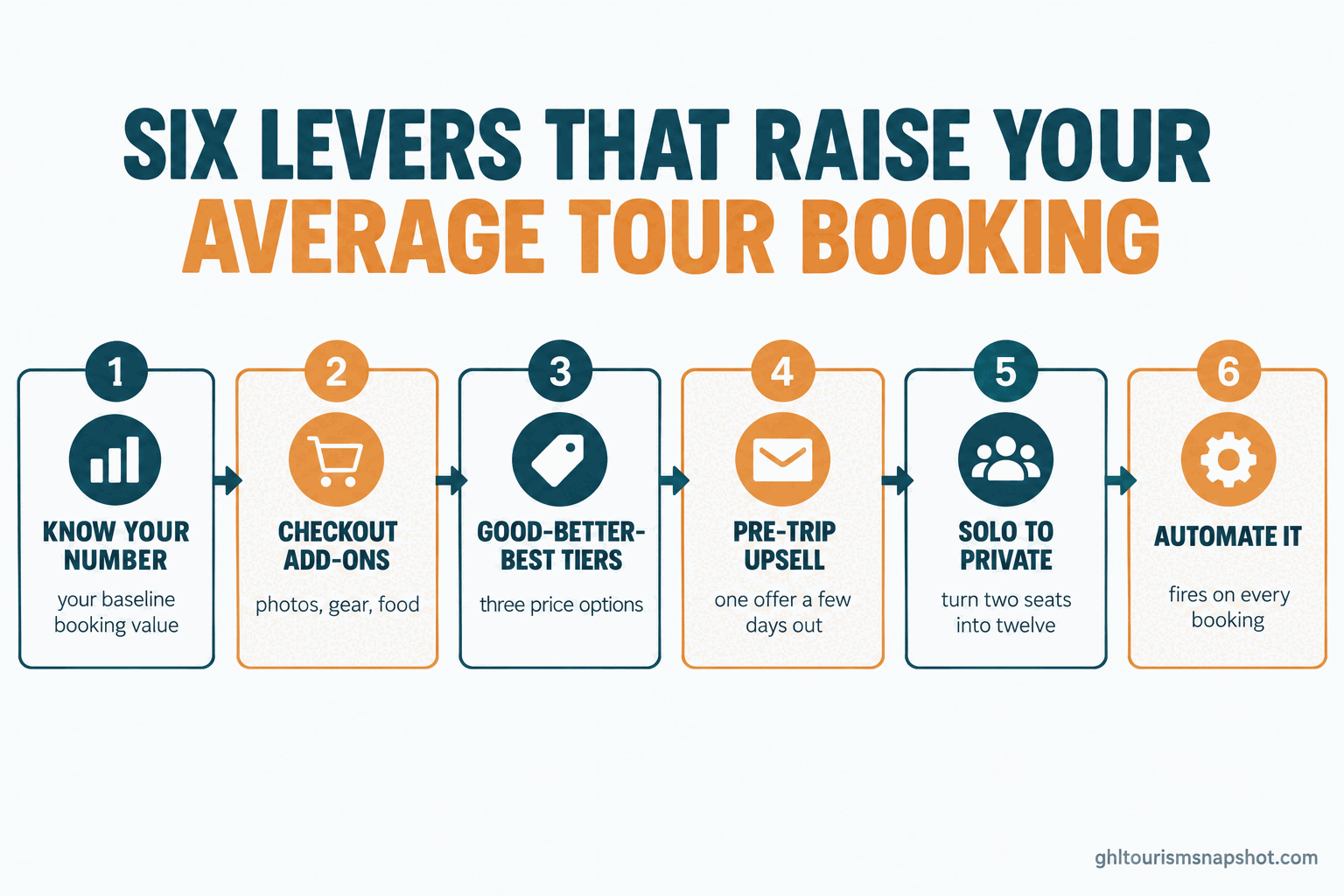
| Lever | What it adds | Where it fires |
|---|---|---|
| Know your number | The baseline you measure against | Before anything else |
| Checkout add-ons | Photos, gear, food, transport | At the moment of booking |
| Good-better-best tiers | A reason to pick the pricier option | On the booking page |
| Pre-trip upsell window | A second chance to add value | After booking, before the trip |
| Solo to private or group | A much bigger ticket | On inquiry and confirmation |
| Automation | The offer, every time, hands-off | Across all of the above |
Lever 1: Add-ons at the moment of yes
The best time to sell someone more is the second they have said yes: card out, friction at its lowest. In Expedia Group’s 2025 Traveler Value Index, a survey of 11,000 travelers, complimentary add-ons were the most appealing promotion for activity bookings. (Expedia Group)
The setup. Pick two or three add-ons that improve the day and cost little to deliver: a photo or video package, a gear upgrade, food or a drink, hotel pickup, or priority check-in. Put them on the booking page as a checkbox, not a phone call later. One booking vendor reports its operators average about $27 in extra revenue for every photo package sold, a single category that compounds fast across a season. (Singenuity)
Where it breaks. Offer ten add-ons and people freeze and pick none, so cap it at three. Price one below what it costs to deliver and you have bought extra work for no money, so check the margin on each.
Lever 2: Good, better, best
One tour at one price is a yes-or-no decision. Three versions make it a which-one decision that quietly raises your average. Most people avoid the cheapest and will not stretch to the most expensive, so they land in the middle, which you set higher than your old single price.
The setup. Keep your current tour as the base. Build a middle tier that bundles your best add-ons at a small saving (photos plus priority plus a drink for less than buying them apart). Build a top tier that is a different experience: smaller group, private guide, flexible start, extras included. Name them for the value, not Bronze or Gold but “Standard Paddle,” “Paddle Plus,” “Private Sunset.” Expedia found package discounts were travelers’ second-most appealing promotion, right behind add-ons, so a bundle that reads as a deal pulls real weight. (Expedia Group)
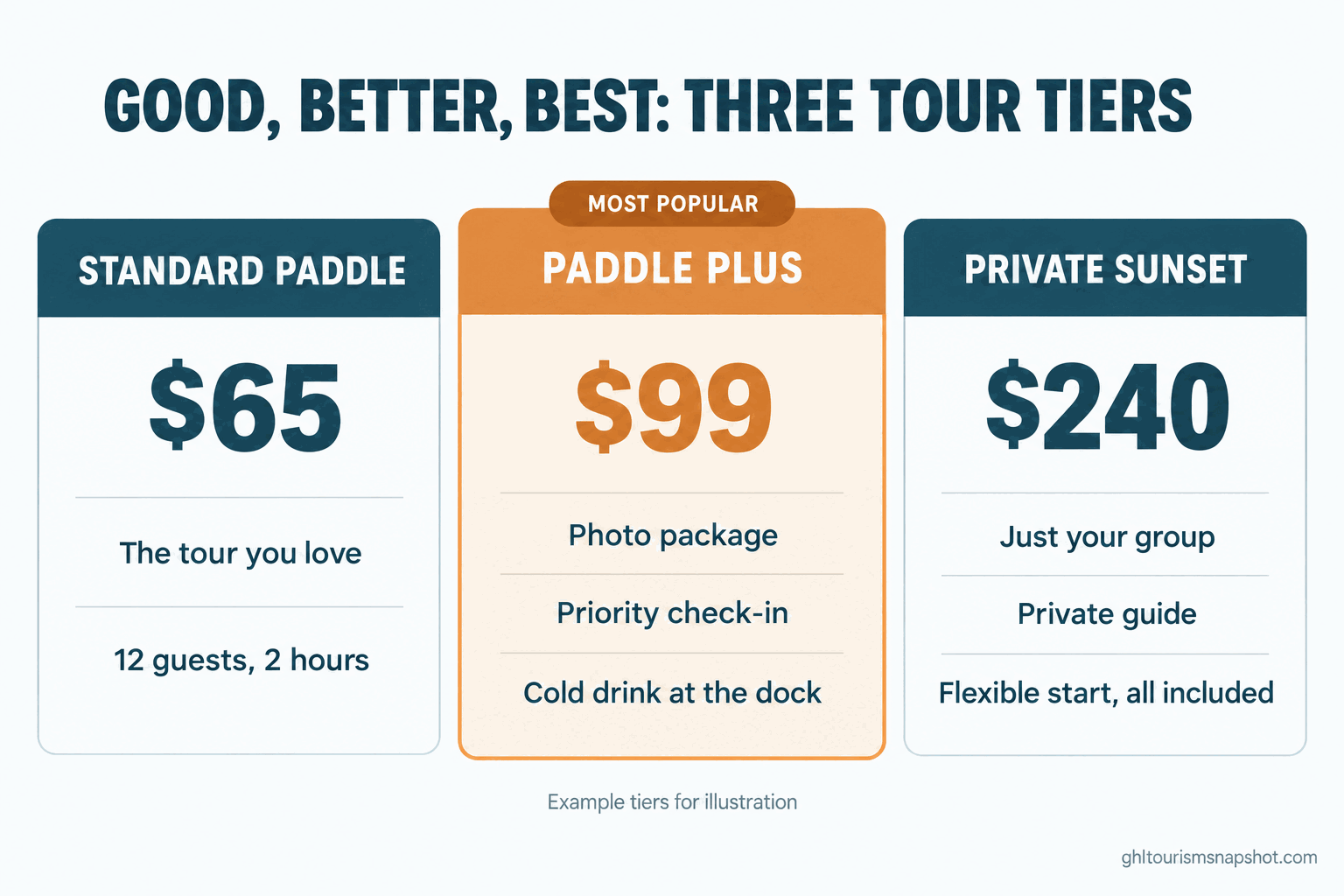
Where it breaks. Price the tiers too close and nobody trades up, so space them clearly (rough rule: the middle is 40% to 60% above the base). Make the top tier “more of the same” and it looks like a rip-off; it has to feel like a different, better day. And do not run five tiers; three is what people can compare.
Lever 3: The pre-trip upsell window
Between the booking and the trip there is a quiet window where the traveler is open to making their day better. Most operators waste it on a bare confirmation. It is a second, warmer chance to sell the add-on they skipped.
The setup. Your pre-trip reminder goes out regardless, because it also cuts no-shows (see how to cut tour no-shows). Attach one soft offer, one-tap to add and charged to the existing booking. Timing is on your side: tours get decided late, often within a day or two of the trip, so a reminder a few days out lands right when people are planning the details. (TrekkSoft)
Where it breaks. Stack three offers into the reminder and you dilute its real job, which is getting people to show up, so send one. And if you text an offer, you need consent, which the compliance section covers.
Lever 4: Turn a solo booking into a private or group one
The biggest jump in booking value is not an add-on, it is a different kind of booking. One person asking about your 10am tour is sometimes a birthday, a reunion, or a company offsite that has not realized a private departure is an option. If you never ask, they book two seats. If you do, they book twelve.
The setup. Build a private and group path and point every relevant inquiry at it. Add a “booking for a group?” line on your booking page, a one-line private nudge on every confirmation for two or more, and train whoever answers the phone to ask: “is this a special occasion or a group?” Groups book weekdays, pay a bigger ticket, and are easier to fill than a dozen strangers. The full version is in how to win more group and private tour bookings.
Where it breaks. Price a private so low that twelve people on it pay less than twelve walk-ins would have, so do the math before you quote. Groups plan on a deadline, so a slow quote loses them; reply fast. And do not force every solo toward a group; most are just two people who want a good tour.
Lever 5: Deposits, card-on-file, and gift cards
Two things raise the real value of a booking without being upsells: protecting the revenue you have, and pulling future revenue forward.
The setup. Take a deposit or full payment at booking, not at the dock, so a no-show does not wipe out the sale and its add-ons. Keep a card on file (with clear permission) so a last-minute upgrade is one tap, not a payment chase. And sell gift cards: prepaid bookings that bring in new customers on redemption and carry you through the quiet months, as covered in the off-season cash-flow playbook.
Where it breaks. Charge a card on file without crystal-clear consent and you invite a chargeback, which costs the sale plus a fee, so get written permission at booking (see how to avoid chargebacks). Gift cards can run into state expiry laws, so check yours. And a deposit too small to sting does nothing.
Lever 6: Make the offer fire on every booking
You will run the first five levers for two weeks, see them work, then get busy guiding and forget. The only version that lasts runs without you remembering. The operator making an extra $30 a booking is not more disciplined than you; they set it up once.
The setup. Three things run automatically. Capture: every booking lands in one place, tagged by tour and party size, so the system knows who to offer what. Offer: the add-on sits on checkout, the tiers on the booking page, and the pre-trip upsell fires a few days out on a trigger. Collect: the deposit, the card charge, and the receipt happen hands-off. Most operators run this on GoHighLevel, which ties calendar, texting, tags, and payment together, though any system that can tag a contact and fire a scheduled offer works. For the wider picture, read how to automate your tour business.
Where it breaks. The classic failure is automating a mess: if bookings live in an OTA, contacts in a phone, and payments somewhere else, no offer fires cleanly because nothing sees the whole booking. Get capture clean first. The other failure is never reading the numbers, so check your average booking value against the baseline monthly and kill offers that do not move it.
Three scenarios: solo, small shop, large
The six levers apply to everyone, but what you build first depends on your size.
The solo operator. A single-kayak guide, a one-van food tour, or a contractor under a host agency. You guide and sell at once, so start with one checkout add-on and the pre-trip text, since both reduce to a single offer set once. Skip tiers and private paths for now; the goal is a few dollars more per booking with zero extra effort.
The small shop (one to three staff). A couple of guides and a seasonal crew, bookings routing through you or a front desk. This is where the system starts paying a wage: put clean capture in place, stand up the three tiers and checkout add-ons, and add the solo-to-group nudge. The automation in Lever 6 matters most here, because a front-desk person who forgets to offer the upgrade costs you the lift.
The large operator. Multiple departures a day, several locations, a team. Your problem is consistency and margin at scale, so the private path and the tier structure are where the money is, moving bigger tickets across a lot of inventory. Owning your guest data instead of renting it from the OTAs compounds most at your size, a theme in winning more direct bookings.
Keep your pricing and offers legal
Add upsells, tiers, and offer texts, and a few rules apply. None of this is legal advice, so check your own state.
Show the real price. Travelers must see the true, all-in price, including mandatory fees, before they pay. US regulators have cracked down on hidden and surprise fees: a mandatory fee is part of the price, not a surprise at the end. (Federal Trade Commission) Optional add-ons are fine; sneaky fees are not.
Get consent before you text an offer. A booking is not permission to send marketing texts. You need a clear opt-in, you must honor STOP and HELP automatically, and in the US you must register business texting through A2P 10DLC or carriers block you. The TCPA allows $500 to $1,500 per non-compliant message. (FCC) The full version is in the SMS marketing playbook.
Advertising rules still apply. If your state regulates sellers of travel, your registration number may have to appear in your advertising. Florida requires sellers of travel to register (FDACS), and California requires the number shown in all advertising (California DOJ). The seller of travel registration guide covers who needs it.
Objections, answered straight
“Won’t upsells feel pushy and cheapen the experience?” Only if you upsell things people do not want. A photo package on a once-in-a-trip paddle is a gift, not a squeeze. The test: would a happy guest thank you for it? If yes, offer it; if it is just a fee, drop it.
“I already pay for FareHarbor or Peek Pro. Doesn’t my booking software do this?” Your booking tool can usually show an add-on checkbox, and you should turn that on. What it does not do well is the lifecycle part: the pre-trip upsell text, the solo-to-group nudge, the tagging that decides who gets which offer. That is CRM work, alongside your booking tool, not inside it. See how the all-in-one approach compares.
“My tours are cheap, there is nothing to add.” Cheap tours are the best candidates, because the add-on is a big percentage of a small ticket. A $27 photo package on a $35 walking tour is a 77% lift on that booking. The lower your base price, the more an add-on moves the needle.
FAQ
Raising tour booking value: questions operators ask
What is average booking value for a tour operator?
It is your total booking revenue over a period divided by the number of bookings. If you did $18,000 across 200 bookings last month, your average booking value is $90. It is the single number you move by adding upsells, tiers, and pre-trip offers.
What add-ons sell best for tours and activities?
Photo and video packages, gear upgrades, food or a drink, hotel pickup, and priority or faster check-in are the common winners. In Expedia Group's 2025 survey, complimentary add-ons were the most appealing promotion travelers named for activity bookings, so people genuinely want them.
When is the best time to upsell a tour booking?
At the moment of booking, when the card is already out, and again in the pre-trip window a few days before the tour. Tours get decided late, so a reminder a few days out lands right when people are planning the details of their day.
How many pricing tiers should a tour have?
Three. A base, a middle that bundles your best add-ons, and a premium private or small-group option. Most buyers avoid the cheapest and will not stretch to the most expensive, so they land in the middle, which you set above your old single price.
Is it legal to text customers an upsell offer?
Yes, with consent. You need a clear opt-in, you must honor STOP and HELP automatically, and in the US you must register business texting through A2P 10DLC. The TCPA allows $500 to $1,500 per non-compliant message, so a booking alone is not permission to market.
Does raising booking value beat getting more customers?
Often, yes. A new customer costs marketing, time, and frequently a 20% to 30% OTA commission. An upsell to a customer you already won carries none of that, so it is close to pure margin and usually the faster profit.
It is a slow Tuesday again, and you just took a booking for two seats on your 10am paddle. This time the booking page offered a photo package and they took it, the confirmation nudged them toward a private upgrade for the birthday they mentioned, and the card on file made it one tap. The $130 booking is now $214, and you did not say a word. The system did, while you rigged the boats. If you would rather install the six levers than build them, see what the Tourism Snapshot sets up for you, or start with the OTA commission break-even calculator.