
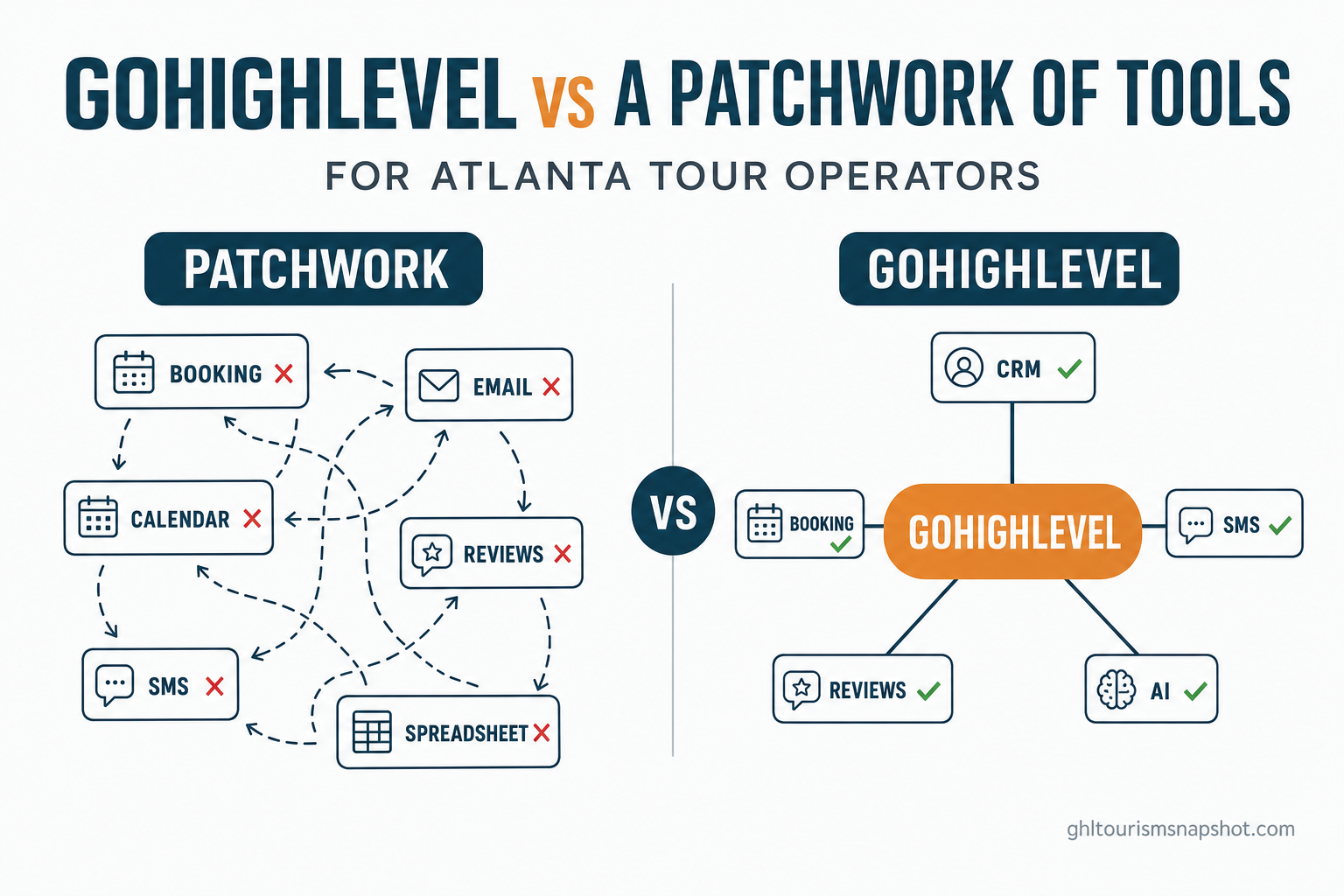
For an Atlanta tour operator, one connected system beats a patchwork of separate tools — because the money doesn’t leak inside any single app, it leaks in the gaps between them. When your booking widget, your email tool, your calendar, your review app, your texting service, and your spreadsheets don’t talk to each other, a traveler falls through a seam every day: the inquiry that never got a follow-up, the lead that sat unanswered for two days, the past guest nobody re-booked. GoHighLevel replaces that stack with one hub where the booking, the CRM, the SMS, the reviews, and the follow-up all run off the same contact record. This is a straight comparison of the two approaches for a tour and activity business in Atlanta — with real 2026 data, honest trade-offs, and no pretense that switching is free.
The patchwork stack most Atlanta operators actually run
Almost no small tour operator chose a fragmented stack. It accreted. You started with a booking widget because you needed to take reservations. Then you added Mailchimp because you wanted to email past guests. Then a separate calendar link for private tours, a review-request app after a bad month for reputation, a texting tool when email stopped getting opened, a form builder for waivers, and a spreadsheet — always a spreadsheet — to reconcile the parts that don’t line up.
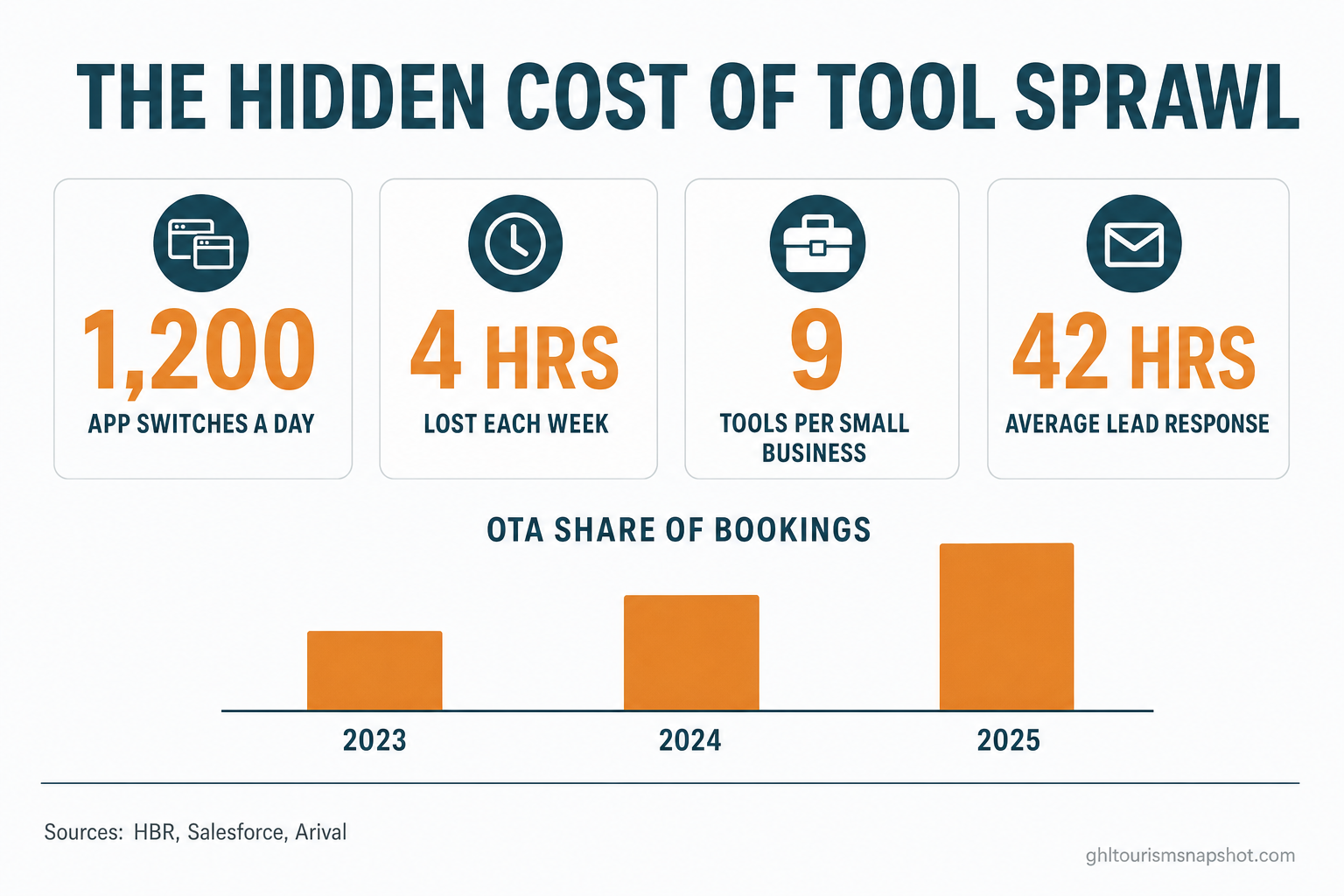
None of those decisions were wrong. But stacked together they produce a business where the single most important asset — the traveler’s record and history — is smeared across six logins that don’t share it. This isn’t unusual: Salesforce’s research finds small and midsize businesses now use an average of nine service channels, and that disconnected tools are a leading cause of the data silos that quietly cost teams opportunities (Salesforce SMB Trends).
Why a patchwork quietly costs you money
The cost of a fragmented stack rarely shows up as a line item. It shows up as friction and forgetting. Every tool that doesn’t talk to the next one becomes a manual handoff, and every manual handoff is a place where a busy operator — mid-tour, off for the day, behind after a holiday weekend — drops the ball.
The productivity research on this is blunt. A Harvard Business Review study of workers across three large companies found people toggle between applications roughly 1,200 times a day, and that the constant switching adds up to just under four hours a week reorienting — about 9% of the work year, or five full weeks (Harvard Business Review). A separate Cornell-affiliated study put the cost of a single context switch at 9.5 minutes to get back into a productive flow (Qatalog + Cornell). For a two- or three-person tour business, that “toggling tax” is time you don’t have during peak season.
But lost time is the smaller problem. The bigger one is the lead that slips through a seam. When a booking lives in one app and your follow-up lives in another, speed collapses — and in travel, speed is the sale. The landmark MIT lead-response study found that contacting a web lead within five minutes makes you 21× more likely to qualify it than waiting just 30 minutes (MIT/InsideSales). Yet Harvard Business Review’s audit of thousands of companies found the average firm took 42 hours to respond, and 23% never responded at all (HBR). A patchwork stack is practically engineered to produce that delay, because no single tool owns the whole conversation.
The Atlanta context: big demand, thin margins for error
Atlanta is not a market where you can afford to leak bookings. Georgia set an all-time record in 2024 with 174.2 million visitors and $45.2 billion in visitor spending, its third record year in a row (Office of Gov. Kemp) — and metro Atlanta alone drew roughly 51 million of those visitors, per the Atlanta Convention & Visitors Bureau (ACVB via Atlanta News First). Civil-rights history tours, food and beltline walks, brewery crawls, Stone Mountain and North Georgia day trips, film-location tours — the demand is enormous, and so is the competition for it.
Two things follow. First, most of that demand arrives on a phone, late, and impatient — a visitor deciding tonight on tomorrow’s tour will book the operator who answers and confirms fastest. Second, you’re fighting the OTAs for the direct relationship. Arival’s booking-tech research shows online travel agencies captured 37% of experience bookings in 2025 — up from 33% in 2024 and 28% in 2023 — while operator-direct website bookings fell from 29% to 25% (Arival). Every direct booking you win is a booking you don’t pay commission on, and a traveler whose contact details you actually own. A fragmented stack surrenders that ground because it can’t reliably capture, respond to, and re-book a direct lead. This is the same direct-vs-OTA logic behind our online-booking playbook for tour operators — getting the booking is only half the job; owning the follow-up is the other half.
GoHighLevel vs a patchwork, side by side
Here’s the honest comparison, function by function. The point isn’t that any single patchwork tool is bad — many are excellent at their one job. It’s that the seams between them are where an Atlanta operator loses money.
| What you need | Patchwork of separate tools | GoHighLevel (all-in-one) |
|---|---|---|
| Traveler record | Split across 5–6 apps; no single history | One contact record with full history ✅ |
| Booking → follow-up | Manual export/copy between tools ❌ | Booking auto-triggers the whole sequence ✅ |
| Speed to lead | Delayed — no tool owns the conversation ❌ | Instant SMS/email + AI reply on inquiry ✅ |
| Reviews after a trip | Separate app you must remember to run ❌ | Auto-requested post-trip, routed by rating ✅ |
| Win-back past guests | Rarely happens; data is siloed ❌ | Automatic re-booking sequences ✅ |
| Reporting | Stitched together by hand in a spreadsheet ❌ | One dashboard, cost-per-booked-seat ✅ |
| Monthly cost | Many subscriptions that quietly add up | One platform fee, tools included ✅ |
| Who maintains it | You, every day, by hand | The system, on autopilot ✅ |
This is the difference between owning tools and owning a system. A patchwork asks you to be the glue. A connected platform is the glue — which is exactly why operators who migrate their business into GoHighLevel describe it less as “new software” and more as “finally getting my evenings back.”
The five hidden costs of a fragmented stack
Beyond the toggling tax, a patchwork imposes five specific, recurring costs on a tour business:
- Data silos. The single most valuable thing you own — the traveler’s history — is scattered. You can’t see that this “new” inquiry is a guest who did your food tour last spring, so you treat a warm lead like a cold one.
- Dropped follow-ups. With no system triggering the next step, follow-up depends on memory. Past guests who’d happily re-book never hear from you, and re-booking a past traveler is the cheapest sale in tourism — the theme of our repeat-bookings guide is that this revenue is sitting right there, un-worked.
- Slow speed-to-lead. As the MIT data shows, minutes matter. Every handoff between tools adds delay, and delay is lost bookings — the exact problem we quantify in the real cost of missed calls.
- Double data entry and errors. Copying a booking from the widget to the email list to the spreadsheet is slow and error-prone. A mistyped date or a missed deposit becomes a no-show or a refund.
- Cost creep you can’t see. Each subscription looks small on its own. Together, SMB software spend has quietly climbed — small companies now spend on the order of $8,000 per employee per year on software (Vertice) — and much of a fragmented stack’s cost is duplicated features you’re paying for two or three times over.
What consolidating into GoHighLevel actually changes
GoHighLevel is a single platform that folds the whole stack — CRM, booking calendars, two-way SMS and email, forms and waivers, review requests, pipelines, and AI chat/voice — into one place where every action runs off the same contact record. For a tour operator, the practical change is that the journey finally runs itself.
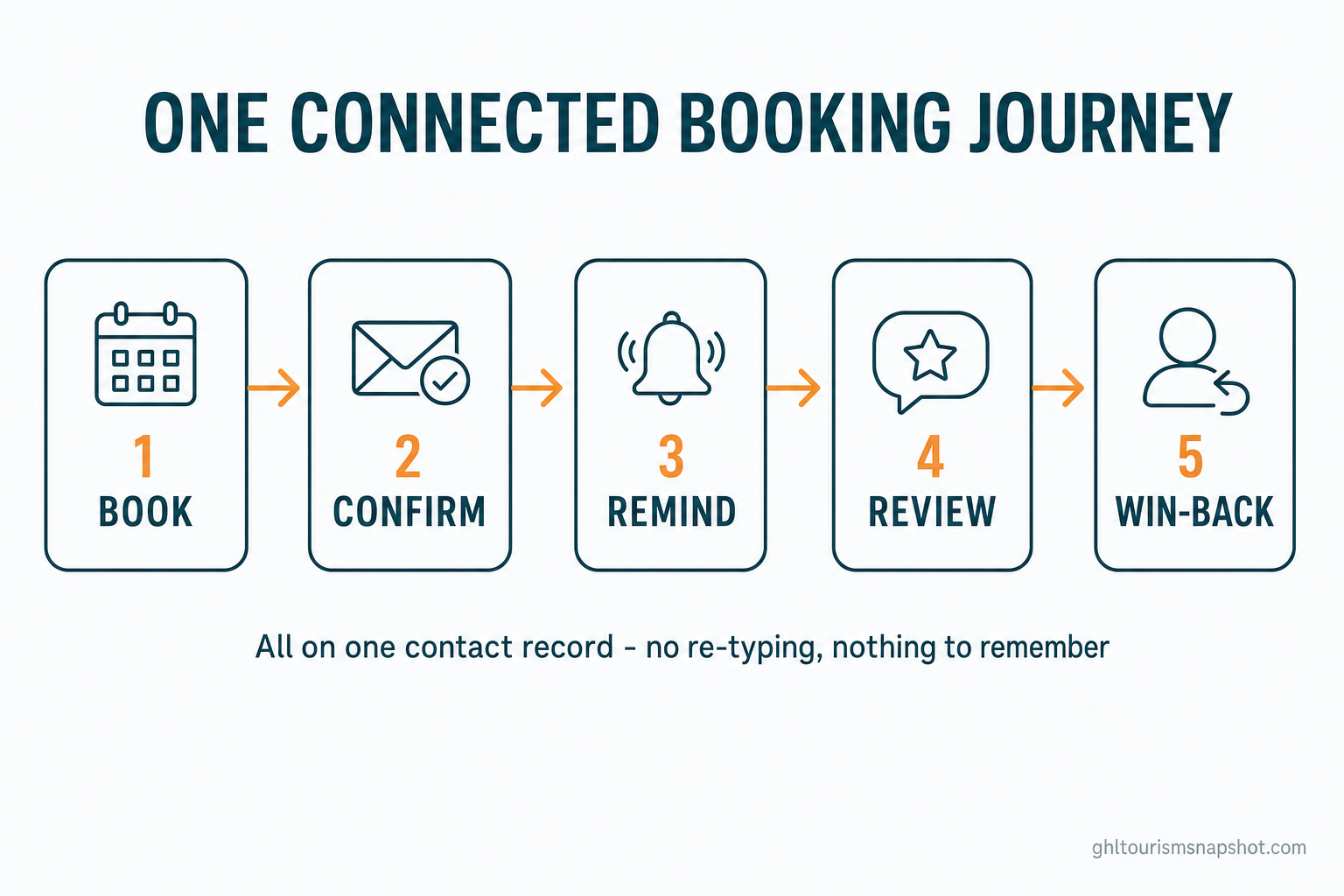
A traveler books a Beltline food tour on your site. That booking instantly creates the contact, tags them by tour type, sends the confirmation and the pre-trip reminders, texts them the meeting point the morning of, and — the day after — asks for a review, routing five-star guests to Google and quietly catching an unhappy one privately. Two months later, they land in a win-back sequence offering your new fall tour. Nobody copied anything. Nobody remembered to follow up. The system did, because the pieces share one brain. That engine is what our CRM & workflow automations feature is built to run — 60+ prebuilt workflows, not a blank canvas you have to wire yourself.
Same tours, two different back offices
A booking lands in your widget. You mean to add the guest to Mailchimp — later. The reminder is manual, so half get sent. After the trip, the review app is a tab you forgot to open. The past-guest list is a spreadsheet nobody has time to email. A new inquiry sits two days because the form emails an inbox you check between tours. Every seam leaks a little revenue.
A booking creates the contact, tags it, and fires the confirmation, reminders, and morning-of text automatically. The review request goes out the day after the trip and sorts happy from unhappy on its own. Past guests get a win-back sequence without you lifting a finger. A new inquiry gets an instant reply. One dashboard shows cost-per-booked-seat. You run tours; the system runs the follow-up.
The honest catch: GoHighLevel is powerful because it’s deep, and that depth is also its learning curve. Setting it up well — the calendars, the pipelines, the AI, the 60-plus workflows — is real work, and doing it badly gives you an expensive version of the same chaos. Which is the whole reason done-for-you setup exists, and the subject of the last section.
When a patchwork still makes sense
Consolidation isn’t always the answer, and it’s fair to say so. If you run one tour, a handful of times a month, as a side venture, a simple booking widget plus a free email tool may be all you need — the overhead of a full platform would outrun the benefit. If you’re deeply invested in one specialist tool whose exact features you rely on (a niche manifest or ticketing system, say), you may want to keep it and integrate rather than replace it — the path we walk through in GoHighLevel integration for tour operators. And if you have an in-house ops person who genuinely enjoys wiring tools together, a well-maintained patchwork can work.
The tipping point is volume and follow-up. The moment you’re running regular departures, chasing repeat business, and losing track of leads across tabs, the seams start costing more than any single tool saves. For most growing Atlanta operators, that point arrives faster than they expect.
How to consolidate without becoming a GHL admin
Here’s the real build-vs-buy. You can learn GoHighLevel yourself — build the calendars, design the pipelines, write the workflows, connect the AI, migrate your contacts — and plenty of technical operators do. But if your time is better spent running tours than mapping automations, the faster path is to have it built for you and simply run it.
That’s what our GoHighLevel Development service is for: we design and build your GHL setup around how your tour business actually works — booking calendars, deposit and reminder flows, review automation, AI chat and voice, reporting — and migrate you off the patchwork without losing your history. If you’d rather not touch the platform at all afterward, our hire-a-VA option runs GHL for you day to day. And if you want the whole thing pre-built for the tourism niche, the Tourism Snapshot installs all 60+ workflows, pipelines, and AI prompts into your GoHighLevel in about 24 hours — done for you, one flat price, no monthly per-tool creep. You can compare it against your current stack on the pricing page.
Frequently asked questions
Is GoHighLevel really cheaper than running separate tools?
Usually, yes — but the bigger saving is hidden. A booking widget, an email tool, a texting service, a review app, a form builder, and a scheduler each carry their own subscription, and much of what you pay for overlaps. GoHighLevel folds those into one platform fee. On top of the direct saving, you recover the time lost copying data between tools — Harvard Business Review measured about four hours a week lost to app-switching — and you stop leaking bookings in the seams, which is where the real money is.
Will I lose my existing bookings and contacts if I switch?
No. A proper migration exports your contacts, booking history, and past-guest lists and imports them into GoHighLevel so nothing is lost — you arrive with your history intact, not a blank system. That migration is exactly what our GoHighLevel Development service handles, and it's the step most operators are (understandably) nervous about doing alone.
Do I have to replace every tool at once?
Not necessarily. If you rely on one specialist system — a niche manifest or ticketing tool, for example — GoHighLevel can integrate with it while consolidating everything else (booking follow-up, CRM, SMS, reviews, win-back). Most operators consolidate the marketing-and-follow-up layer first, since that's where the biggest leaks are, and decide about the specialist tools later.
Isn't GoHighLevel hard to set up?
It's deep, which means a good setup takes real work — calendars, pipelines, AI, and 60-plus workflows configured for how tours actually run. That depth is the point, but it's also why doing it yourself has a learning curve. Done-for-you setup (or the prebuilt Tourism Snapshot) removes that: the system is built and configured for you, so you get the all-in-one benefit without becoming an admin.
Why does consolidation matter so much for an Atlanta tour operator specifically?
Atlanta is a high-volume, high-competition market — Georgia drew a record 174.2 million visitors in 2024, roughly 51 million to metro Atlanta — and much of that demand books late, on a phone, from someone comparing three operators. In that environment, speed-to-lead and reliable follow-up decide who wins the seat, and a fragmented stack is structurally too slow. One connected system responds instantly and follows up automatically, which is how you defend direct bookings against the OTAs.