
For a Phoenix tour operator, manual booking — taking reservations by phone, email, DMs, and a shared spreadsheet — costs you the departures that get decided after you’ve stopped answering. A traveler standing in the Scottsdale heat at 8 p.m., deciding on tomorrow’s Grand Canyon day trip or a sunrise hot-air-balloon ride, will book with the operator whose page lets them pick a time and pay in ninety seconds. If that isn’t you, you never even see the inquiry. You just run a lighter van.
This is a straight look at what a phone-and-email booking process actually costs a tour or activity business in Phoenix and across Arizona — with real 2024–2026 data — and what a 24/7 online self-booking system changes. Not a pitch for more dashboards. A clear accounting of where the leaks are and how to close them.
Why manual booking quietly loses you money
Manual booking rarely fails loudly. You’re not watching a booking form throw an error — you’re just answering the phone when you can, replying to emails between tours, and copying dates into a spreadsheet at the end of a long day. It feels like it’s working, because the bookings you do capture are real. The problem is the ones you never see: the inquiry that came in at 9 p.m. and booked a competitor by morning, the traveler who gave up after the third email about availability, the party of six that vanished because the deposit “link” was a request to call during business hours.
Those aren’t rare edge cases. They’re the majority of how modern travelers behave. And in a destination like Phoenix — where a huge share of your customers are visitors deciding on the fly — the manual process is fighting the exact moment your buyer is ready to commit.
The uncomfortable truth is that a booking system isn’t a luxury upgrade for big operators. It’s the baseline the traveler already expects, because every other experience they’ve booked this trip — the flight, the hotel, the rental car, the restaurant — let them do it themselves, instantly, from a phone. When yours doesn’t, you don’t read as boutique. You read as closed.
The Phoenix context: day-trippers and after-hours decisions
Phoenix and the greater Valley — Scottsdale, Tempe, Sedona day trips, Grand Canyon and desert excursions — run on in-destination demand. A large portion of your travelers aren’t planning months out from home; they’re already here, chasing a sunrise balloon flight, a Jeep tour through the Sonoran Desert, a Camelback hike with a guide, or a day trip north before the afternoon heat. That behavior has two consequences that punish a manual process specifically.
First, the decision is late and mobile. Vacationers firm up plans in the evening for the next morning, on their phones, often on hotel Wi-Fi. Your booking “window” is their downtime — 8 to 11 p.m. — which is exactly when a phone-and-email operation is dark. Second, the desert clock is unforgiving. Phoenix tours are built around heat and light: early departures, sunrise slots, seasonal peaks. A traveler who can’t lock tomorrow’s 6 a.m. departure tonight doesn’t wait for your callback — they book the operator who let them reserve on the spot, or they skip it.
This is the same local-demand logic behind our Google Business Profile playbook for tour operators: getting found in Phoenix and being instantly bookable are two halves of one job. Ranking for “desert tours near me” does nothing if the traveler who taps through hits a contact form instead of a calendar.
The five ways manual booking leaks departures
When you trace where manual booking actually loses money, it’s almost always one of these five leaks — usually several at once.
1. The after-hours black hole
Most in-destination booking decisions happen outside business hours, and a manual process simply isn’t open for them. Every unanswered evening inquiry is a seat that fills with someone else or stays empty. A self-booking calendar is the only staff member that works the 8-to-midnight shift when travelers actually decide.
2. The slow-reply cliff
Even during business hours, “I’ll reply when I get a second” is too slow. The most-cited research in sales operations — the MIT/InsideSales Lead Response Management study of roughly 15,000 leads — found that reaching out within 5 minutes instead of 30 made a business about 21× more likely to qualify the lead and 100× more likely to even connect (MIT/InsideSales). Almost nobody hits that bar: Harvard Business Review’s audit of 2,241 companies found the average first response took 42 hours, and 23% never responded at all (HBR). A separate Drift secret-shopper test of 433 companies found just 7% replied within five minutes (Drift). Self-booking wins here by deleting the reply entirely — the traveler books without waiting for a human at all.
3. Phone tag and double-bookings
Manual scheduling means someone is mentally holding availability across a spreadsheet, an inbox, and a phone. That’s how two parties get booked onto the last four seats, how a private charter gets promised over a slot that’s already sold, and how an hour a day disappears into “let me check and call you back.” A live calendar with a single source of truth ends the double-booking scramble and the phone tag both.
4. The checkout that’s too hard
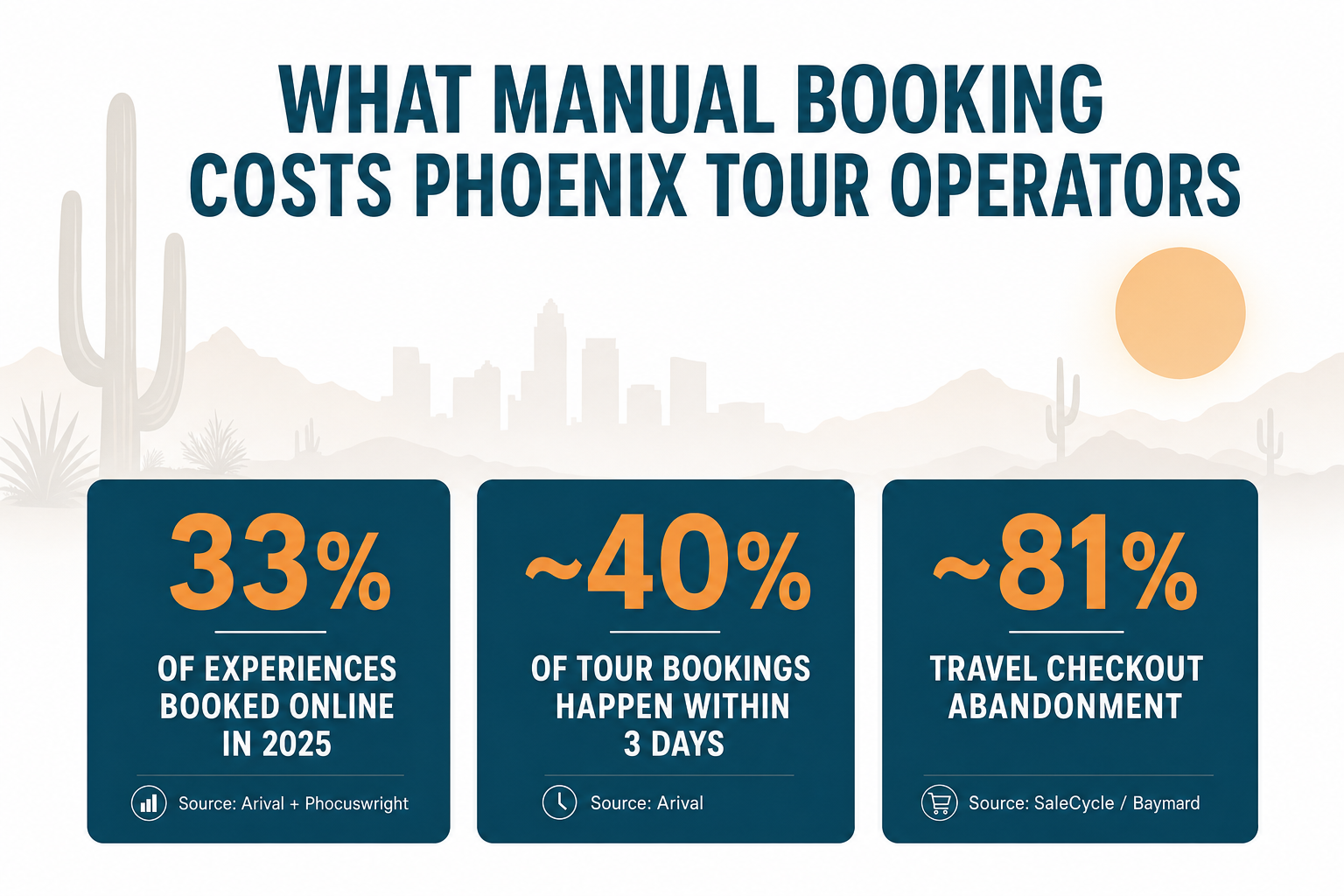
When you do get a traveler to the point of paying, a clumsy process loses a big share of them. Travel already has the worst checkout abandonment of any industry — around 81%, versus a ~70% cross-industry average (SaleCycle · Baymard). And the reasons are boringly fixable: Baymard’s research pins the top causes on unexpected extra costs (48%), being forced to create an account (26%), and a checkout that’s too long or complicated (22%) (Baymard). “Call to pay a deposit” is the most complicated checkout of all.
5. The no-shows nobody reminded
A booking you took but never confirmed or reminded is a coin-flip on departure day. Manual operations rarely have the time to send a reminder cadence, so soft bookings quietly evaporate into empty seats. Automated confirmations, deposits, and multi-stage reminders are the cheapest no-show insurance there is — the whole point of our reduce-no-shows playbook, and something a manual calendar can’t do at scale.
The data: travelers want to book online, now, on a phone
Step back from the leaks and the trend is unmistakable — demand is moving online faster than the experiences sector is meeting it. The global market for tours, activities, and attractions is projected to grow from $271 billion in 2025 to $342 billion by 2029, yet only 33% of experience bookings happened online in 2025, versus 64% for travel overall. Online experience penetration is forecast to climb from 17% in 2019 to roughly 42% by 2029 (Arival + Phocuswright). Read that as an operator: a third of your category is online today, and it’s heading toward half. The demand your manual process can’t catch is the fastest-growing part of the market.
Two behavior shifts sharpen the point. The window is compressing — roughly 40% of tour and attraction bookings now happen within three days of the activity (Arival) — so being bookable right now beats being reachable later. And mobile has taken over: the mobile share of activity bookings jumped from 11% in 2019 to 28% in 2023, and it hasn’t slowed (Arival). Your buyer is a phone in a hotel room at night. A manual process meets them with a voicemail box.
The same impatience shows up everywhere buyers are studied: Salesforce’s research repeatedly finds that around 82% of customers expect an immediate response, and most define “immediate” as 10 minutes or less (Salesforce). Travelers aren’t unusually demanding — they’re normal buyers, and normal buyers now self-serve. This is the front-end version of the speed-to-lead problem: the fastest response is the one that needs no response at all.
What a 24/7 self-booking system actually does
“Get a booking system” sounds like a software project. In practice it’s a specific, well-worn set of moving parts that turn an inquiry into a confirmed, paid seat without you touching it. Here’s what the appointment automation built into the Tourism Snapshot handles end to end:
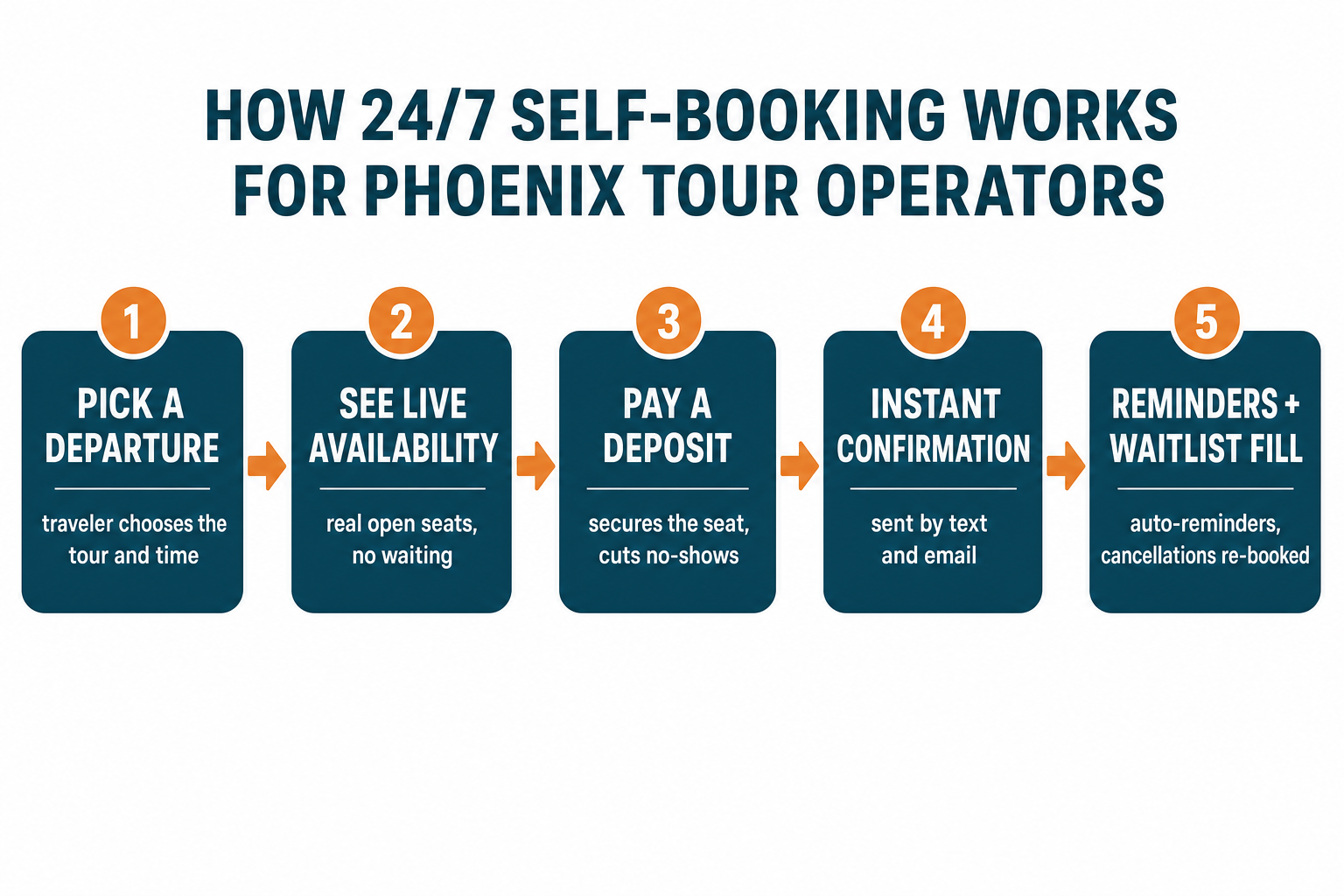
- Live availability, by departure. Travelers land on the right calendar — the 6 a.m. balloon flight, the Sedona day trip, the private Jeep charter — and see real, accurate openings, so they never wait to hear “is that available?”
- Self-serve booking with a deposit. They pick a time, enter party size, and pay a deposit or the full amount on the spot. A deposit is the single most effective no-show reducer there is, and it happens automatically.
- Instant confirmation. The traveler gets an immediate, trustworthy confirmation — not a promise that you’ll email back — which is exactly the reassurance an in-destination buyer needs to stop shopping.
- Multi-stage reminders and one-tap reschedule. Automated reminders go out as the departure nears, delivered through SMS automation (texts open at roughly 98% and are read within minutes), and a traveler whose plans shift can reschedule with one tap instead of becoming a no-show.
- No-show recovery and waitlist auto-fill. If someone cancels, the next waitlisted traveler is offered the seat automatically — a last-minute cancellation becomes a re-booked seat instead of an empty one.
- One source of truth. Every booking, reschedule, and payment flows into your CRM and workflow automations, so there’s no spreadsheet to reconcile and no double-booking to untangle.
Notice what’s missing from that list: you. That’s the point. The system doesn’t make you faster at manual booking — it removes the manual step, which is the one that leaks. Your job shifts from taking bookings to running great tours.
Putting a number on the leak
You don’t need exact figures to feel this, but a rough model makes it concrete. Say you run desert and day-trip departures that average $120 a seat, and a modest 6 inquiries a week currently arrive after hours or go cold before you reply. If a self-booking system captures even half of those — three seats a week — that’s ~$360 a week, or north of $18,000 across a busy year, recovered from bookings you were already earning and simply not catching.
Now layer in no-shows. If deposits and automated reminders convert even two would-be no-shows a week into shown, paid departures, you’ve protected another few hundred dollars weekly on seats you’d otherwise have run empty. None of this is new demand or new ad spend — it’s plugging the leaks in demand you already have. That’s why a booking system tends to pay for itself faster than almost any marketing you could buy: the cheapest booking is the one you were about to lose.
How to get a booking system without becoming a GHL admin
The catch most operators hit is that a real booking system — live calendars, deposits, confirmations, reminders, waitlists, and a CRM behind it — is genuinely fiddly to build and connect yourself. That’s the whole reason the Tourism Snapshot exists: it’s the entire booking-and-follow-up system, pre-built inside GoHighLevel and installed for you in about 24 hours, so you get the self-serve calendar and the automation without learning the platform. It’s the same “own your booking” logic behind winning direct bookings back from the OTAs — except here the goal is simply to stop losing the bookings you already generate.
If you’d rather see it before you decide, the fastest way is to watch it run against your own departures.
Manual booking isn’t a character flaw — it’s just what worked before travelers moved online. But the data is one-directional now: they book on phones, at night, within days of the trip, and they book with whoever lets them do it themselves. In a competitive, visitor-heavy market like Phoenix, the operator with the effortless booking page wins the seat every time. The good news is that closing the gap is a solved problem — and it doesn’t require you to become a systems person to do it.
FAQ
What is an online booking system for a tour operator?
It's software that lets travelers see your live availability, pick a specific departure, pay a deposit or full amount, and get an instant confirmation — all by themselves, 24/7, without phoning or emailing you. It then handles reminders, rescheduling, and no-show recovery automatically. For Phoenix operators whose customers decide in the evening for the next morning, it's the difference between capturing a booking and never seeing it.
How much does manual, phone-and-email booking actually cost me?
The biggest costs are invisible: after-hours inquiries that book a competitor, slow replies that lose the traveler, and no-shows nobody reminded. With ~40% of tour bookings happening within three days of the activity and travel checkout abandonment near 81%, most of the loss is demand you already earned but couldn't catch in time. Even recovering half of a handful of missed bookings a week typically adds up to five figures a year.
Will a self-booking system reduce no-shows?
Yes — it's one of the most effective no-show reducers available. Requiring a deposit at booking and sending automated multi-stage reminders (via SMS, which is read within minutes) keeps soft bookings from evaporating, and one-tap rescheduling turns a would-be no-show into a moved booking rather than an empty seat.
Do I have to learn GoHighLevel to run one?
No. The Tourism Snapshot installs the entire booking-and-automation system into GoHighLevel for you in about 24 hours — calendars, deposits, confirmations, reminders, waitlists, and the CRM behind them — so you get a working self-booking system without building or configuring it yourself. You can book a free demo to see it running against your own departures first.
Is this only for big operators?
No — small operators often gain the most, because they have the least spare time to answer after-hours inquiries and chase no-shows manually. A self-booking system effectively adds a tireless booking agent that works nights and weekends, which is exactly the shift a one- or two-person Phoenix operation can't cover on its own.
Related reading
- Speed to Lead for Tour Operators: Why the First 5 Minutes Decide the Booking
- Abandoned Booking Recovery for Tour Operators: The 2026 Playbook
- How to Cut Tour No-Shows With Reminders and Deposits
- Direct Bookings for Tour Operators: How to Stop Losing 20–30% to OTAs
- How to Fill Last-Minute Empty Seats and Soft Departures