
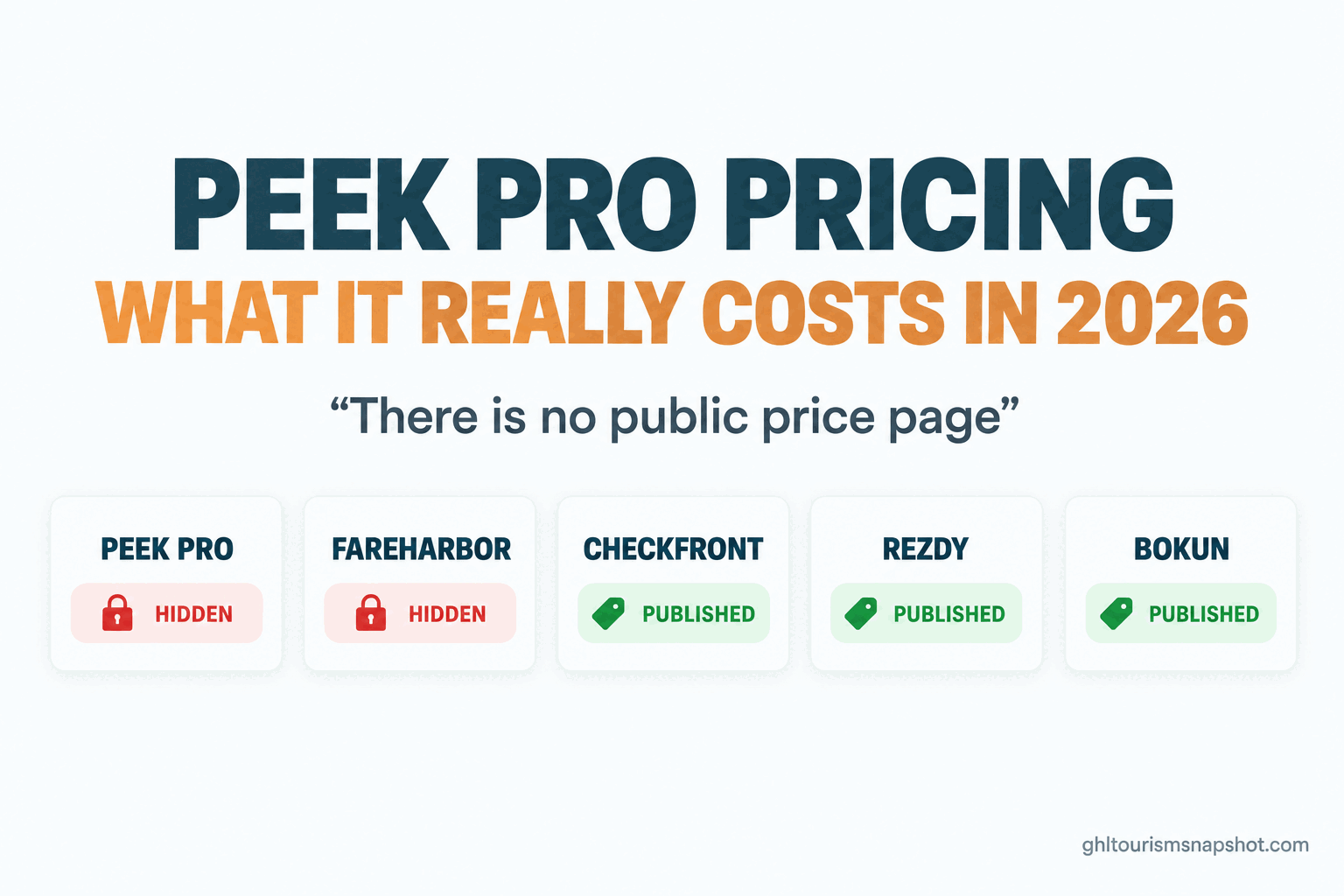
Peek Pro does not publish a price. You fill in a demo request, sit through a 45-minute walkthrough, and at the end a rep says they will “build you a custom quote.” You still do not know the number. That is not an accident, it is the business model. This is the plain-English teardown of what Peek Pro actually costs a tour operator in 2026: the per-booking fee that does the real damage, three cost scenarios, and the exact questions that drag the real number into the open before you sign.
The short answer: what Peek Pro costs
Peek Pro sells on a per-booking fee, not a flat subscription. The pitch is “free until you sell,” which is appealing for a certain operator. The catch is the fee never stops: every booking carries a cut, forever, on every repeat.
The number is the problem, because Peek does not state it in public. Across the independent guides that track this market, the reported fee sits in the 6% to 8% band per online booking, and one 2026 guide describes a free plan at 6% with paid plans near $199 a month for a lower one. (Capterra, Bokun) Add card processing of roughly 2.3% plus $0.30 a ticket. For a low-volume operator that can be a fine trade; for anyone selling real seat counts it is one of the most expensive lines you carry.
Why there is no price page
Operators ask me whether they are missing a page. They are not. Peek genuinely does not list prices anywhere a traveler, or a competitor, can read them. The site is a features list and a “request a demo” button.
This is confirmed in Peek’s own legal terms. The Peek Merchant Agreement defines “Peek Fees” as the commissions and flat fees “payable to Peek, as set forth in the Service Order,” and notes that Peek Pro is governed by a separate “Peek Professional Software Addendum.” (Peek Merchant Agreement) The price is a private document you only see once you are in the sales process, and it can differ from the operator down the street.
Not all the reasons for this are sinister: quote-based pricing lets a rep tailor a rate to your volume. But it has one effect that is never in your favor. You cannot comparison-shop. You have to hand a sales team your details and your time before you learn the single fact that decides everything. FareHarbor, the other giant here, runs the same playbook, which is why the two are hardest to pin down. (FareHarbor pricing, CaptainBook)
The real cost, line by line
The headline fee is only the first layer. Four separate costs can land on a single booking, and the demo rarely walks you through all of them.
1. The booking fee. Reported at 6% to 8% of the online booking value. This is the big one, a percentage, so it scales directly with your price and volume. (Capterra)
2. Card processing. Reported around 2.3% plus $0.30 per ticket. Some platforms fold this into the booking fee and some charge it separately, so ask which model your quote uses.
3. Onboarding or setup. Reports conflict: some operators describe several hundred to a couple of thousand dollars for a full migration, while other summaries list setup at $0. Make it a line item in your quote, not a surprise in month one.
4. Who absorbs the fee. It can be passed to the traveler at checkout or absorbed from your payout, and that choice changes both your effective rate and your conversion.
At a reported 6% fee, a $150 seat is $9 gone before processing. Here is how one seat compares across the platforms a small operator shortlists.
The gap is not a rounding error. A seat that costs $9 on Peek Pro costs $1.50 on Bokun’s top tier and nothing on a Viator-sourced Bokun booking. Multiply by a full season and your booking software becomes one of the largest lines on your profit and loss, a strange decision to make without seeing a price.
Three scenarios: solo, mid-size, large
A percentage fee feels small on one booking and enormous across a year. The only way to judge Peek Pro is to run your own volume. Below are three illustrative operators at a $120 average ticket, modeled at a reported 6% fee (booking fee only). Swap in your own numbers before any demo.
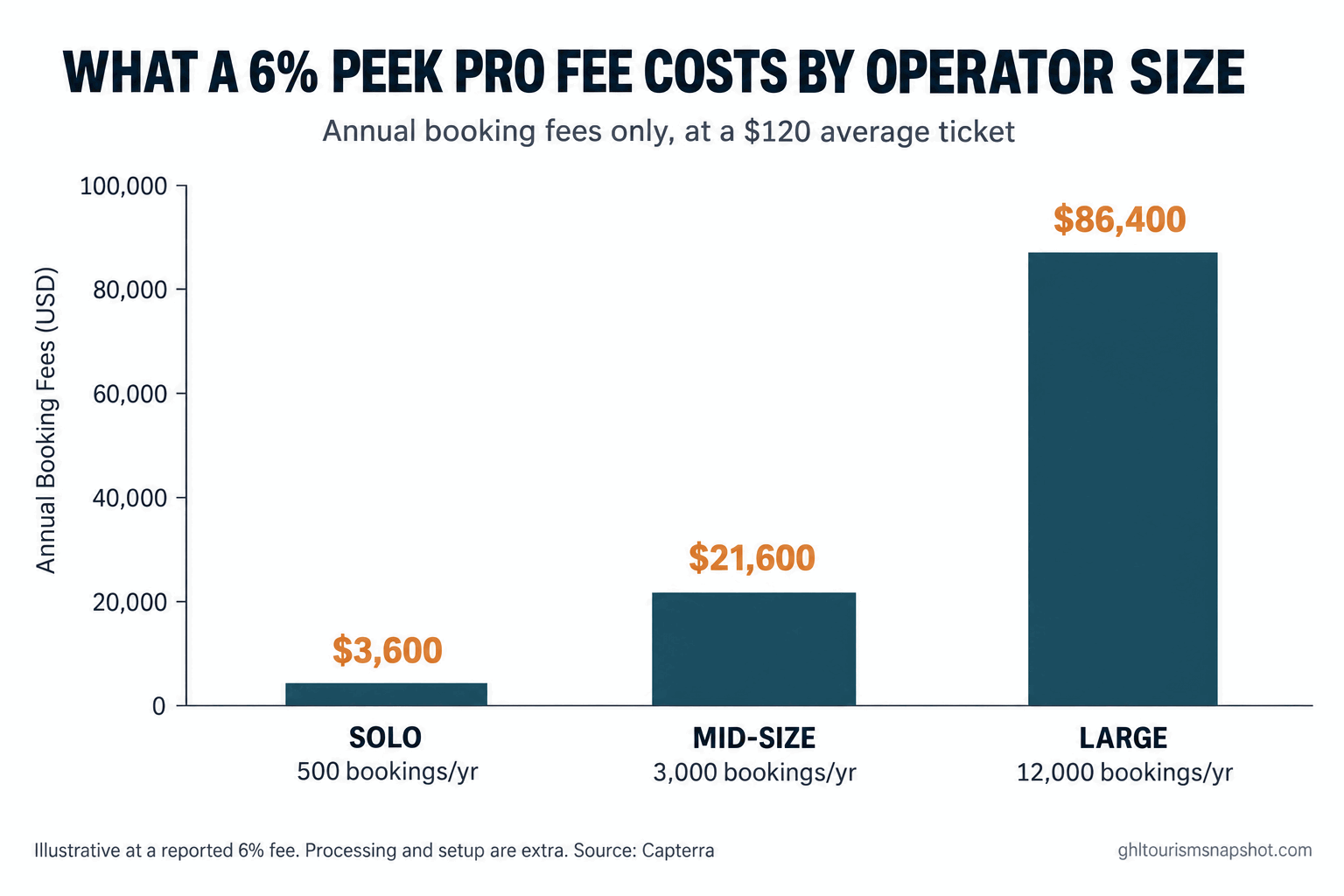
The solo operator. A kayak tour or single walking route, 500 bookings a year at $120 a head. At 6%, that is roughly $3,600 a year in booking fees, plus processing. With no subscription, “free until you sell” is a real selling point: you pay nothing in the slow months and the fee is a slice of revenue you actually earned. At this size, Peek Pro’s model is defensible.
The mid-size shop. Three vans, a couple of routes, 3,000 bookings a year. Now the same 6% is roughly $21,600 a year, and that is the number that should stop you. That is a part-time guide’s wages going to software every year. Here the transparent competitors win on pure math, because a subscription plus a 1% to 3% fee is often far cheaper than a flat 6%. This is the band where operators feel trapped: they adopted Peek when they were solo and the fee grew quietly with them.
The large operator. Multiple locations, 12,000 bookings a year. At 6% that is roughly $86,400 a year in booking fees alone. No large operator should pay a flat percentage at this scale without a hard-negotiated rate. Quote-based pricing can actually help you here, if you push, because vendors discount for volume. The danger is you never find out, because you never treated the rate as negotiable.
Peek Pro against the transparent field
Half the market publishes real numbers today. The useful split is not “good versus bad software,” it is “priced in public versus priced in a sales call.” Here is the field a small operator shortlists.
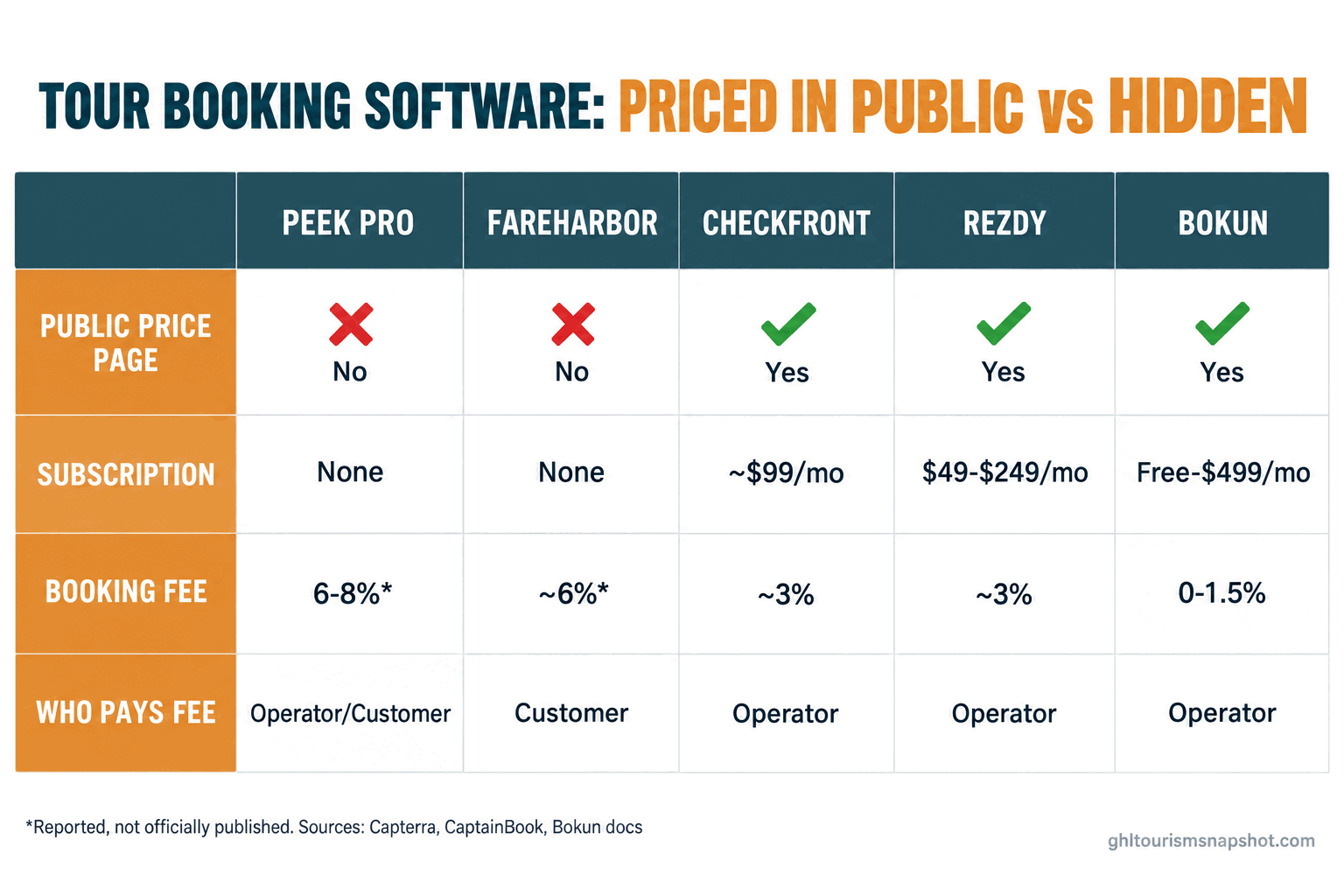
| Platform | Public price page? | Subscription | Booking fee (reported) | Who usually pays the fee |
|---|---|---|---|---|
| Peek Pro | No, quote only | None advertised; some tiers reported near $199/mo | ~6% to 8% per online booking | Operator or customer, set in the Service Order |
| FareHarbor | No, demo first | None | Up to ~6% per direct booking | Usually the customer, added at checkout |
| Checkfront | Yes | ~$99/mo (single plan on trackers) | ~3% online, commonly cited | Operator |
| Rezdy | Yes | $49 / $99 / $249 a month | ~3% per booking | Operator |
| Xola | Partly | None | 2.39% + $0.30 per transaction | Operator, or customer on Flex plans |
| Bokun | Yes | Free, then $49 / $149 / $499 a month | 0% Viator and offline; 1% to 1.5% otherwise | Operator or customer |
A few honest caveats. Checkfront’s trackers show a single plan near $99 a month, though reviewers report recent increases. (PricingSaaS) Rezdy’s roughly 3% fee comes from a competitor’s guide, so verify it. (Rezdy) Xola’s 2.39% plus $0.30 rate has no subscription, but its Flex plans add a service fee around 3% to 6%. (Xola) Bokun’s free tier charges no service fee but is genuinely limited (no website widgets, no non-Viator integrations), and Bokun is owned by Viator’s parent, Tripadvisor, which is why Viator bookings run at 0%. (Bokun docs)
The pattern is hard to miss. The two platforms that hide the price, Peek Pro and FareHarbor, carry the highest reported fees. That is not a coincidence you want to pay for.
Where the Peek Pro cost model bites
Every pricing model has a shape, and the shape tells you where it will hurt. Here is where a per-booking model stings.
It bites hardest when you succeed. A flat percentage grows in lockstep with your best season: the month you sell out every departure is the month you hand over the most. If growth is your plan, model the fee at next year’s volume.
The fee is invisible, so it never gets reviewed. The cut is netted out of each payout, so it never shows up as a bill you dread. Operators who argue over a $40 subscription happily lose thousands a year to a fee they never see as a line. Calculate your effective rate once a quarter from your payout reports.
Passing the fee to the customer can cost you the booking. A 6% surcharge turns your $150 tour into a $159 tour at the moment they are deciding. On a price-sensitive route that dents conversion. Ask to see both models and test which nets you more.
Lock-in is real, and your data is the hostage. Migrating a live calendar, past-customer records, and gift-card liabilities is a real project. Before you sign, ask exactly how you export your customer list and future bookings if you leave. A vendor that makes that hard is telling you something.
Steal this: the questions that force the real price out
You will not get a number by asking “how much is it.” You get one by asking specific, closed questions that are awkward to dodge. Walk into any quote-gated demo with this list and do not leave until every line has a figure next to it.
That last line matters most. A verbal rate in a demo is not a price, it is a vibe. The written quote is the only thing you can hold them to. If a rep will not put the all-in cost in an email, you have your answer.
Who Peek Pro is actually right for
This is not a hit piece. There is a real operator for whom Peek Pro is sensible.
It fits best when you are low-volume and want zero fixed cost. For a seasonal tour, a side business, or a brand-new operation with unpredictable bookings, “pay nothing until you sell” removes real risk: you will not stare at a $99 subscription in February with an empty calendar. It also fits operators who value the distribution and negotiate hard, since Peek pushes bookings through its own marketplace, so if that channel drives real travelers the fee is partly customer acquisition rather than overhead.
It is the wrong tool when you are mid-size and growing, or margin-thin. The moment a flat percentage on rising volume outruns a subscription-plus-low-fee competitor, you are paying for a convenience you no longer need. If you already do a few thousand bookings a year, run the Rezdy and Bokun math before you renew. The difference is often a five-figure annual swing.
Protect your margin, whatever you run on
Here is the part the booking-software debate always skips. The platform fee is only painful because you pay it again on every repeat and every referral. A traveler who loved last year’s trip and books again through the same funnel costs you the same cut as a brand-new stranger. That is the leak worth sealing, whichever booking tool you pick.
The operators who keep the most margin treat the booking platform as a checkout, not as their customer relationship. They capture the traveler’s contact details, follow up fast, ask for the review while the memory is fresh, and bring the next booking home through a channel they own: pre-trip reminders that cut no-shows, a review ask after every trip, and a win-back sequence that re-books last season’s travelers at near-zero cost. A booking that comes straight to you carries card processing and nothing else.
The deeper playbook is in our guide to winning more direct bookings, and the OTA commission break-even calculator shows the exact point a direct booking beats a marketplace sale. For the full field of what every tool costs, our tour booking software pricing teardown lines them all up, and if you want off FareHarbor specifically, start with the best FareHarbor alternatives for small operators.
Objections, answered straight
“Peek Pro has no monthly fee, so isn’t it basically free until I sell?” Free of a subscription, yes. Free of cost, no. A 6% cut on everything you sell is a variable cost that grows with you. For a low-volume operator that trade can be smart; for a busy one it is the most expensive way to pay for software, because it never caps out.
“Everyone passes the fee to the customer, so why do I care?” A checkout surcharge quietly lowers your conversion rate, costing you bookings you never see, and it makes your advertised price less competitive against the operator next door who absorbed the fee. The customer paying the fee is not the same as the fee being harmless.
“I already run on Peek Pro and switching sounds brutal.” Do not switch on a whim. But do two things this quarter: calculate your true effective rate from your payout reports, and ask your rep, in writing, to match a transparent competitor’s math at your volume. You may get a better rate without moving at all. If they will not budge and the gap is five figures, migration pays for itself.
“Aren’t the transparent tools just cheaper-looking but worse?” Sometimes the cheapest tier is genuinely limited; Bokun’s free plan strips out direct website widgets. But Rezdy, Checkfront, and the paid Bokun tiers are mature platforms used by serious operators. “Hides its price” and “best product” are not the same claim, so never assume the quote-gated option is automatically stronger.
FAQ
Peek Pro pricing questions operators ask
How much does Peek Pro cost per month?
Peek Pro does not sell on a standard monthly subscription the way Rezdy or Checkfront do. Its model is a per-booking fee, reported in the 6% to 8% range, with one 2026 guide describing paid tiers that start near $199 a month for a lower fee. None of this is published by Peek, so the only accurate figure is the one in your own written quote.
Why doesn't Peek Pro show its prices online?
Because it prices by quote. Peek's own merchant agreement places its fees in a private Service Order rather than on the website, which means pricing is tailored during a sales conversation and you cannot comparison-shop it in advance. FareHarbor uses the same demo-first approach.
Does Peek Pro charge a booking fee to me or to the customer?
It can go either way, and it is set in your agreement. On many tour platforms the booking fee can be absorbed by the operator out of each payout or passed to the traveler as a surcharge at checkout. Ask to see your net on a sample booking under both models before you sign.
Is Peek Pro cheaper than FareHarbor?
Both hide their pricing and both carry reported fees up to around 6%, so neither is reliably cheaper on paper. Get written quotes from each at your real volume and compare the all-in cost per booking, including processing and setup.
What are the transparent alternatives to Peek Pro?
Rezdy (about $49 to $249 a month plus roughly 3%), Checkfront (a published plan near $99 a month), Bokun (a free tier plus 1% to 1.5%, 0% on Viator and offline), and Xola (2.39% plus $0.30 per transaction, no subscription) all publish enough to model your cost without a sales call.
Pricing details here are drawn from third-party trackers, vendor documentation, and competitor guides as cited; reported Peek Pro and FareHarbor figures are not officially published, so confirm the current rate with the vendor before you decide. For context, the U.S. Bureau of Labor Statistics projects employment of tour and travel guides to grow 8% from 2024 to 2034, so demand for well-run experiences is rising even as the software cost underneath them climbs. (BLS Occupational Outlook Handbook)