
It is a wet Tuesday in the off-season, you have finally got an hour to look at your booking setup, and you notice the line item that has bugged you all year: a “service fee” of a few percent added to every ticket a customer buys through your FareHarbor page. You go looking for what that fee actually is. There is no pricing page. Just a button that says “Book a demo.” Here is the short answer: the best FareHarbor alternative depends on how you sell. Want published, predictable pricing? Checkfront or Rezdy. Already lean on Viator? Bokun. Want no monthly bill? Xola. And if your real goal is to stop paying a percentage on every seat and start owning your customer list, the move is to bring booking, follow-up and reviews onto one platform you control.
We work with small tour operators every week, so we look at this the way you do: not “which tool has the most buttons” but “what does this cost per booked seat, and do I keep my customer.”
Why operators start shopping for a FareHarbor alternative
FareHarbor is a capable tool with a real support team, and plenty of operators are happy on it. But small shops go looking for something else for three specific reasons, and the right alternative depends on which one is biting you.
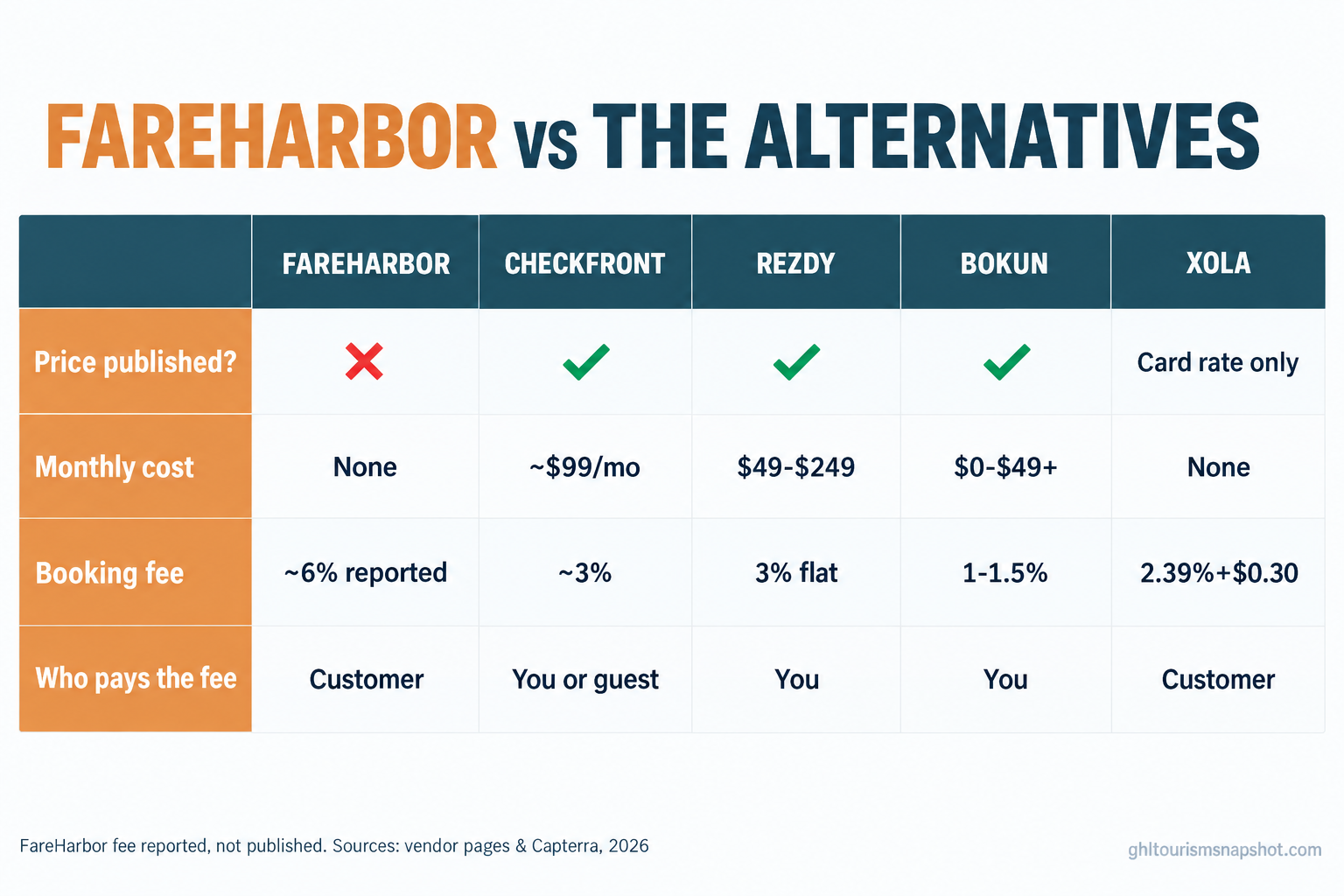
The price is a secret until you give up your phone number. FareHarbor publishes no subscription and no fee. You book a demo, a specialist “builds it for your operation,” and the number arrives at the end (Trekksoft). Maddening if you just want to compare two tools on a Tuesday night, and you never know whether the kayak shop across the harbor got a better rate.
The fee rides on your customer. The widely reported FareHarbor fee is roughly 6%, typically added to the traveler’s total at checkout rather than deducted from you (CaptainBook). It feels free because it is not on your invoice. It is not free. Your $200 tour shows as about $212 next to a competitor listing a clean $200, and you lose the comparison-shopped bookings you never see.
You do not own the relationship. When the booking lives inside a widget, your best asset, the list of people who already paid to spend a day with you, is harder to reach and to take with you. That is the quiet cost, and the one that matters most, because past travelers are the cheapest bookings you will ever get.
If price secrecy is your problem, a transparent tool fixes it. If the passed-through fee is the problem, you want a low-fee or no-fee model. If owning your customer is the problem, no booking widget alone solves it. And whatever the headline fee, remember card processing adds about 2.9% + $0.30 on top (Stripe rates), so a “1.5% fee” is never really 1.5%.
The best FareHarbor alternatives in 2026
Here are the five alternatives a small operator ends up comparing, plus the option most do not consider until later. Prices are from the cited sources as of 2026, and the demo-only tools are reported, not published, so confirm your own numbers before you sign. For the full vendor-by-vendor breakdown, see our tour booking software pricing teardown.
| Tool | Monthly cost | Booking fee | Price public? | Best for a small shop |
|---|---|---|---|---|
| Checkfront | ~$99/mo (or higher flat plan) | ~3% (or $0 on the flat plan) | ✅ Yes | Wants one predictable bill |
| Rezdy | $49 / $99 / $249 | 3% flat, all plans | ✅ Yes | Sells through agents and resellers |
| Bokun | $0 free / $49 START+ | 1.5% / 1.25% / 1%; 0% Viator | ✅ Yes | Already heavy on Viator |
| Xola | None | 2.39% + $0.30, plus partner fee to customer | ⚠ Card rate only | Wants no monthly commitment |
| Peek Pro | None (quote only) | 6-8% reported | ❌ Demo only | Sold on Peek’s marketplace reach |
| Own it (all-in-one) | Flat, no per-seat fee | None | ✅ Yes | Wants to keep the customer |
Sources: Checkfront, Rezdy, Bokun, Xola, Peek Pro.
Checkfront
The transparent all-rounder. Checkfront publishes its pricing, which already puts it ahead of FareHarbor. Expect more than one plan shape: an entry plan around $99/mo with roughly a 3% online fee, and a higher flat plan that drops the per-booking fee for a bigger monthly bill (Capterra). Right for an operator who wants one predictable number, starting on the low base and moving to the flat plan once volume makes the 3% hurt. Where it breaks: people pick the wrong shape and overpay, so run your real volume through both first.
Rezdy
The published-price anchor. Three tiers, month to month: Foundation $49, Accelerate $99, Expansion $249, each with a flat 3% online booking fee (Capterra). Rezdy’s strength is distribution: it pushes your tours out to travel agents and resellers. Right for an operator who sells through agents and OTAs as well as direct. Where it breaks: if almost all your sales are direct, you pay for a distribution engine you do not use.
Bokun
The Viator play, and you have to understand the ownership to price it honestly. Bokun is owned by Tripadvisor, which also owns Viator. There is a genuine free plan at $0, then paid tiers from $49/mo (START), with fees of 1.5% / 1.25% / 1% by tier and 0% on Viator and offline bookings (Bokun). Right for an operator already doing serious volume on Viator. Where it breaks: saving 1.5% on software while Viator takes a reported 20%, commonly 20% to 30% in practice (Strathcode), is no saving. The tool is cheap because the channel it feeds is expensive.
Xola
The no-monthly-bill option, with an asterisk. Xola charges no subscription and advertises 2.39% + $0.30 per transaction (Capterra). The headline leaves out a separate “partner fee” Xola adds to the customer’s total, not published, disclosed on a sales call, and reported several points higher (Xola guide). Right for a very small operator who wants zero monthly commitment. Where it breaks: same passed-through model as FareHarbor, so the sticker shock lands on your traveler.
Peek Pro
Worth naming because operators shortlist it, but it does not solve FareHarbor’s biggest annoyance: it is also quote-only, no public price, demo required (Capterra). Third parties put the fee at 6-8% plus processing, typically passed to the customer (Software Advice). Right for an operator sold on Peek’s marketplace exposure. Where it breaks: you trade one demo-gated, passed-through fee for another, and the negotiated rate means two shops pay very differently.
Own the booking (the all-in-one option)
The option most operators do not weigh until their second or third switch. Every tool above is a booking widget: it takes the order and stops. It does not answer the after-hours inquiry, text the reminder, chase the no-show, or ask the happy guest for a Google review. Those jobs stay on you, or on staff you pay.
The alternative is to run booking, instant reply, reminders, reviews and rebooking on one platform you control, at a flat cost with no per-seat fee. That is what an all-in-one system built on GoHighLevel does, and it is where operators land when they tire of paying a percentage to a widget that hands the customer back to an OTA. It is more setup than flipping on a booking page, but it is the only option here that treats your customer list as yours (GoHighLevel vs a patchwork of tools).
The fee math nobody shows you on the demo
The percentage looks like a rounding error until you multiply it by a real year. Here is what each platform’s fee costs a small shop doing $120,000 in online bookings a year.
Annual booking-fee cost on $120,000 of online sales (USD), author calculation from advertised or reported rates. FareHarbor and Peek Pro fees are reported, not published, and are typically added to the customer’s total. Sources: Trekksoft, Capterra, Bokun.
Now watch what happens as you grow. A percentage fee climbs with every good season, while a flat tool with no per-booking fee stays put. This is the crossover that decides it.
Annual cost of a 3% online booking fee as online sales grow (USD), author calculation from published Rezdy and Checkfront rates. A flat tool with no per-seat fee is a straight line near the bottom, which is why the models cross as you scale.
At $50,000 the 3% fee is a manageable $1,500. At $500,000 it is $15,000 a year, and a reported 6% passed-through fee is effectively $30,000 on your customers. You would never sign a flat $15,000 check for a booking button, yet a percentage fee walks you there quietly.
Which one fits your shop: solo, small team, growing
The right alternative is not the same for a one-person kayak outfit and a six-guide food-tour company. Match it to where you are.
Solo operator (one or two departures a day, roughly $60,000 to $100,000 online a year). The monthly fee matters more than the percentage here, because the percentage is still small in dollars. Bokun’s free or START plan and Xola’s no-subscription model are genuinely cheap, and Rezdy Foundation at $49/mo is predictable. The trap is picking a tool you outgrow in one good summer, or a passed-through fee that dents conversion while you fight for every booking. If you sell almost entirely direct, lean toward the lowest published fee and keep your list somewhere you own.
Small team (three to six departures a day, roughly $150,000 to $300,000 online a year). This is where the models cross. A 3% fee is now $4,500 to $9,000 a year on top of your subscription, so Checkfront’s higher flat plan, or any no-fee option, beats the “cheaper” low-base plan by thousands. Stop optimizing the monthly price and start optimizing the fee. This is also the size where the after-booking work, reminders, no-show recovery, review requests, becomes a real staffing cost, the case for an all-in-one you move your booking flow onto without losing dates or data.
Growing operator ($300,000+ online a year). The fee is now your dominant software cost by far, and a passed-through one is a five-figure annual tax on your own growth. It is worth bringing booking in-house at a flat cost even if setup takes a weekend. The question stops being “which widget is cheapest” and becomes “why am I paying a percentage to a booking button at all.”
How to switch without losing a booking
The fear that keeps operators stuck is losing a live booking during the move. It is real and avoidable: export first, run both systems in parallel, and cancel the old tool only after its last booking has run.
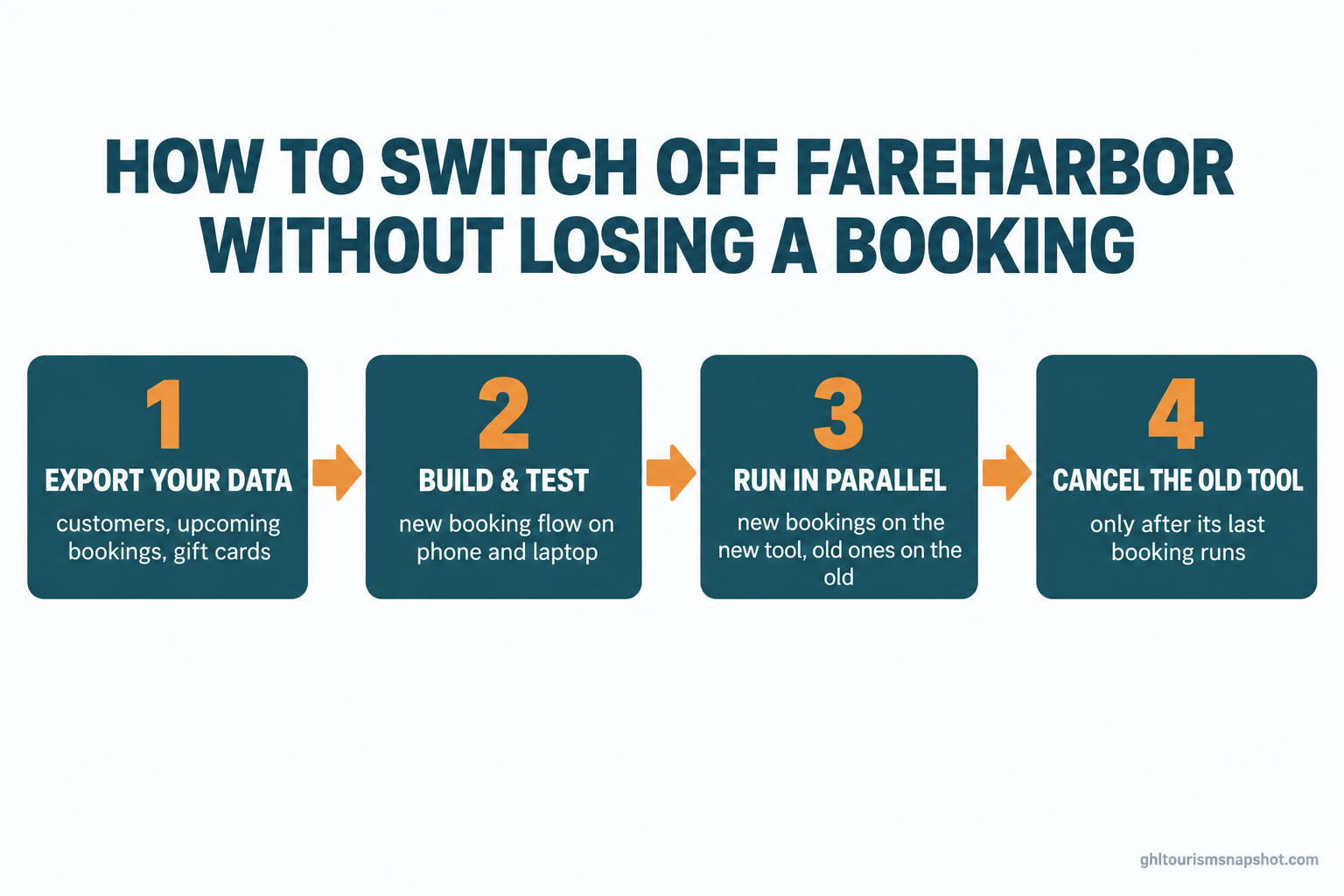
The step operators forget is the data export, so make the vendor do it in writing: ask for all customer contacts, upcoming and past bookings for the last 24 months, and any gift-card balances, in CSV, and whether there is a charge. Where this breaks: some tools make export slow or partial, which is exactly why you export before you cancel. If a vendor cannot hand you your own customer list cleanly, that is your answer on whether you should have been on it.
Common objections
“FareHarbor works fine, switching sounds like a nightmare.” It is real work, but a one-time cost against a fee you pay forever. Export your list, run a parallel month, cut over in your slow season, and the pain is finite. The 6% is not.
“A percentage fee is fair, I only pay when I make money.” True when you are small, which is why the passed-through tools feel good early. But the fee never stops climbing and takes the most in your best season. At $300,000 in sales a 3% fee is $9,000 a year and a 6% fee is $18,000. You would never write a flat check that size for a booking widget.
“The fee is on my customer, so it costs me nothing.” It costs you the comparison-shopped bookings you never win, and you do not see them, which is why the fee feels invisible.
“Do I need to be technical to run any of this?” No. Every published tool here is built for owners, not developers, and the all-in-one route is usually installed for you.
To finish that wet Tuesday: the fee you could not find was never going to get smaller, and the demo was never going to make it clearer. The operators who feel best about switching stopped asking “which widget is cheapest” and started asking “which lets me keep my customer.” That question has one answer, and it is not a booking button.
FAQ
Frequently asked questions
What is the best FareHarbor alternative for a small tour operator?
It depends on how you sell. For published, predictable pricing, Checkfront or Rezdy ($49/$99/$249 a month with a flat 3% online fee). If you sell heavily on Viator, Bokun. If you want no monthly bill, Xola. If your goal is to stop paying a per-seat fee and own your customer list, an all-in-one platform that also handles reminders and reviews is the stronger long-term move.
Why won't FareHarbor show me its pricing?
FareHarbor publishes no subscription and no fee; you book a demo to get a quote (Trekksoft). Its fee is widely reported at around 6%, typically added to the customer's checkout, but it is not on any official page, so treat that as reported, not published.
Is Xola actually cheaper than FareHarbor?
Not necessarily. Xola has no subscription and advertises 2.39% + $0.30 per transaction, but adds an undisclosed partner fee to the customer's total that some operators report several points higher (Capterra). It uses the same passed-through model as FareHarbor, so run your real numbers first.
Is Bokun really free, and what's the catch?
Bokun has a genuine $0 plan, but it is narrow and steers you toward Viator, which owns Bokun through Tripadvisor. Paid-plan fees are 1.5% / 1.25% / 1%, with 0% on Viator and offline (Bokun). The catch is the channel: Viator's commission is a reported 20%, commonly 20% to 30% in practice (OTA Playbook).
How much does a 3% booking fee actually cost me?
About $1,500 a year on $50,000 of online sales, $3,600 on $120,000, $7,500 on $250,000, and $15,000 on $500,000, on top of your subscription (author calculation from published Rezdy and Checkfront rates). Past a certain volume, a flat plan with no fee is cheaper.
Will I lose bookings or data if I switch off FareHarbor?
Not if you export first and run both systems in parallel. Export customer contacts, upcoming and past bookings, and gift-card balances before you cancel anything, take new bookings on the new tool while honoring existing ones on the old, re-point your booking links, and cancel the old subscription only after its last booking has run.
Editorial note: GHL Tourism Snapshot is a GoHighLevel automation and services product, not a travel agency or seller of travel. We don’t sell, book, or guarantee any tour. Prices and fees are drawn from the cited sources as of 2026; the demo-only FareHarbor and Peek Pro figures are reported, not officially published, so confirm current numbers on each vendor’s page before you buy. Nothing here is legal advice.
Related posts
- What Tour Booking Software Actually Costs in 2026: the full vendor-by-vendor pricing teardown behind this comparison.
- Direct Bookings for Tour Operators: the OTA-commission math behind why owning the booking beats renting it.
- GoHighLevel vs a Patchwork of Tools: what changes when booking, follow-up and reviews live in one place.
- Online Booking for Phoenix Tour Operators: how to move a booking flow without losing dates or data.
- Tour Operator Compliance Checklist: Seller of Travel, TCPA texts, and waivers, in plain English.