
It is 6:15am and you are staring at a radar loop. Twelve people are booked on the 9am kayak trip, the wind is building, and you already know you are not putting paddlers on that water. Now the hard part: telling twelve strangers their morning is off, every one of them paid in advance. Handle it well and most rebook and thank you for the honesty. Handle it badly and you refund the lot, and two weeks later your bank emails you about a disputed charge. The fix is a rebooking-first policy you publish before anyone books, texts that fire the moment you make the call, and a clean refund path for the few who say no.
Weather is the single most common reason an outdoor tour gets cancelled, and the most contentious (Group Travel Network). In a storm-prone stretch of the calendar, cancellation rates for weather-exposed activities run 15 to 20 percent, against under 5 percent in stable months (Travelity). How you handle one scrubbed trip in six shapes whether your season turns a profit.
Why a weather cancellation costs more than the trip
Most operators think a weather cancellation is a wash. It is not. Every cancellation you refund is a booking you spent money to win, gone, and if you fought your way off the online travel agencies to earn that direct booking, a full refund hands the whole thing back.
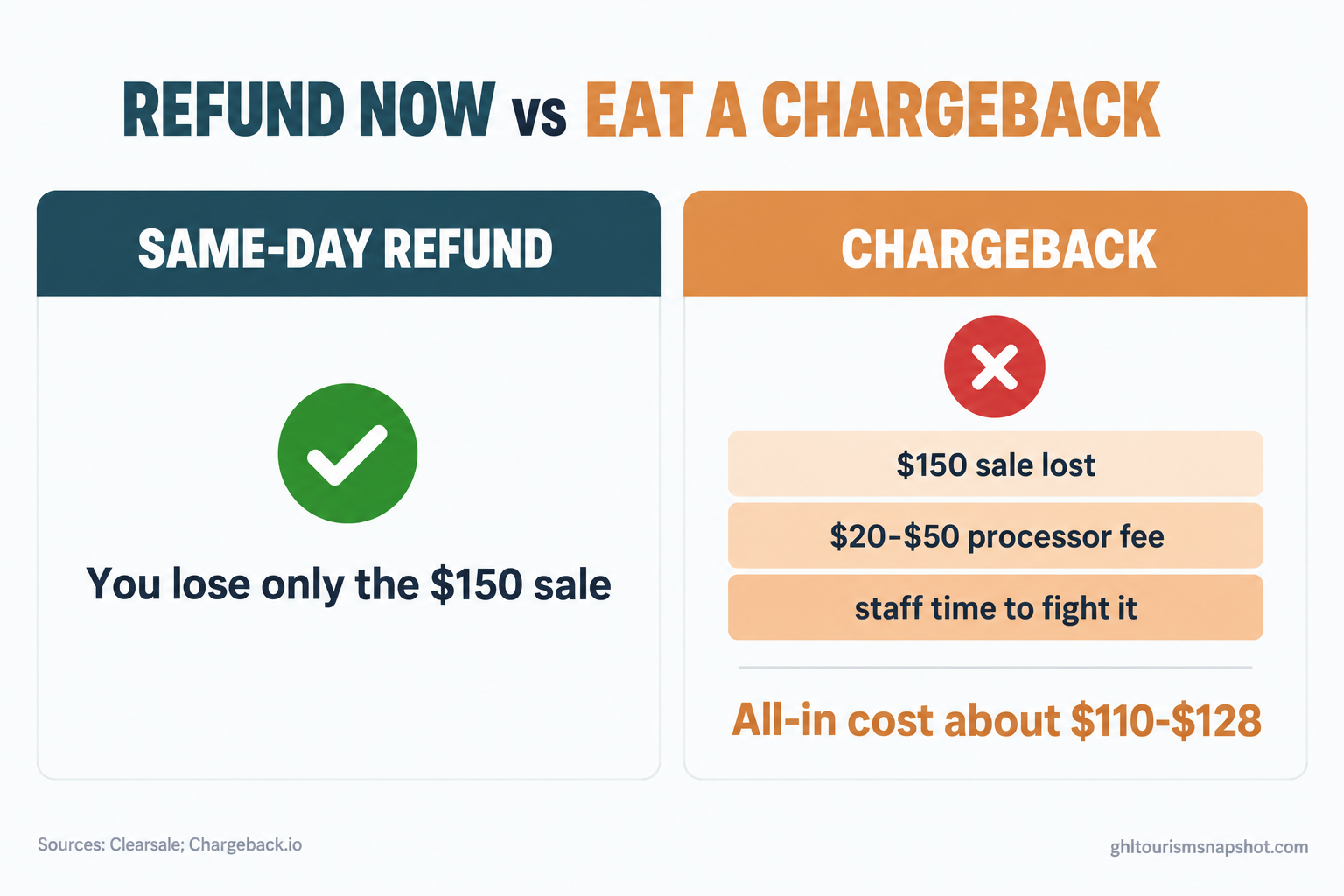
The worse version is when the customer forgets your policy and disputes the charge with their bank instead of talking to you. Around 20 percent of all card disputes are first-party misuse (friendly fraud), where a real customer disputes a charge they actually made, and US consumers filed roughly 158 million disputes in 2025 (Chargeflow, Moneywise).
A dispute is not just the lost sale. It adds a $20 to $50 processor fee plus staff time, pushing the all-in cost of one chargeback toward $110 to $128 (Clearsale), and travel runs one of the higher dispute amounts, near $120 (Chargeback.io). Worse, Visa’s Acquirer Monitoring Program, live since April 2025, tracks each merchant’s dispute-to-sales ratio and has tightened the threshold toward sub-1-percent, so stacking up disputes puts your processing itself at risk (Ravelin).
Approximate weather cancellation rate for weather-exposed tours, by season, as a percentage of scheduled departures. Source: Travelity.
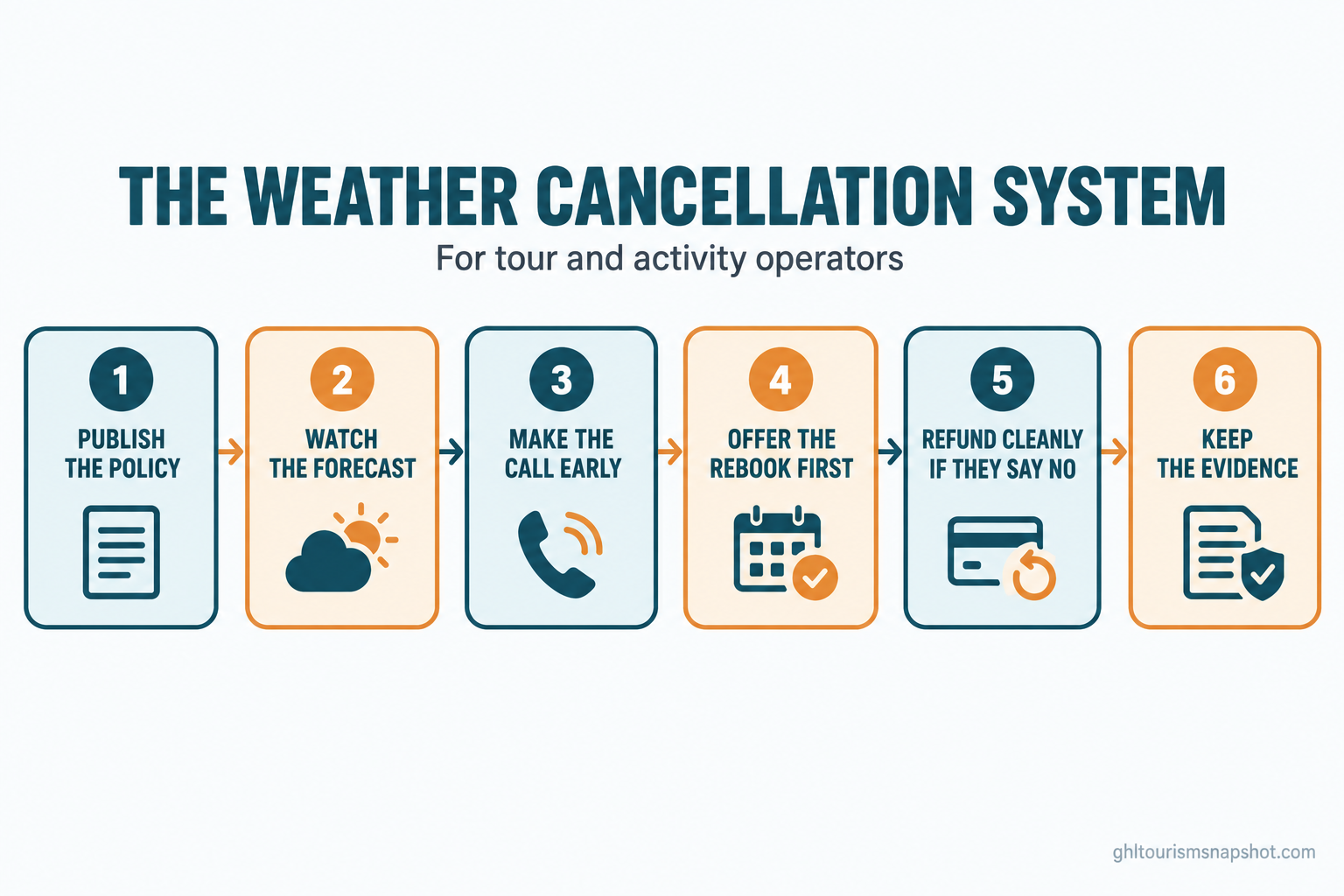
The six-stage weather cancellation system
You do not need software, just a decision made once and written down and a handful of messages in the right order:
- Publish the policy so the customer agrees before they pay.
- Watch the forecast and decide early, not at the meeting point.
- Make the call with a clear, human message the moment you decide.
- Offer the rebook first, with a link that takes two taps.
- Refund cleanly for the few who cannot or will not rebook.
- Keep the evidence so a dispute, if one comes, is one you win.
Stage 1: Publish a policy people read before they book
The argument you have on a rainy morning was won or lost weeks earlier, on your booking page. A vague policy turns every cancellation into a negotiation; a specific one, sitting where they book, means most of the fight never starts.
A good policy answers four questions: who decides a trip is off (you, on safety grounds), what triggers it (measurable thresholds, not a mood), what the customer gets (a rebook or credit first, a refund if that will not work), and how fast (same day). The magic word is measurable. “We may cancel at our discretion” invites a dispute; “we cancel when the marine forecast shows sustained winds above 20 knots” does not, because anyone can check it.
Put that clause on the booking page and in the confirmation, so the customer sees it before a cloud ever rolls in.
How this breaks: the policy lives only in a terms page nobody opens, so a cancelled customer feels blindsided and disputes the charge instead of tapping the rebooking link. Put it in the booking flow with an explicit checkbox, so “I never agreed to that” is off the table.
Stage 2: Watch the forecast and decide early
The worst cancellation is the one you make at the meeting point, with guests already parked and dressed. The earlier you call it, the more options everyone has, and the calmer it stays.
Build a simple rhythm. At 48 hours out, flag anything marginal. At 24 hours out, make the real decision for the next day and send the heads-up, on your published threshold, not your gut. Deciding early is what lets rebooking work: a guest who hears at 4pm has time to grab another slot; one who hears at the dock has already burned their morning.
How this breaks: you wait, hoping the forecast turns, and cancel last minute over and over, so guests learn your confirmations mean nothing and your reminder texts, your best tool against no-shows, lose credibility. Decide on a rule at a set time and stick to it.
Stage 3: Make the call, and make it kindly
The moment you decide, the message goes out, not an hour later. A text beats a phone call for a group: one send reaches twelve people with the same clear information.
Tone matters. Lead with their safety, own the decision, and move straight to the fix. Do not apologize five times or over-explain the meteorology, and never make it sound like a maybe. “We are calling off tomorrow’s 9am for safety, here is how to grab another spot” beats a rambling weather report and reads as professional, not flaky. Send it on the channel they booked through, text first, email as backup. If you run two-way SMS, better still: half will reply, and you want that in one place.
How this breaks: silence, so a blindsided guest finds out by showing up, and is the one most likely to dispute. A warm, fast, specific message is your cheapest chargeback prevention.
Stage 4: Offer the rebook before the refund
This stage decides your season’s numbers. A cancelled trip is money still in your account, so make rebooking the easiest next step and the refund the thing they have to ask for.
Order the offer deliberately. First: a free reschedule to any open date, with a link that pre-loads their booking so it takes two taps. Second: a full credit, valid a year. Only third, and only if they ask: a refund. You are not hiding the refund, that backfires; you present the rebook first because for most people a reschedule to a sunny day is the better deal. A small sweetener, a free upgrade or a priority date, turns a cancellation into a repeat booking.
How this breaks: you send a refund link first, or make them rebuild the booking from scratch. Every extra tap loses rebooks, so the link has to carry their details and land on confirm-and-done.
Stage 5: Refund cleanly when they say no
Some guests cannot rebook: they fly home tomorrow, or the trip was a one-shot. For them the refund has to be fast, full, and friendly. Refund to the original payment method, for the full amount, ideally same day, then confirm when it lands, because “where is my money” is the number one reason a patient customer turns into an impatient disputer. A refund the customer is not sure is coming is a chargeback waiting to happen. And resist a “processing fee” on a cancellation you initiated: you did not run the trip and it was your call, so a partial refund reads as unfair and invites a dispute you will lose. Keep partial refunds for customer-side cancellations.
How this breaks: you drag your feet to protect cash flow in a tight off-season, but every day you delay raises the odds of a dispute, which costs you the refund anyway plus the fee plus your time.
Stage 6: Keep the evidence that wins a dispute
Even with a clean policy and a fast refund, a dispute will occasionally land. When it does, the file you already have decides whether you win.
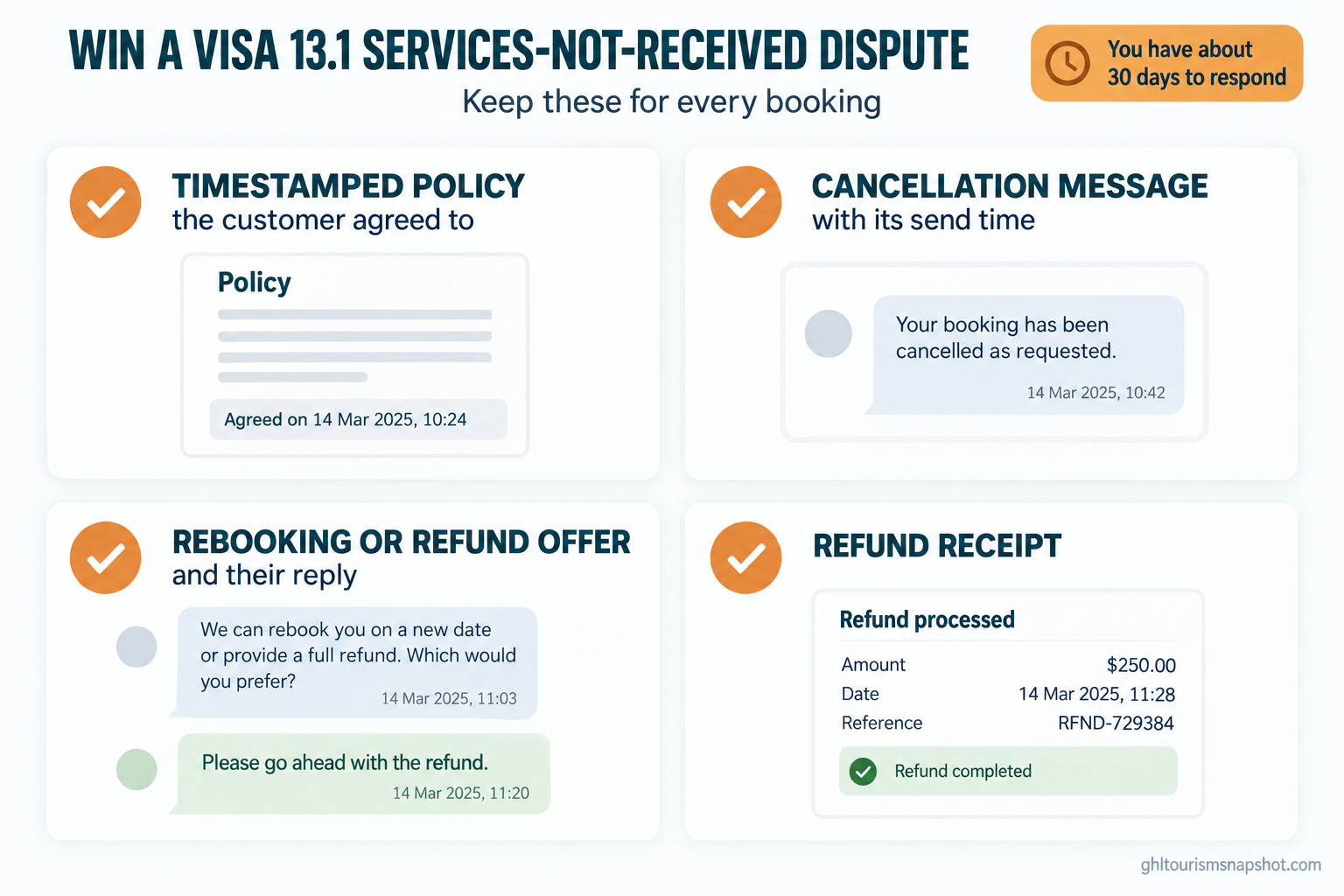
A weather cancellation usually gets disputed under a “services not received” reason code, which for Visa is code 13.1. The bank gives the cardholder up to 120 days to file and gives you about 30 days to respond (Chargebacks911). You win with a clear paper trail, so for every booking keep the timestamped policy they agreed to, your cancellation message with its send time, the offer and their response, and any refund receipt. A completed refund often ends a “not received” dispute on its own, because you already gave the money back.
| Situation | Your strongest evidence | Likely outcome |
|---|---|---|
| You refunded, then they disputed | Refund receipt with date | Usually closed in your favor |
| They took a credit, then disputed | Signed policy + credit issued + terms | Winnable with clear records |
| They rebooked, then disputed the first charge | Rebooking tied to original booking | Winnable, show the service moved |
| No policy on record, disputed | Little to stand on | Likely lost |
How this breaks: the records live in three places, or your memory, or a texting app you cannot export, so when the deadline hits you cannot assemble the file in time and lose by default. Keep everything for every booking in one system, so a dispute is a five-minute copy-paste, not a scramble.
Steal these: the exact messages to send
Adapt these, swapping in your business name, booking link, and thresholds.
That goes straight into your processor’s dispute form: attach the four documents, keep it factual.
Solo, mid-size and large: scaling the system
The six stages are the same at every size. What changes is how much you automate and how much you touch by hand.
The solo operator (one guide, a few trips a week). Run it manually: a saved-text folder with the four messages above, a weather app, and a rule to decide by a set time each day. Refund through your booking tool. Do not skip the published policy with a checkbox, because a solo operator has the least to lose to a dispute. The whole system is 15 minutes a day.
The mid-size operator (a 12-person boat, daily departures). Volume makes manual painful: one cancelled sailing is a dozen texts. Automate the sends, so one action cancels the departure and fires the heads-up, cancellation, and nudge to the whole manifest with a rebooking link that carries each guest’s details. You still make the safety call by hand, but the messaging and records run themselves, and a missed reminder or rebooking flow starts costing real money here.
The large operator (multiple tour types, seasonal crew). Different activities have different thresholds: light rain that scrubs a scenic flight is fine for a city walk. So the system needs per-activity rules, a way for a shift lead to trigger the right flow without calling you, and one CRM where any manager can pull a booking’s history in seconds.
The compliance you cannot skip
Two rules touch this system. This is plain-English summary, not legal advice.
First, texting. Cancellation and rebooking messages fall under the Telephone Consumer Protection Act. A text tied to a booking the customer made sits on much safer ground than a marketing blast, because they gave you the number to make that booking. Still, get a clear opt-in at checkout, include an opt-out, and register for A2P 10DLC so your texts deliver. Getting the TCPA wrong risks $500 to $1,500 per message (Cornell LII, 47 U.S.C. 227); the full detail is in our tour operator compliance checklist. Second, records: an electronic signature or checkbox is valid under the federal ESIGN Act, so a phone tap at checkout holds up the same as ink (FTC). That agreement, plus your timestamped messages and refund receipts, is the evidence Stage 6 depends on. Compliance and chargeback defense are the same paperwork, done once.
Common objections
“Won’t a rebooking-first policy annoy customers who just want their money back?” Not if the refund is genuinely available and you never hide it. People are not annoyed by an offer of a free reschedule to a nicer day; they are annoyed by being trapped. Offer the rebook first and honor the refund the second they ask.
“What if they rebook or take a refund and then dispute anyway?” It happens, which is why Stage 6 exists. If you refunded, the receipt usually ends the dispute; if they took a credit or rebooked, your signed policy and the record of the service moving, not vanishing, wins the case.
“Isn’t this what my booking software already does?” Partly. Most tools take a payment and issue a refund. Few send a sequenced set of cancellation and rebooking texts to a whole manifest, carry each guest into a one-tap link, and file every message for dispute defense. That connective layer is usually the gap, the same one that has operators running a stack of half-connected tools. And no, you do not need to be technical: the policy is writing, the messages are copy-paste, and the automation is a done-for-you setup.
FAQ
Frequently asked questions
Should I refund or offer a rebook for a weather cancellation?
Offer the rebook or credit first and keep the refund available for anyone who asks. A rebook keeps the money in your business and turns a cancelled trip into a future one; a refund gives the booking back. Present the reschedule as the easy one-tap default, and honor a refund the moment they prefer it.
How do I write a weather cancellation policy that avoids disputes?
Make it specific and measurable, and put it where the customer sees it before paying. Say who decides (you, on safety grounds), what triggers a cancellation (concrete thresholds like winds over 20 knots, not vague discretion), what the customer gets, and how fast. Then get a checkbox agreement at checkout.
Can a customer file a chargeback after I cancel for weather?
Yes, most often under a services-not-received code such as Visa 13.1. But these are winnable with clean records: keep the timestamped policy they agreed to, your cancellation message with its send time, the offer you made, and any refund receipt. A completed refund frequently ends the dispute on its own.
How fast should I refund a weather-cancelled trip?
Ideally the same day, and always within the window your policy promises. Refund the full amount to the original payment method and confirm when it will arrive. Slow or uncertain refunds are the number one trigger for a chargeback.
Is it legal to text customers about a weather cancellation?
Yes. A text tied to a booking the customer made is a transactional message and sits on much safer ground than a marketing blast, because they gave you their number to make that booking. Get a clear opt-in at checkout, include an opt-out, and register for A2P 10DLC so carriers deliver your texts.
What weather threshold should trigger a cancellation?
Use a measurable, checkable standard suited to your activity. Water tours key off wind speed, small-craft advisories, and lightning distance; land tours use heat indexes or road conditions; scenic flights use visibility and ceiling. Publish the specific numbers so a customer can verify the forecast met your bar.
Weather will never stop cancelling trips. What you control is the ten minutes after the call. Back at that 6:15am radar loop: you tap one thing, twelve people get a warm text with a two-tap rebooking link, most pick a sunny day, the rest are refunded the same afternoon, and every message files itself in case a bank comes asking. The storm still rolled in; your season barely felt it.