
It is a slow off-season Tuesday, you have an hour to shop for booking software, and you open the FareHarbor site to check the price. There isn’t one, just a button that says “Book a demo.” You try Peek Pro. Same thing. Here is the short answer: most tour booking software costs less in monthly subscription than you think and far more in per-booking fees than you expect, and the two tools that hide their price hardest, FareHarbor and Peek Pro, are the ones charging a percentage of every ticket. This teardown puts the real 2026 numbers side by side so you can work out your true annual cost before anyone gets you on a demo call.
We serve tour operators, so we look at this the way you do: not “which tool has the most features” but “what will this cost me per booked seat once the fees are counted.”
Why the pricing is so confusing
Two reasons you can’t get a straight answer.
First, the price is split in two on purpose: a subscription (what you see, if you see anything) and a booking fee (what you often don’t). The subscription is the number vendors show because it looks small. The booking fee is a percentage of every ticket, and because it scales with your revenue, it is usually the bigger cost. Splitting the price makes each half look cheap.
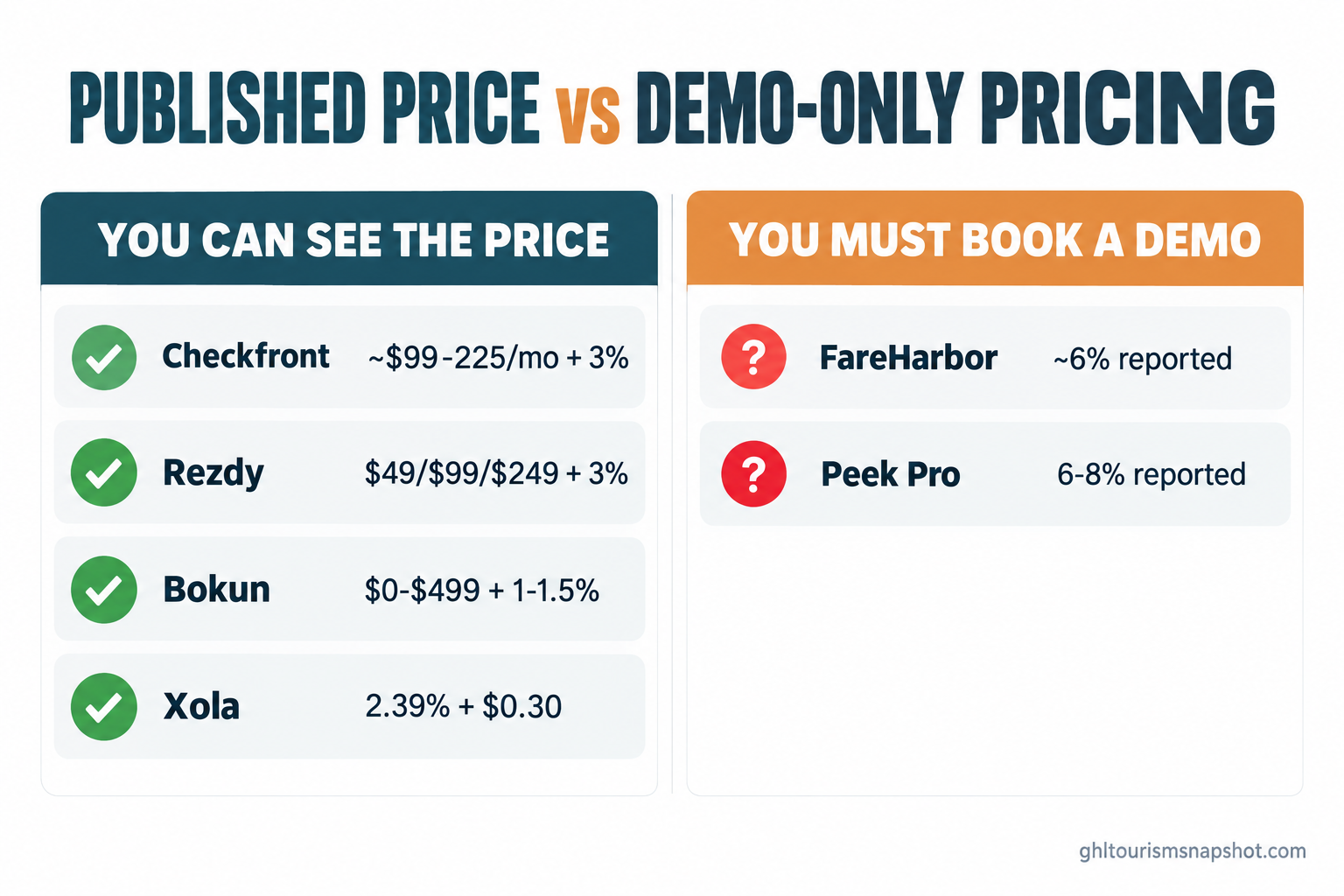
Second, several vendors hide the whole thing behind a demo. FareHarbor and Peek Pro do not publish prices at all, saying they “tailor pricing to your operation” (Trekksoft, Capterra). The effect is that you can’t compare them without giving up an hour and your phone number, and you never know whether the operator down the road got a better deal.
So ignore the headline and calculate your all-in cost: subscription plus the fee applied to a realistic year of online sales. Do that and the ranking often flips. A “free” tool with a percentage fee can cost more than a $99/mo plan once volume climbs.
The two ways this software charges you
Every tool here uses some mix of two models, and knowing which tells you almost everything.
Model one: low subscription, percentage booking fee. A modest monthly fee, then a cut of each online booking, usually 1% to 3%. Rezdy, Checkfront, and Bokun work this way. The base cost is predictable, but the fee grows exactly as your business does, so your best season is the season the software takes the most.
Model two: no subscription, higher percentage fee. Nothing monthly, and the fee does all the work, often 2.4% to 8%. FareHarbor, Peek Pro, and Xola sit here. It feels great when you are small and stings when you are big, because there is no ceiling. And with FareHarbor and Peek Pro the fee is commonly passed to the customer as a “service” charge at checkout, which shifts the sticker shock onto your traveler and can suppress conversion (CaptainBook).
Underneath both sits payment processing, roughly 2.9% + $0.30 per transaction, standard card rates no booking tool escapes (Rezdy). When a vendor quotes a low fee, ask whether processing is included or stacked on top.
What each tool actually costs in 2026
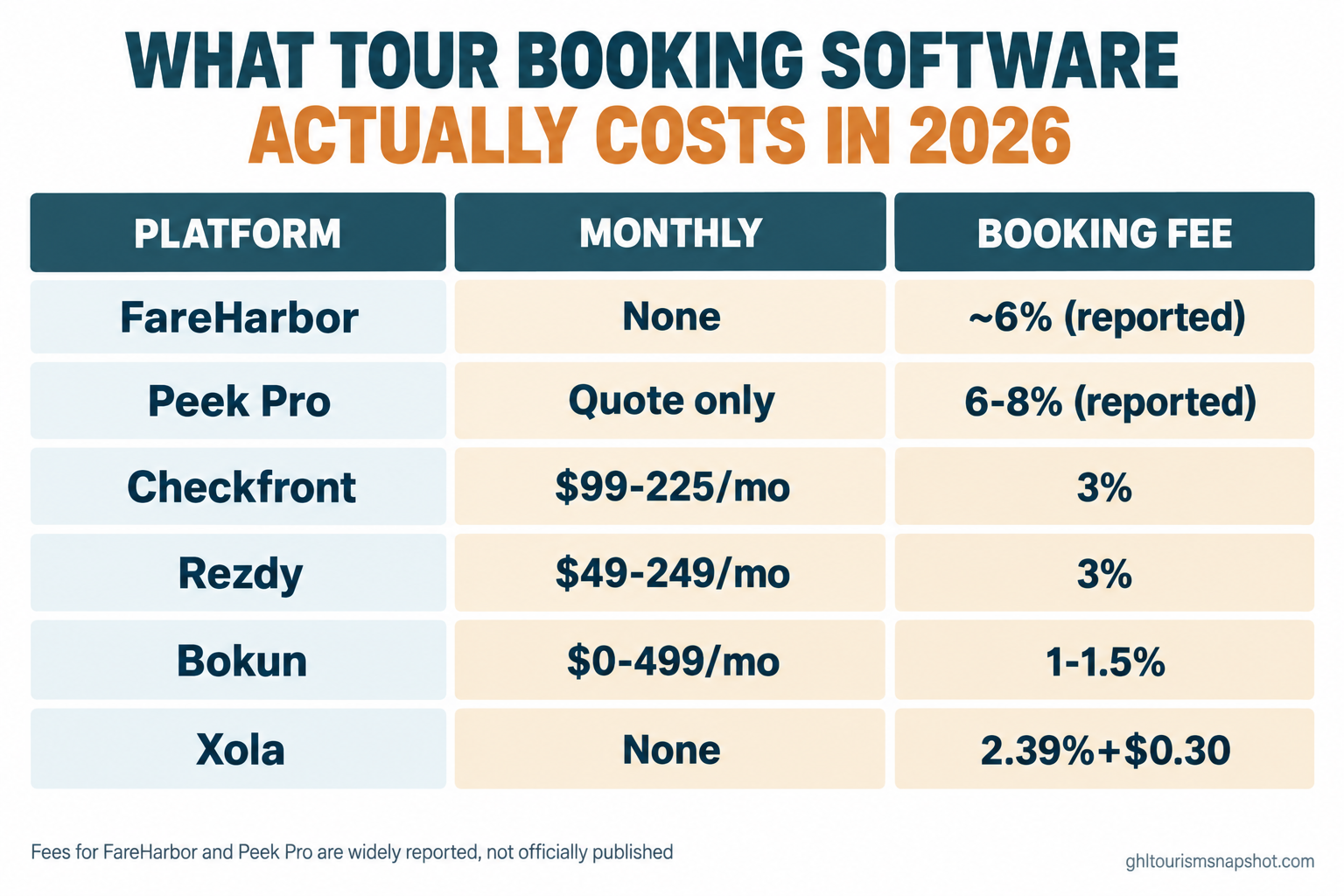
These figures come from the vendors’ own public pages where they publish one, and from corroborating third-party sources where they don’t. Every row links to its source, and the demo-only FareHarbor and Peek Pro fees are reported, not published, so confirm your numbers before you sign.
| Tool | Monthly subscription | Online booking fee | Price public? | Best fit |
|---|---|---|---|---|
| FareHarbor | None | ~6% reported, usually to customer | ❌ Demo only | High-volume, wants a hands-on team |
| Peek Pro | None (custom quote) | 6–8% reported | ❌ Demo only | Sold on Peek’s marketplace reach |
| Checkfront | ~$99–$225/mo | 3% (can pass to guest) | ✅ Yes | Wants a flat, predictable plan |
| Rezdy | $49 / $99 / $249 | 3% flat, all plans | ✅ Yes | Sells through resellers/agents |
| Bokun | $0 / $49 / $149 / $499 | 1.5% / 1.25% / 1%; 0% Viator | ✅ Yes | Already heavy on Viator |
| Xola | None | 2.39% + $0.30, to customer | ✅ (rate on request) | Small, wants no monthly bill |
Sources: FareHarbor, Peek Pro, Checkfront, Rezdy, Bokun, Xola.
FareHarbor
The biggest name and the hardest to price. No subscription, no published fee. You book a demo, a specialist “walks through the numbers for your operation,” and you find out (FareHarbor). The widely reported fee is around 6%, sometimes 5% at high volume, typically added to the traveler’s total at checkout rather than deducted from you (Trekksoft). Treat it as reported, since it is not on any official page. Right for operators who want a support team that builds the setup for them. Breaks because the fee rides on the customer: your listed price runs about 6% above a fee-free competitor and loses comparison-shopped bookings you never see.
Peek Pro
The other demo-gated tool. No public price, custom quote only (Capterra). Third-party sources put the fee at 6–8% plus processing around 2.3% + $0.30 per ticket, again typically passed to the customer (Software Finder). Right for operators who value Peek’s marketplace exposure. Breaks the same way FareHarbor does, and because the rate is negotiated, two operators on the same platform can pay very different amounts.
Checkfront
Checkfront publishes its pricing, which puts it ahead on transparency. After merging with Rezdy in late 2023 it restructured, so you will see more than one shape: an entry plan near $99/mo with a 3% booking fee, and a flatter Growth plan near $225/mo with no per-booking fee (Capterra, Checkfront support). That fork is useful: a low base with a fee if you are small, a higher flat rate with no fee if you are busy. Right for operators who want to pick their own trade-off. Breaks when people choose the wrong shape, so run your volume through both first.
Rezdy
The transparent anchor. Three public tiers, month to month: Foundation $49, Accelerate $99, Expansion $249, each with a flat 3% online booking fee and a small offline fee that drops with the plan ($1.00, $0.85, $0.70 per booking) (Rezdy, Capterra). Rezdy’s strength is distribution: it pushes your tours out to resellers and agents. Right for operators who sell through agents and OTAs. Breaks if almost all your sales are direct, because you pay for a distribution engine you don’t use and the 3% still applies.
Bokun
Owned by Tripadvisor, which owns Viator, and the pricing shows it. Plans are Free $0, START $49, PLUS $149, PREMIUM $499, with direct-booking fees of 1.5% / 1.25% / 1% and, crucially, 0% on Viator and offline bookings (Bokun, Capterra). The free plan is real but narrow: it mainly manages Viator and offline bookings, with no full website widget. Right for operators already doing volume on Viator. Breaks because the free, 0%-on-Viator design steers you toward Viator, where the commission is a reported 20%, commonly 20–30% (TicketingHub). Saving 1.5% on the tool while handing 20% to the OTA is not a saving.
Xola
The no-subscription model. No monthly fee, one feature set for everyone, and a per-transaction fee advertised at 2.39% + $0.30, charged to the customer as a partner fee (Xola guide, Capterra). The exact rate is disclosed on a sales call, can vary internationally, and Stripe processing may sit on top, so it is a floor, not an all-in number. Right for small operators who prefer zero monthly commitment. Breaks like the other passed-through fees: it lifts your checkout total above a fee-free competitor’s.
The number that isn’t on the pricing page
The advertised booking fees, side by side, are clearer than any headline plan price.
Advertised or reported online booking fee by platform (%). FareHarbor and Peek Pro figures are reported, not officially published; Peek shown at the midpoint of a reported 6–8% range. Sources: Trekksoft, Capterra, Bokun.
The fee looks like a rounding error until you multiply it by a real year. Here is what a flat 3% online fee, the going rate for Checkfront and Rezdy, costs at three revenue levels.
Annual cost of a 3% online booking fee by annual online revenue (USD). Source: author calculation from published Rezdy / Checkfront fee rates.
At $500,000 in online sales, a 3% fee is $15,000 a year, and a 6% passed-through fee is effectively $30,000 on your customers’ invoices, making every tour look pricier than the one next door. A $49/mo subscription, by contrast, is $588 whether you sell $50k or $500k. Past a certain volume, a flat plan with no per-booking fee beats a “cheap” plan with a 3% fee.
What it costs a solo, mid-size, and large operator
The right tool depends on your volume, because the two models cross over as you grow.
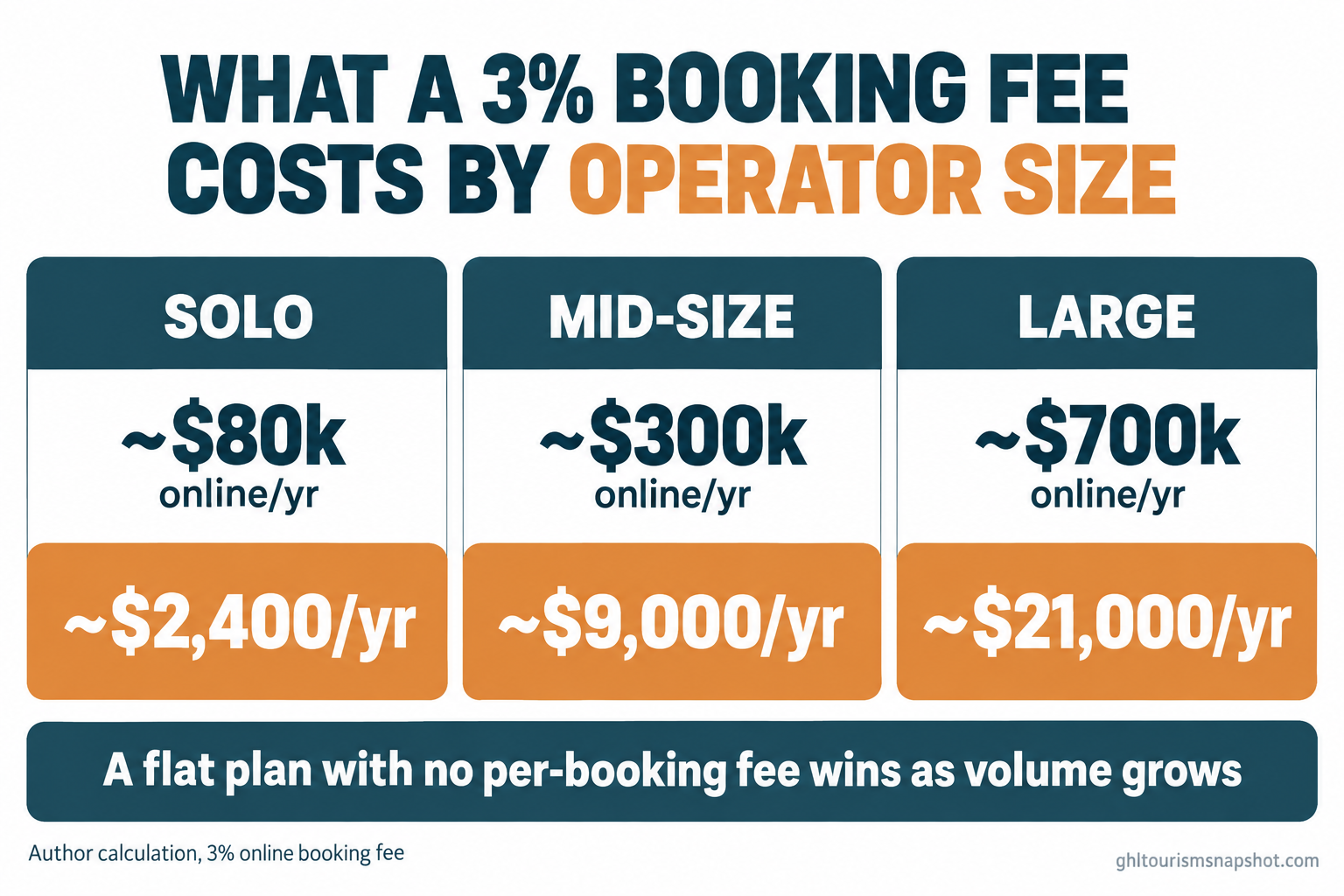
Solo operator (one or two tours a day, ~$80,000 online a year). The subscription matters more than the fee here because volume is low. A no-subscription tool like Xola (2.39% is about $1,900/yr) or Bokun’s free/START plan is genuinely cheap; Rezdy Foundation runs about $588 + $2,400 in fees, near $3,000. The trap is choosing a tool you will outgrow in one good season.
Mid-size team (three to six departures a day, ~$300,000 online a year). This is where the models cross. A 3% fee is now $9,000 a year on top of your subscription, so a flat plan with no fee, like Checkfront’s ~$225/mo Growth plan (about $2,700/yr), beats the “cheaper” $99/mo + 3% option by thousands. Stop optimizing the monthly price; optimize the fee.
Large operator (~$700,000+ online a year). The fee is now the dominant cost by far: 3% is $21,000+ a year, and a reported 6% passed-through fee is effectively $42,000 loaded onto your customers. Any flat-rate option, or bringing booking in-house at a fixed cost, pays for itself many times over. This is where operators start asking why they pay a percentage to a booking widget at all.
The pattern is simple: the smaller you are, the more the subscription matters; the bigger you get, the more the fee matters. Any percentage fee gets more expensive precisely as you succeed.
Questions to ask before you sign
If you are going to spend an hour on a demo, make the vendor earn it. The good ones answer these plainly; the ones dodging tell you something too.
Question 6 matters most. Past travelers are the cheapest bookings you will ever get, so a platform that makes it hard to take your data with you is not the low-fee deal it looked like. That is the whole case for owning your direct bookings.
The compliance costs no pricing page mentions
Booking software isn’t the only bill with your name on it. Two compliance areas cost real money and appear on no vendor’s plan page, so budget for them separately.
Seller of Travel registration. Several states require tour and travel businesses to register. Florida charges a $300 annual registration, requires a surety bond up to $25,000 (up to $50,000 for vacation certificates), and can fine up to $5,000 per violation (Florida DACS). California requires registration too, and its number must appear in all of your advertising under Business and Professions Code 17550 to 17559 (California DOJ). Washington, Hawaii, and Iowa are commonly cited too, so verify your state before you assume you are clear.
TCPA and A2P 10DLC for booking texts. The moment you send automated confirmations and reminders by SMS, you are subject to the TCPA, which means clear consent and a working STOP opt-out, and US carriers require A2P 10DLC registration for business texting. Get consent wrong and penalties run into hundreds of dollars per message. A booking tool that texts travelers should handle this registration for you, so ask whether it does. We cover the reminder side in the no-show playbook.
Common objections
“A percentage fee is fine, I only pay when I make money.” True when you are small, which is why the no-subscription tools feel good early. But the fee never stops growing: at $300,000 in sales a 3% fee is $9,000 a year, and a 6% fee is $18,000. You would never pay a flat $18,000/yr for a booking widget, yet a percentage fee gets you there quietly.
“The fee is passed to my customer, so it costs me nothing.” It costs you the bookings you don’t win. Travelers comparison-shop, and a 6% service fee makes your $200 tour show as $212 next to a competitor at a clean $200.
“I already use FareHarbor and switching sounds painful.” It is real work, but a one-time cost against a fee you pay forever. Export your customer list and upcoming bookings, run a parallel month, then cut over, as the Phoenix online-booking guide walks through. The switching pain is finite; the fee is not.
FAQ
Frequently asked questions
How much does FareHarbor cost?
FareHarbor has no monthly subscription and no published price; you book a demo to get a quote. Its fee is widely reported at around 6% (as low as 5% at high volume) and typically added to the customer's checkout total, but it is not on any official page, so treat it as reported (Trekksoft).
Why doesn't Peek Pro show its pricing?
Peek Pro is quote-only, with no public price and a custom quote on a demo call (Capterra). Third-party sources put its fee at 6–8% plus processing, typically passed to the customer, and because it is negotiated, operators pay different amounts for the same product.
What is the cheapest tour booking software?
By subscription, Bokun's free plan ($0) and Xola (no monthly) are cheapest, and Rezdy starts at $49/mo. But 'cheapest' depends on volume: a low or no subscription with a percentage fee can cost more than a higher flat plan once you sell enough, because the fee grows with every booking while a subscription stays fixed.
How much is a 3% booking fee actually costing me?
A 3% online fee costs $3,000/yr on $100,000 of online sales, $7,500 on $250,000, and $15,000 on $500,000, on top of your subscription (author calculation from published Rezdy and Checkfront rates). Past a certain volume, a flat plan with no fee is cheaper.
Is Bokun really free?
Bokun has a genuine $0 plan, but it mainly manages Viator and offline bookings and lacks the full website widget of the paid tiers (Bokun). It is Tripadvisor/Viator-owned and steers you toward Viator, where the commission is a reported 20%, commonly 20–30% (TicketingHub).
Do tour operators need a Seller of Travel registration?
In several states, yes. Florida requires a $300 annual registration plus a surety bond and can fine up to $5,000 per violation (Florida DACS), and California requires registration with the number shown in all advertising (California DOJ). Verify your state's rules before you advertise.
Editorial note: GHL Tourism Snapshot is a GoHighLevel automation and services product, not a travel agency or seller of travel. We don’t sell, book, or guarantee any tour. Prices and fees are drawn from the cited sources as of 2026; confirm current figures on each vendor’s page before you buy. Nothing here is legal advice.
Related posts
- Direct Bookings for Tour Operators: the OTA-commission math behind why owning the booking beats renting it.
- GoHighLevel vs Multiple Tools for Atlanta Tour Operators: what happens when booking, CRM and follow-up live in one place.
- Online Booking for Phoenix Tour Operators: how to move a booking flow without losing dates or data.
- Reduce Tour No-Shows: the reminder system that protects the seats you did sell.
Ready to stop paying a fee on every seat? See the full Tourism Snapshot pricing, compare the options side by side, or talk to a real person.