
If you run tours in Austin and you’re deciding how to stop losing after-hours bookings, the choice usually comes down to two options: hire a human answering service, or put a 24/7 AI receptionist on the phone. Both promise the same thing — “we’ll answer when you can’t.” The honest answer for most operators is that an AI receptionist wins on cost, speed, and — the only number that actually matters — booked seats. But it’s not a blanket win, and this post walks the trade-offs function by function, with real 2026 data, so you can pick the right tool for how your tours actually run.
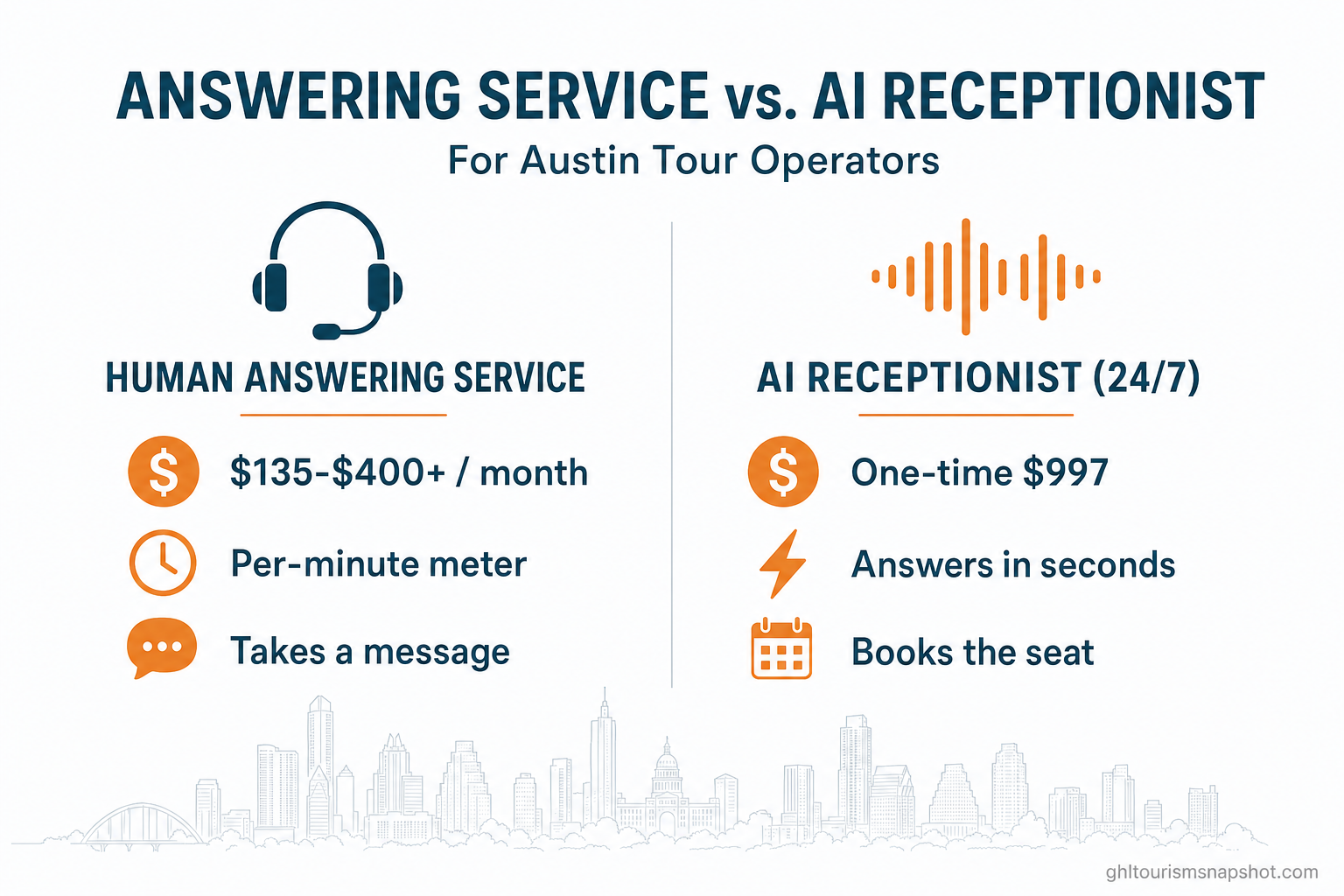
This is the cost-per-booked-seat version of the decision. Not “which sounds more modern,” but which one puts the most confirmed travelers on your departures for the least money — and which one fits an Austin operator whose phone rings hardest exactly when no one’s at the desk.
Answering service vs. AI receptionist: what each one is
A human answering service is an off-site call center. When you don’t pick up, the call rolls to their operators, who follow a script, take a message, and either forward it to you or — on higher-tier plans — try to book from your calendar. It’s a real person, which is genuinely reassuring for complex or emotional calls. You pay for that person by the minute or the month.
An AI receptionist (sometimes called an AI voice agent or AI caller) is a 24/7 conversational system that answers in your brand’s voice, knows your tours, dates, pricing and meeting points, answers the traveler’s questions, and books the seat on the spot — logging everything into your CRM. It isn’t voicemail and it isn’t a phone tree: it talks, it listens, and it never sends the caller to a competitor because it was busy. If you want the deeper primer on how these agents actually hold a conversation, we wrote it here: AI voice agents for tour operators.
The third “option” most operators are actually running today is voicemail plus a callback — which, as the data below shows, is the most expensive choice of all, because the booking is usually gone before you hear the message.
The Austin context: your phone rings after hours
Austin is not a market where you can afford to leak inquiries. The city welcomed 40.2 million visitors in 2024, generating $11.4 billion in economic impact and supporting more than 151,700 local jobs (Visit Austin). Lady Bird Lake kayak trips, bat-bridge cruises, food and BBQ crawls, Sixth Street and live-music tours, Hill Country wine and distillery day trips — the demand is enormous, and it books late. A visitor deciding tonight what to do tomorrow will call three operators and book the first one that answers.
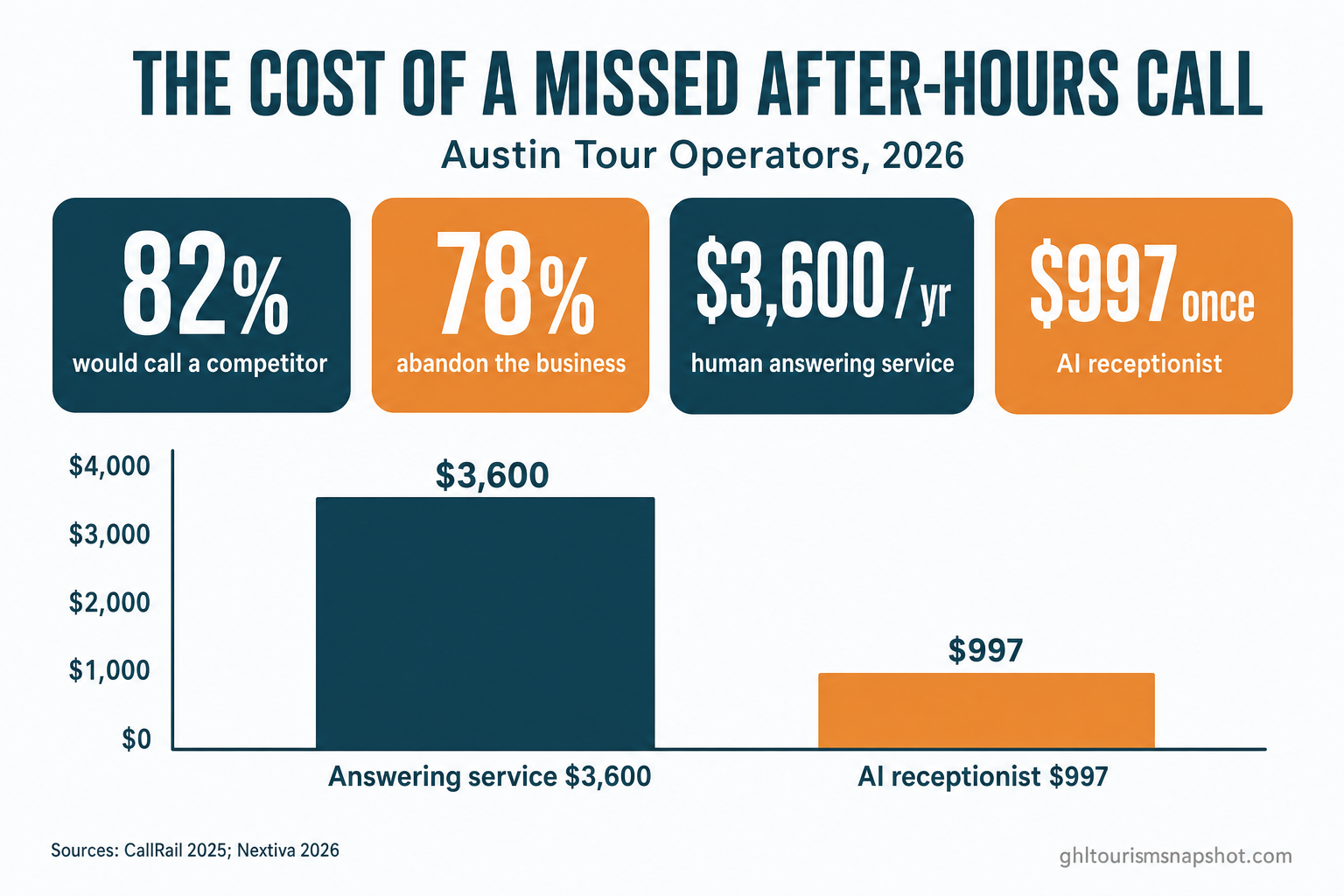
That’s the problem: the calls that decide your week come in at 9 p.m. on a Saturday, from a phone, while you’re mid-tour on the water or already asleep. And the cost of missing them is now measurable. In CallRail’s 2025 survey of 1,000 U.S. consumers, 78% said they’d abandoned a business after an unanswered call, and 82% said they’d call a competitor instead (CallRail, 2025). We put hard dollars on that dynamic in our breakdown of the real cost of missed calls for tour operators — in a city as competitive as Austin, that unanswered ring is a booking the operator down the street just took.
Side by side: voicemail vs. answering service vs. AI receptionist
Here’s the honest function-by-function comparison. The point isn’t that human answering services are bad — for some operators they’re the right call. It’s that the gaps between what each option promises and what actually converts a late-night Austin inquiry are where your bookings live or die.
| What matters for a tour booking | Voicemail + callback | Human answering service | AI receptionist (24/7) |
|---|---|---|---|
| Answers at 9 p.m. on a Saturday | ❌ Caller hits voicemail | ⚠️ Only if you pay for 24/7 | ✅ Always, instantly |
| Speed to answer | ❌ Hours later, if at all | ⚠️ Rings through, then a human picks up | ✅ In seconds, every time |
| Knows your tours, times & meeting points | ❌ | ⚠️ Reads a generic script | ✅ Trained on your tours + FAQs |
| Books the seat directly into your calendar | ❌ Takes a message | ⚠️ Sometimes; often just a message | ✅ Books live on the call |
| Handles a peak-season rush of calls at once | ❌ | ⚠️ Hold times or per-minute overages | ✅ Many calls in parallel |
| Cost model | “Free,” but leaks bookings | ~$135–$400+/mo + per-minute | One-time in the snapshot, no meter |
| Logs the lead into your CRM automatically | ❌ You re-key it later | ⚠️ Message forwarded; you re-enter it | ✅ Straight into GoHighLevel |
| Same brain across phone, web chat & SMS | ❌ | ❌ Phone only, usually | ✅ One system, every channel |
The pattern is clear: voicemail loses the booking, a human answering service can save it but charges you by the minute and usually stops at “took a message,” and an AI receptionist is built to do the one job that matters — book the seat while the traveler is still on the line — and drop it straight into your system. That last column is exactly what the 24/7 online booking playbook is about: capturing the inquiry is only half the job; converting and recording it is the other half.
The real cost, over a full year
A human answering service looks cheap by the month and expensive by the year. Typical small-business plans run $135–$400+ per month, with live-operator rates of roughly $0.75–$1.75 per minute and additional setup, holiday, and overage fees that vendors themselves note can add 30–50% to the advertised rate (Nextiva, 2026). At a middle-of-the-road ~$300/month, that’s $3,600 a year, every year — a recurring meter that spins faster in peak season, exactly when your call volume is highest.
An AI receptionist flips that math. In our done-for-you Tourism Snapshot, the AI Caller is one of eleven automations included in a one-time build — no per-minute meter, no monthly answering-service invoice, answering unlimited calls in parallel. The chart below compares a full year of coverage.
This is the difference between renting coverage and owning a system. And because Gartner projects conversational AI will remove $80 billion in contact-center labor costs by 2026 — with 85% of customer-service leaders planning to explore or pilot customer-facing conversational GenAI in 2025 (Gartner) — the gap between the two cost models only widens over time.
Speed to lead: where bookings are actually won
Cost is the tiebreaker, but speed is the game. The landmark MIT / InsideSales lead-response study found that contacting a web lead within five minutes makes you about 21× more likely to qualify it than waiting just 30 minutes (MIT / InsideSales). Yet Harvard Business Review’s audit of 2,241 companies found the average firm took 42 hours to respond, and 23% never responded at all (HBR).
A voicemail-and-callback loop is practically engineered to land in that 42-hour bucket. A human answering service compresses it — but a person still has to pick up, and 24/7 coverage costs more. An AI receptionist collapses response time to seconds, on every call, at 3 a.m. or during a peak-season rush of ten simultaneous callers, because it isn’t waiting in a queue. This is the same speed-to-lead logic behind reducing no-shows: the faster and more reliably you respond, the more of your demand you actually convert.
The stakes scale with the market. Arival’s research puts the global tours, activities and attractions market at roughly $253 billion in 2024, heading toward $342 billion by 2029, with only about a third of experiences booked online — meaning the phone is still where a huge share of tour bookings are won or lost (Arival).
Which one should an Austin operator pick?
Here’s the candid version, because no tool is right for everyone:
- Choose a human answering service if your calls are highly complex, emotionally sensitive, or require judgment a script can’t cover, and your call volume is low enough that the monthly meter stays cheap. A warm human voice has real value for premium, high-touch, custom-itinerary operators.
- Choose an AI receptionist if your bookings are time-sensitive, your busiest hours are nights and weekends, your call volume spikes in peak season, and most inquiries are answerable (“What time’s the sunset kayak tour? Do you have two spots Saturday? Where do we meet?”). That describes the vast majority of Austin tour and activity operators.
- Don’t choose voicemail. It’s the only option the data unambiguously rejects: it converts the fewest callers and quietly sends the rest to a competitor.
For most operators the honest recommendation is an AI receptionist as the front line, with a human — you, your team, or a GoHighLevel VA who runs the system — handling the rare call the AI flags as complex. You get instant, 24/7 coverage without the per-minute meter, and a person for the moments that truly need one.
How to get an AI receptionist live
You don’t need to become a telephony engineer. The AI Caller ships as part of the Tourism Snapshot: we install it into your GoHighLevel, connect it to your calendars and tour catalog, file your free A2P 10DLC registration, and tune the script to your voice — typically live in about 24 hours. If you’d rather migrate your whole stack into one system first, our GoHighLevel development service handles that; if you want someone to run it day to day, our hire-a-VA service puts a trained specialist inside your account. Either way, the phone stops being the leak in your business.
Frequently asked questions
Is an AI receptionist cheaper than a human answering service?
Almost always, over a full year. A mid-tier human answering service runs around $300/month — about $3,600/year, recurring, with per-minute overages that spike in peak season (Nextiva, 2026). The AI Caller in our Tourism Snapshot is part of a one-time $997 build with no per-minute meter, so after year one it keeps answering at no added monthly cost. The bigger saving is the bookings you stop losing to unanswered calls.
Will an AI receptionist sound like a robot to my Austin travelers?
Modern conversational AI holds a natural back-and-forth — it answers questions about dates, pricing, and meeting points, and books the seat on the call. We tune it to your brand's voice and your specific tours, and it's designed to hand off to a human for the rare call that needs judgment. The goal isn't to hide that it's AI; it's to make sure every caller gets an instant, helpful, on-brand answer instead of voicemail.
What happens on a call the AI can't handle?
It captures the traveler's details, logs the lead into your GoHighLevel CRM, and routes a warm, summarized hand-off to you or your team — so even the calls it escalates arrive as a booked-ready lead, not a lost one. Nothing falls into a voicemail black hole.
Can it handle a peak-season rush of calls at the same time?
Yes — that's a core advantage over both voicemail and a human answering service. An AI receptionist answers many calls in parallel, so ten simultaneous callers on a busy Saturday all get answered in seconds. A human service either queues them or charges per-minute overages during exactly the hours you can least afford a hold.
Does the AI receptionist only answer the phone?
No. Because it lives inside GoHighLevel, the same system answers web chat and SMS with the same knowledge of your tours — so a traveler who texts at midnight or messages your website gets the same instant, booking-focused response as a caller. It's one connected front desk across every channel, not a phone-only bolt-on.