
It is 6:50am and you are loading the van when a text comes in: “Hey, is the 9am still happening? Never heard anything after I paid.” You did send a confirmation. It went to an email she never opened. Now you are typing with one thumb, holding a cooler with the other, reassuring a guest who is half-convinced she got scammed. Multiply that by every booking and you get your mornings back by fixing one thing: the words that go out on their own, at the right moment, on the channel people actually read. This is the full set: when to send each one, the exact copy, and the rules that keep you legal.
What silence costs you right now
Think about the last seat that went empty on a departure you could have filled. Someone booked, paid a deposit, then forgot. No reminder landed, no one showed. On a twelve-person boat at $75 a head, two no-shows is $150 gone, and you cannot sell it once the dock lines are off. The quieter cost is time: every booking without a clear confirmation becomes a phone call or a worried guest at the meeting point, and you answer the same five questions all season.
And experiences are a growing business: the US Bureau of Labor Statistics projects 6% job growth for tour and travel guides through 2035, while travel agents sit flat at 0%. (BLS, guides) (BLS, agents) More travelers want to book directly with the people who run the tour, and the ones who win them send messages that feel personal. These templates let a one-or-two-person shop sound like that without being chained to the phone.
Text or email? Pick the right pipe
Get the channel wrong and the best copy lands in an inbox nobody opens. The rule: text anything time-sensitive or short, email anything long. In an NP Digital analysis of 2,731 campaigns across 57 companies, texts were opened about 51% of the time against roughly 24% for email. (NP Digital)
That opt-out gap is why. Texts interrupt, so spend them on things a guest is glad to be interrupted for (trip confirmed, meet here, forecast changed) and save the newsletter and long itinerary for email.
| Message | Best channel | When it fires |
|---|---|---|
| Booking confirmation | Text + email | Instantly, within seconds of payment |
| Deposit / balance reminder | Text | 7 days, then 48 hours before balance is due |
| Pre-trip prep | 3 to 5 days before the trip | |
| Day-before weather check | Text | The afternoon before, by 3pm |
| Running-late nudge | Text | 20 to 30 minutes before start time |
| Review request | Text | The morning after the trip |
| Off-season win-back | Email + text | 3 to 6 weeks before your season opens |
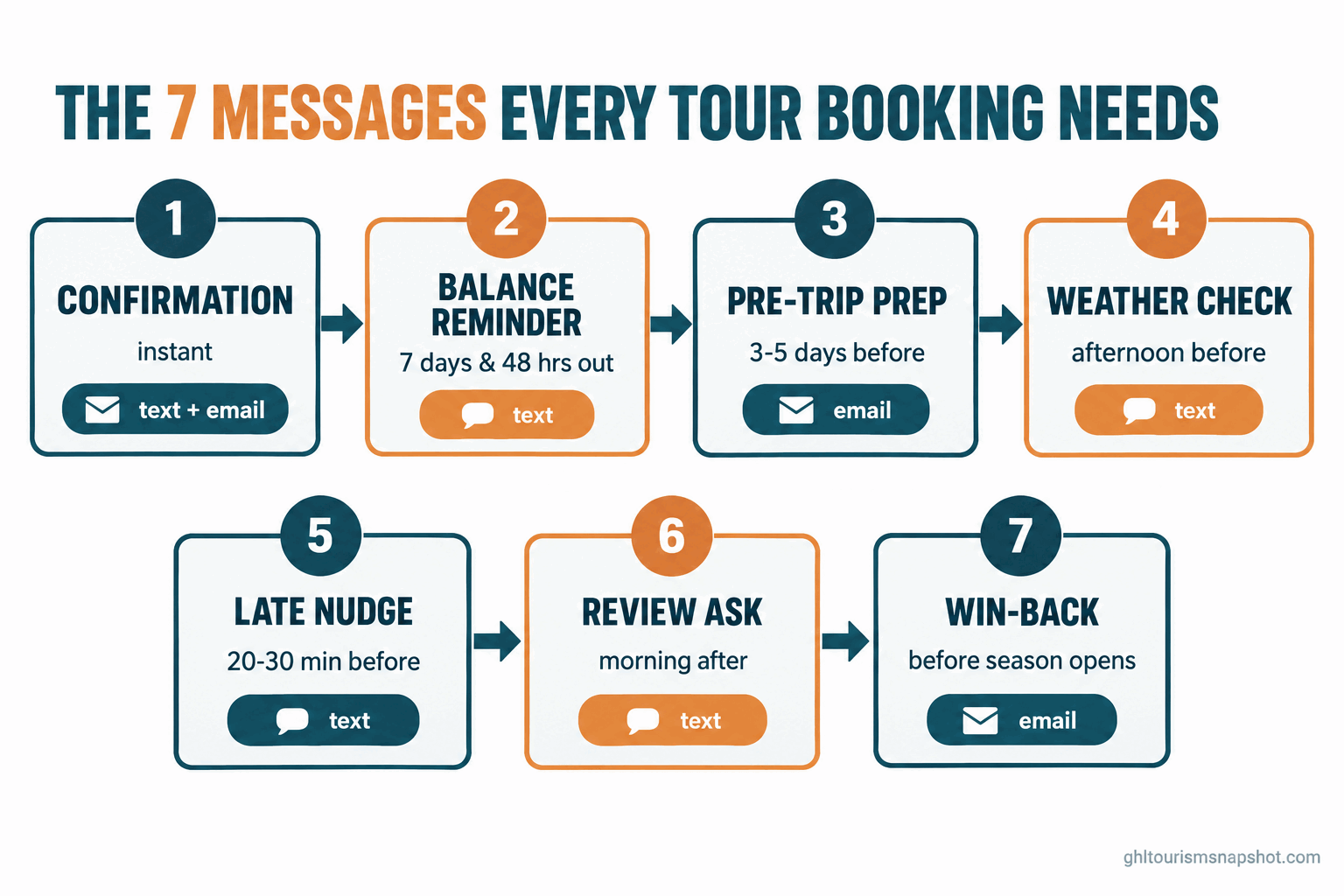
The seven messages every booking needs
Most operators send one message, the confirmation, and call it a system. A booking has seven moments where the right message changes whether a guest shows up, reviews you, or comes back. Below is each, with the copy, the timing, and how it breaks. Start with the first three.
1. The instant booking confirmation
The one message you cannot skip. It has to land within seconds and answer the guest’s only question: did it work? Send both the moment payment clears: the text reassures, the email carries the receipt.
Where it breaks. The email-only confirmation, sent to an address someone mistyped at checkout, is how you get the 6:50am “is this still happening” text, so send the text too and put the order number and amount in the email.
2. The deposit and balance-due reminder
If you collect the balance later, this is pure recovered revenue: people do not withhold it on purpose, they forget. A two-text nudge turns most into paid seats, one 7 days out and a firmer one 48 hours out.
Where it breaks. No payment link in the text means the guest has to dig through an old email, which means never, so put the one-tap link right in the message and invite a reply, turning a quiet cancellation into a reschedule instead of a chargeback.
3. The pre-trip prep message
This email halves your day-of chaos: everything a guest needs to show up at the right place, dressed right, far enough ahead to act on. It also quietly cuts no-shows (more in how to reduce tour no-shows). Send it 3 to 5 days before.
Where it breaks. Sending it the night before, when nobody can rearrange the morning. Give them three to five days, and put the where and when at the very top, because half your guests will skim.
4. The day-before weather and readiness check
Outdoor operators live and die by this one. A short text the afternoon before confirms the trip is on (or calmly handles a change) and catches a wavering guest before they quietly no-show. Done well, it avoids a refund fight too (our weather cancellation policy guide covers that). Send it by 3pm.
Where it breaks. Going silent when the weather turns bad: the guest wakes up to rain and either shows up angry or files a dispute, so get ahead of it and lead with carrying their payment over, and never oversell a shaky forecast.
5. The running-late and no-show nudge
A guest stuck in traffic does not need a lecture; they need to know you see them and can wait. And the one who forgot needs a single nudge to turn a no-show into a late arrival. Send it 20 to 30 minutes before start, to anyone not checked in.
Where it breaks. Too early reads as nagging and too late means they are written off, so aim 20 to 30 minutes out; and on the rebook lead with a warm “let’s find a new date,” never with fees, because a no-show guest is already embarrassed.
6. The post-trip review request
The highest-value message you send. A guest is never happier than the morning after a great trip. Ask then, point them at your own Google profile, and you build the asset that wins bookings for years. It is the engine behind getting more 5-star reviews on autopilot, paired with automated review responses. Fire it the morning after, by text.
Where it breaks. Blasting a public review link to every guest, including the one who had a rough trip, earns you a one-star in writing, so invite unhappy guests to reply first and route them to the private intercept, and never pay for a review, which violates Google’s policies and can get your reviews pulled.
7. The off-season win-back
This is what makes a list worth keeping. You have what the OTAs will not: people who loved your tour and gave you their number. One well-timed note before your season opens fills departures that would otherwise start empty, at near-zero cost. It is the backbone of steady off-season cash flow. Send it 3 to 6 weeks before your season opens, email plus a short follow-up text.
Where it breaks. The generic blast that reads like spam. Segment by the tour they actually took and speak to it, and send it into the gaps before the rush, not after your calendar is full. This only works if you captured consent at booking, which the compliance section covers.
Three operators, one template set
The seven messages do not change with your size; how you run them does.
The solo guide (you, a kayak, 15 trips a week). Automate the confirmation, the prep, and the review ask, and send the day-before weather text yourself each evening, since you are making the call anyway. Three automated messages plus one manual text covers 80% of the value. Start here; add the rest later.
The small shop (2 to 3 staff, seasonal guides). Volume is now past what one person can text by hand, and it shows: some guests get a warm confirmation, others get nothing. Automate all seven and route replies to a shared inbox, so a 7am reply gets answered whether or not you hold the phone. Our speed to lead piece covers why the first reply matters.
The large operator (multiple locations, year-round). Same messages, but segmentation is the whole game: tag every contact by location, tour type, and season so a win-back for a sunset paddle in one city never lands on an ATV guest in another. The templates stay human; the plumbing is what scales.
Keep it legal: consent, STOP, quiet hours, and CAN-SPAM
Texting guests is not a free-for-all, and the rules got stricter in 2025. This is general guidance, not legal advice, so confirm the specifics for your state.
Consent. You can text a guest about the trip they booked: meeting point, safety note, weather change. Marketing texts (the win-back, the “book direct” offer, promos) need prior express consent, which in practice means a checkbox at booking that says you may text them offers. (Parker Poe, on 2025 TCPA developments)
STOP and opt-outs. Under the FCC revocation rules effective April 2025, replies like STOP, QUIT, CANCEL, END, and UNSUBSCRIBE all count, and you cannot force people through one magic word. Honor it promptly; one confirmation reply is fine, anything promotional after that is not.
Quiet hours. Federal rules restrict solicitation calls and texts to between 8am and 9pm in the recipient’s local time zone. (47 CFR 64.1200) Some states are tighter (Florida caps it at 8am to 8pm). Set automations to the guest’s time zone.
A2P 10DLC registration. Since February 2025, US carriers block business texts from numbers not registered through the Application-to-Person 10DLC system run by The Campaign Registry. It is a one-time setup through your messaging provider; skip it and your texts do not deliver.
Email, under CAN-SPAM. Your emails need an honest subject line, a real physical postal address in the footer, and a working unsubscribe link you honor within 10 business days and keep live at least 30. (FTC CAN-SPAM guide) The penalty is up to $53,088 per email, so the footer is not optional. Advertising travel in states like California or Florida may also require a Seller of Travel registration number in your marketing.
Objections, answered straight
“Won’t all these messages annoy my guests?” Not if they are useful and timed right. Nobody is annoyed by a clear confirmation, a meeting-point reminder, or a heads-up that the trip is on. The annoyance comes from the wrong message at the wrong time: a promo at 7am, a review ask a week late. Follow the timing above and you are simply the operator who has their act together.
“I already send a confirmation. Isn’t that enough?” It is the floor, not the system. The prep, weather check, and start-time nudge get them to show up; the review ask and win-back turn one trip into a public review and a repeat booking. The messages you are most tempted to skip are the ones that compound.
“Do I need to be technical to run this?” No. It is a one-time setup: load the templates, set each to fire at the right trigger, connect your booking system. After that it runs without you.
“What if a guest replies to an automated text?” They should reach a human, fast. Texts work because they feel personal, and a reply vanishing into a no-reply void breaks that. Route every inbound reply to an inbox you or your team actually watch (see our SMS marketing guide).
FAQ
Tour booking messages: questions operators ask
How many messages should I send for one booking?
Seven: an instant confirmation, a deposit or balance reminder if you take one, a pre-trip prep note, a day-before weather check, a start-time nudge, a review request the morning after, and an off-season win-back. Just starting? Run the first three and add the rest as you have time.
Should booking messages go by text or email?
Text anything short and time-sensitive: confirmations, reminders, the weather call, the late nudge, the review ask. Email anything long or with a receipt: the full confirmation, the prep note, and the win-back story. Texts get opened far more often (about 51% versus 24% for email) but draw more opt-outs, so reserve them for messages people are glad to get.
Is it legal to text my tour guests?
Yes, for trip logistics tied to a booking they made, like the meeting point or a safety note. Marketing texts (promos, win-backs, book-direct offers) need prior express consent, usually a checkbox at booking. You must honor opt-out words like STOP, keep to quiet hours (federally 8am to 9pm in the guest's time zone, and some states tighter), and register US business texting through A2P 10DLC or your messages will not deliver. This is general guidance, not legal advice.
When is the best time to ask for a review?
The morning after the trip, by text, with a one-tap link straight to your Google profile, when the guest is happiest and the experience is freshest. Add one line inviting anyone who had a problem to reply to you first, so you can fix it privately. Never pay or discount for a positive review, which violates Google's policies.
Do I need software to send these, or can I do it by hand?
A solo guide running a handful of trips a week can send the confirmation and review ask by hand. Past roughly a dozen bookings a week, manual sending breaks down and messages get missed. That is where automation tied to your booking system pays for itself: each template fires at the right trigger without you touching it.
The words are only half of it. The other half is making them fire on their own, tied to the booking that triggers them, so the guest who booked at 6:50am gets her confirmation before you have closed the van door.