
It is a gray Tuesday in early November. The last leaf-season kayak trip went out three weeks ago, your phone has gone quiet, and payroll for your two year-round staff is due Friday. Summer was good, genuinely good, but the money that felt like plenty in July is thinning fast, and the next real booking is five months out. The fix is not a better summer. It is a handful of systems that pull cash into the quiet months on purpose: deposits that bank money early, gift cards that sell now for trips later, early-bird pre-sells, win-back offers to last year’s guests, and one product that actually runs in the off-season.
Most operators treat the off-season like weather, something that happens to you. It is not. It is a cash-flow problem, and cash-flow problems are what close good businesses. The median small business in the United States holds just 27 days of cash buffer, and for low-margin seasonal operators the figure drops to about 16 (JPMorgan Chase Institute). Sixteen days of runway when the bookings stop is how a slow winter becomes a closed door.
Why the off-season quietly closes good tour businesses
The trap is that the off-season does not feel like an emergency while it is happening. Summer paid the bills, the balance is still positive, so you coast. Then the fixed costs keep arriving on schedule, the insurance, the lease, the loan payment, the two people you cannot afford to lay off, and the balance slides week after week with almost nothing coming in.
This is not a demand problem. Appetite for guided experiences is strong and growing: tour-guide employment is projected to grow 8% between 2024 and 2034, much faster than the average job, while the old travel-agent model grows just 2% (BLS). People still want the trip. The problem is that all the money shows up in the same few months.
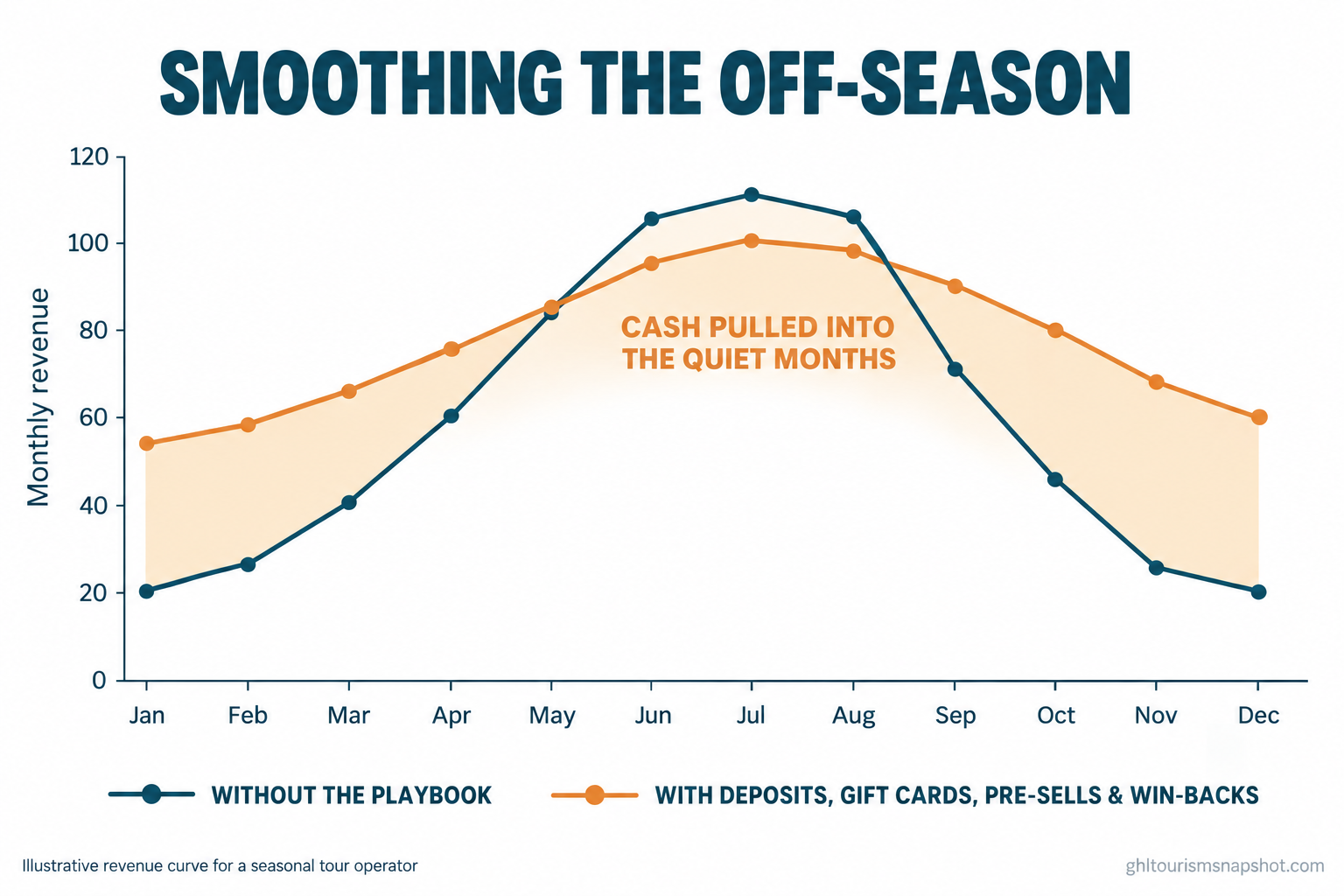
So the job is not to book more summer. It is to move money out of the peak and into the trough. Every lever below either pulls cash forward from a future trip, or pulls a past customer back at almost no cost.
Illustrative revenue split for a weather-exposed seasonal tour operator, by quarter. The exact shape varies by destination; the point is the peak-to-trough gap the levers below are built to fill.
The six levers that keep cash coming in
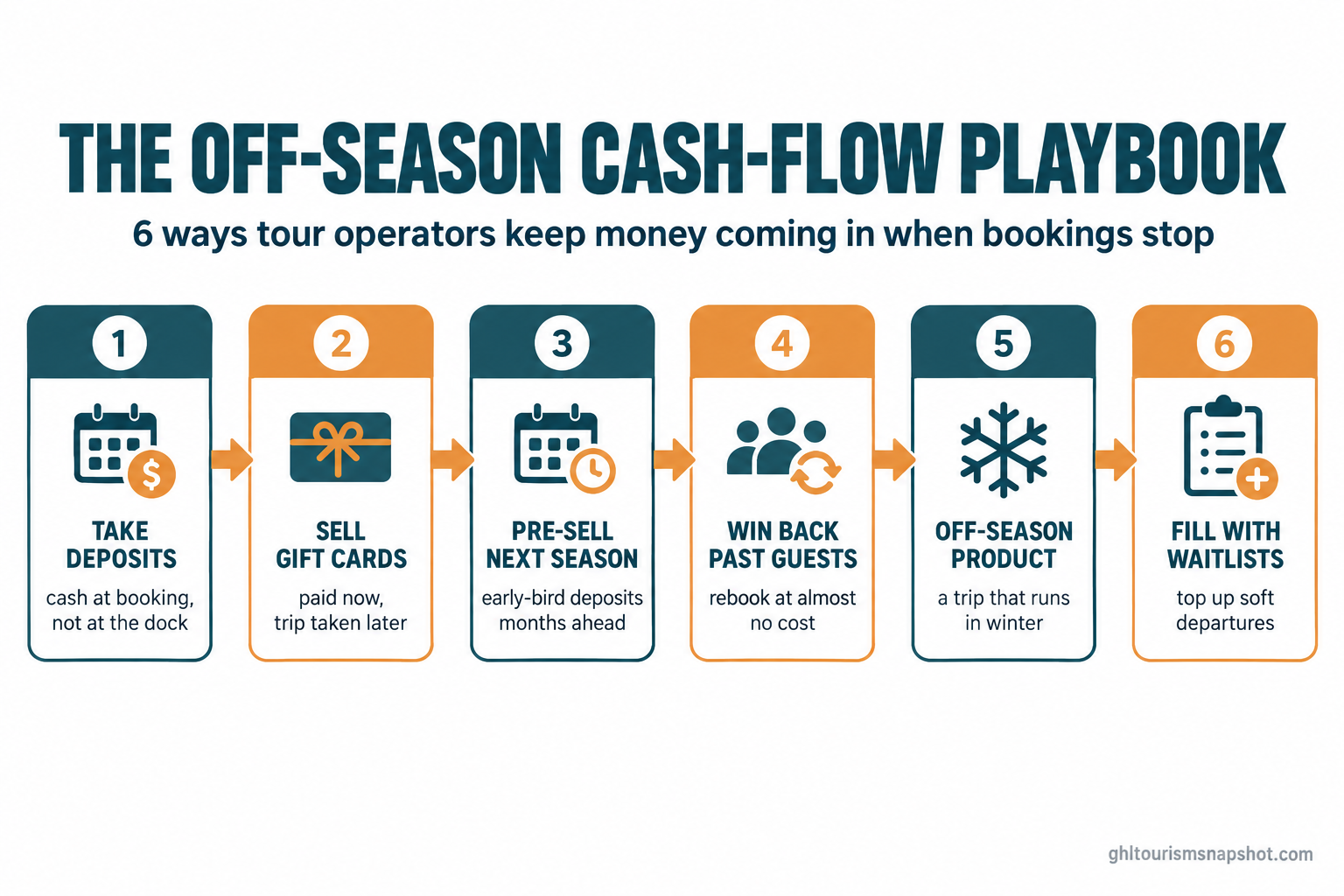
You do not need all six at once, and you do not build them in a busy July. Pick the two or three that fit your business and set them up in the shoulder weeks:
- Take deposits so money lands at booking, not at the meeting point.
- Sell gift cards so cash comes in now for trips taken later.
- Pre-sell next season with early-bird offers that bank deposits months ahead.
- Win back last season’s travelers with a targeted offer.
- Build one off-season product that runs when your main tours cannot.
- Fill the gaps with waitlists and holds.
Lever 1: Take deposits and pull cash forward
If you still take full payment on the day of the tour, you are handing yourself a cash-flow problem for free. A deposit moves part of the sale into your account the moment someone books, and makes that booking far more likely to happen. Restaurants see this plainly: reservations that carry a deposit average a 1.7% no-show rate, and deposits can cut no-shows by as much as half (Tock). A seat with skin in the game shows up, so the deposit is also one of the cleanest ways to cut no-shows without nagging people.
Set a deposit of 20% to 50% at booking, with the balance charged automatically from a card on file before departure. For a summer trip booked in spring, that deposit is a buffer through the slow months.
How this breaks: you set a deposit but collect the balance by hand, so the day before every trip you are texting people for money instead of prepping gear. Automate the balance charge and name the date in the confirmation, so nobody is surprised.
Lever 2: Sell gift cards and vouchers
A gift card is the purest off-season cash instrument you have. Someone pays full price today for a trip that happens whenever the recipient gets around to it, and a “day on the water” makes a far better present than another sweater. The demand is already there: 43% of US adults hold at least one unused gift card, worth an average of $244, up from $187 in 2023 (Bankrate).
Run your push where the buying already happens: the weeks before the winter holidays, Valentine’s Day, Mother’s and Father’s Day, and graduation. Sell them straight off your website through your own checkout and booking system so the money hits your account instantly and the recipient books later. A quieter benefit: a share of gift cards are never redeemed, so that cash stays yours with no trip to run.
How this breaks: you sell gift cards but have no clean way to redeem them, so a guest shows up in July with a code nobody can find. Track every card as a real balance in your CRM so redemption is a two-second lookup at the meeting point.
Lever 3: Pre-sell next season with early-bird offers
Your travelers already book ahead. In 2025, 60% of travelers bought tour and attraction tickets at least three days in advance, and 17% of tour bookers purchased at least a month out (Arival). That habit is a cash-flow gift. Open next season’s calendar in the depths of this off-season, and give people a reason to commit now: a locked-in current-year price, a small early-bird discount, or priority pick of dates.
The mechanics match a deposit, just further ahead. Someone books a June trip in February, pays a deposit, and you have banked cash in your worst month against a trip that costs nothing until summer. Promote it to your warmest audience, past guests and your email list.
How this breaks: you open early-bird bookings but bury the deadline, so there is no urgency and people file it under “later.” Give the offer a firm end date, send a reminder in the last 48 hours, and cap the discounted spots so the scarcity is real.
Lever 4: Win back last season’s travelers
The cheapest booking you will ever make is from a guest who already loved a trip with you. Winning back a past customer costs a fraction of finding a new one, and small lifts in retention move profit hard: a 5% increase in retention can raise profits by 25% to 95% (Harvard Business Review). If you guided 800 people last summer and even a slice rebook or send a friend, you have filled next season without spending a dollar on ads.
The catch is that most operators never capture the contact details, because the booking lived on an OTA that owns the customer. If your travelers come through a third party, reclaiming the direct relationship is the prerequisite for any win-back at all. Once you have their email and phone with consent, send a warm, specific message: not a blast, but “you did the fall foliage paddle last October, here is first look at next year’s dates.” Segment by the trip they took and the message writes itself. This is the heart of a good repeat-booking system.
How this breaks: you send one generic “we miss you” email to your whole list and it lands flat. Segment by last trip taken and by recency, then send an offer that fits, and the same list produces several times the bookings.
Lever 5: Build one product that runs in the off-season
Sometimes the answer is a trip that works when your main one cannot. If your flagship is weather-locked, find a version that survives the cold, the dark, or the rain. A kayak outfitter adds a guided winter wildlife walk. A food-tour operator runs a holiday-market crawl in December and a cozy indoor “tastes of the neighborhood” tour in January. A brewery-tour company leans into private groups, corporate outings, and gift experiences that fill weeknights the public calendar never touches.
You do not need a second business, just one repeatable off-season product that covers your fixed costs through the trough. Private and corporate bookings are especially useful, because a single company outing can be worth ten public seats and often books midweek, precisely when you are otherwise empty. Keep a “book a private or corporate experience” option on your site year-round.
How this breaks: you invent an off-season product but never tell anyone, so it launches to silence. Announce it to your existing list first, before you spend a cent reaching strangers.
Lever 6: Fill the gaps with waitlists and holds
Even a quiet season has demand you are leaving on the table. When a shoulder-season departure looks soft, a waitlist and a last-minute offer can top it up. Let travelers join a waitlist for sold-out or unscheduled dates, then trigger an automatic message the moment a seat opens. Pair that with a standing “locals’ midweek” list that gets first crack at soft departures at a modest discount, and you turn empty seats into cash instead of running half full.
This is the same muscle that fills last-minute empty seats in peak season, just pointed at the thinner months. It runs on its own: a seat opens, the system texts the waitlist, someone books, and you never touched it.
How this breaks: you keep the waitlist in your head or a notebook, so when a seat opens you forget to work it. Keep the list in your CRM and let the open-seat trigger send the message automatically.
Steal these: the exact messages to send
Adapt these to your voice, trip names, and dates, then load them into your automations.
Deposit balance reminder (SMS, 5 days before the trip):
Hi {first name}, your {tour name} is on {date}. The remaining balance of {amount} will run on the card on file {date}. Reply here if anything’s changed. See you soon! {operator name}
Gift-card holiday push (email):
Subject: Give a day they’ll actually remember
Sweaters get returned. A {signature experience} doesn’t. Our gift cards never expire on the fun part, pick any amount or a set trip, and they book whenever suits them. Order by {date} for the holidays. {link}
Early-bird pre-sell (SMS to past guests):
{first name}, next season’s dates are open early. Book by {date} and lock this year’s price plus first pick of departures. A deposit holds your spot, balance later. Grab yours: {link}
Win-back, segmented by last trip (email):
Subject: First look at next year’s {trip they took}
Hi {first name}, you joined us for the {trip} last {season}, one of our favorite mornings of the year. We just opened next season’s dates and wanted you to have first pick before we announce them publicly. Same crew, a couple of new stops. Want back on? {link}
Solo, mid-size and large: how the plan scales
The six levers are the same at every size. What changes is how many you run and how much you automate.
The solo operator (a one-person kayak or walking tour). Your time is the scarce resource, so pick the two highest-impact levers and automate them fully. Take a deposit on every booking, and run a gift-card push before the winter holidays. Both bank cash without adding an hour to your week, and both can live entirely inside an automated booking and messaging system. Skip the custom off-season product until you have staff.
The mid-size shop (1 to 3 year-round staff, seasonal guides). This is where win-back and pre-sell earn their keep. Segment your list of past guests and run a targeted win-back plus an early-bird pre-sell each off-season, then add one off-season product to cover fixed costs. The risk at this size is systems that do not talk, so a gift card sold on the website never reaches the CRM. Consolidating onto one platform instead of a patchwork is what makes the whole thing run without you.
The large operator (multiple guides, high volume, several trip types). Now it is about segmentation and yield. Run all six levers, with win-back and pre-sell segmented by trip type and recency, waitlists on every soft date, and an active off-season product line. At volume, small percentage gains are big dollars: shaving your no-show rate and lifting rebookings a few points each beats one more summer ad campaign. The whole apparatus has to be automated, because nobody runs it by hand at scale.
The compliance you cannot skip
Moving money around the calendar touches a few rules. This is an operations guide, not legal advice, so confirm the specifics for your state and see our fuller tour operator compliance checklist.
Selling trips in advance and issuing gift certificates can trigger Seller of Travel registration in some states. Florida requires annual registration (a $300 fee) plus a surety bond and can fine violators, and California requires registration with the number shown in your advertising (Florida Dept. of Agriculture & Consumer Services). Gift cards are regulated too: many states restrict expiration dates and dormancy fees, so “never expires” is often the safe and legal default.
The messages above are marketing texts and emails, which means TCPA and A2P 10DLC for SMS and CAN-SPAM for email. Only contact people who opted in, register for A2P 10DLC before sending campaign texts, include a clear opt-out, and honor STOP instantly. A win-back blast to a scraped list is how you earn a complaint instead of a booking.
Common objections
“Won’t off-season discounts cheapen my brand?” Only if you discount the trip itself. Most levers here do not: a deposit is not a discount, a gift card sells at full price, and an early-bird trades a small price hold for an early commitment. Save real discounts for soft last-minute seats, where a booking at 80% beats an empty seat at 100%.
“I don’t have time to build all this.” You do not build it in season, and you do not build it by hand. Automating deposits, gift cards, pre-sells, and win-backs means you set them up once, in a quiet week, and they run for years. A weekend now against a saved season later.
“I already use FareHarbor, Checkfront, or Rezdy for bookings.” Keep taking bookings there. Those tools process a reservation; they do not run a gift-card campaign, segment your past guests, or fire a win-back sequence. The marketing and cash-flow layer sits alongside your booking software and pulls in the customer data so you can act on it. Many operators run a dedicated CRM and automation platform like GoHighLevel next to their booking tool for exactly this. (That is our GoHighLevel partner link; if you start a plan through it we may earn a commission, at no extra cost to you.)
“What if I can’t deliver a trip someone pre-paid or gifted?” Publish a clear policy up front: gift cards and pre-sells are transferable and rebookable, and your weather-cancellation terms cover a scrubbed departure with a reschedule or credit. Honest terms before the sale keep a pre-payment from becoming a chargeback later.
FAQ
How much deposit should a tour operator take?
A deposit of 20% to 50% at booking is common, with the balance charged automatically from a card on file before the trip. Deposit reservations average a 1.7% no-show rate, so the deposit protects the sale as well as your cash flow.
Do gift cards really help off-season cash flow?
Yes. A gift card is paid in full today for a trip taken later, so the cash lands in your slow months. Demand is strong: 43% of US adults hold an unused gift card worth $244 on average (Bankrate, 2024). Sell them off your own site so the money hits your account instantly, and track every balance in your CRM.
When should I open early-bird bookings for next season?
In the depths of your current off-season, when you most need the cash. Most travelers book ahead anyway (60% buy tour tickets at least three days in advance, per Arival), so an early offer with a price hold and a hard deadline converts that habit into deposits banked in your worst month.
Is it worth marketing to past guests instead of finding new ones?
Almost always. A 5% lift in retention can raise profits 25% to 95% (Harvard Business Review), and winning back a past guest costs far less than acquiring a new one. The prerequisite is owning the contact details, which means capturing direct bookings rather than letting an OTA keep the customer.
Do I need special software to run these off-season plays?
You need a way to take deposits, sell and track gift cards, hold customer contacts with consent, and send automated email and SMS. A booking tool alone rarely does all of that, which is why many operators run a CRM and automation platform alongside it. The Tourism Snapshot installs the whole set into GoHighLevel for you.
The November Tuesday from the top of this page does not have to feel like a slow-motion emergency. The operators who sleep through the off-season moved money into it on purpose: a deposit banked in spring, gift cards sold in December, early-birds committed in February, last year’s guests already rebooked. Set the systems up once, and let the quiet months pay for themselves.