
If you run tours in San Francisco and your website isn’t booking trips, the problem usually isn’t traffic — it’s conversion. A San Francisco tour website turns into a booking machine when it loads fast, sells the trip on the first screen, shows the price and the proof a traveler needs, lets them book from a phone in three taps, and answers the moment they raise a hand. Get those right and the same visitors you already have start converting into confirmed seats instead of bouncing back to the search results and booking with Viator.
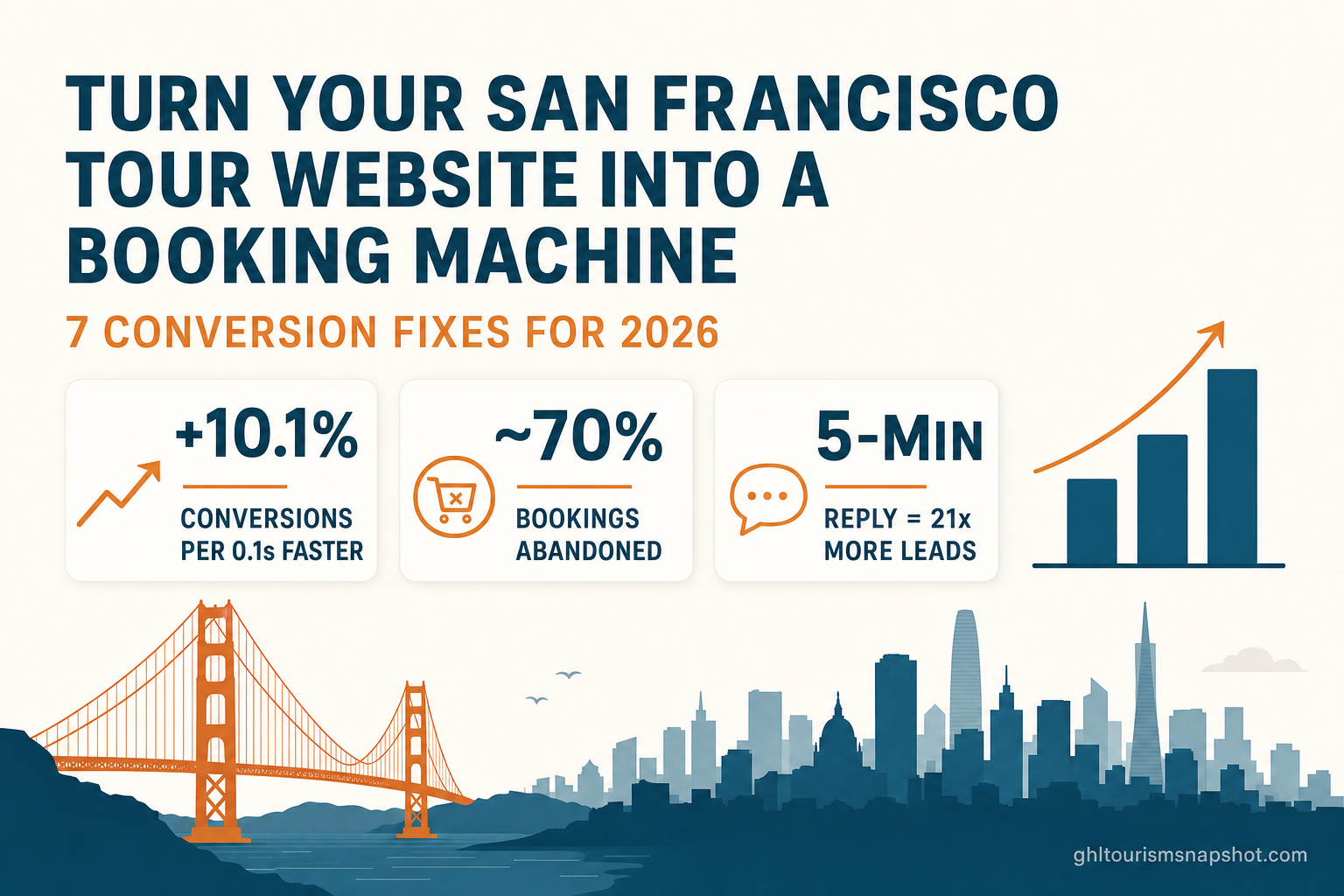
This is the operator-to-operator version: what a low-converting site actually costs a San Francisco tour business, backed by real 2026 data, and the seven fixes that move the needle — in the order that matters. It pairs with our companion guides on page speed and platform choice; here we focus on the thing those set up — turning a visitor into a booking.
Why your San Francisco tour website isn’t converting
Start with the honest benchmark: travel and tours convert low. Where a general ecommerce store runs around a 2–3% conversion rate, travel sites — a high-consideration, compare-three-options, come-back-twice purchase — often sit closer to 0.2%–0.7%, with a “good” rate around 2%+ (Littledata). That sounds bleak-y, and it is. But it’s also the opportunity: when your baseline is under 1%, a handful of conversion fixes can double booked seats without spending a dollar more on traffic.
San Francisco makes the stakes concrete. The city hosted 23.3 million visitors in 2024, including 2.3 million international travelers, who together spent $9.26 billion (SF Travel). A large share of those people are standing at Fisherman’s Wharf or scrolling in a Union Square hotel lobby with a phone, three other bay-cruise or Alcatraz-adjacent operators one tap away, deciding right now who to hand a card to. Your website is the storefront for that decision — and most operator sites quietly lose it.
The reason a good tour with real reviews still doesn’t book online is almost never the tour. It’s friction: a site that loads slowly on foreign data, a first screen that buries the trip, a price the traveler can’t find, no proof they can trust, a booking form built for a desktop, and no reply when they finally reach out. Each one bleeds a percentage of ready-to-book visitors. Fix them in order and the leaks close.
The real cost of a low-converting SF site
Two numbers frame the cost. First, abandonment: documented online cart abandonment averages ~70% across a meta-analysis of dozens of studies (Baymard Institute), and travel — with its research-heavy, comparison-shopping journey — ranks among the highest-abandoning sectors of all (SaleCycle). Seven in ten people who start to book a tour don’t finish on the first go.
Second, the alternative you’re paying for. When your own site doesn’t convert, the booking doesn’t vanish — it goes to an online travel agency and rents your customer back to you. Online travel agencies captured roughly a third of experiences bookings and rising while operators’ own-website share slipped, and OTA commissions typically run 20–30% of the ticket (Arival). Every booking you convert on your own site is a booking you don’t pay a fifth-to-a-third of away — which is exactly why closing website friction is one of the highest-ROI moves a tour operator can make. (We go deeper on the OTA math in Direct Bookings for Tour Operators.)
Here’s the useful part: the reasons travelers abandon are overwhelmingly things you control.
Top reasons buyers abandon checkout (share of abandoners citing each). Source: Baymard Institute.
None of that is a traffic problem. It’s a conversion problem — and the seven fixes below hit each cause directly.
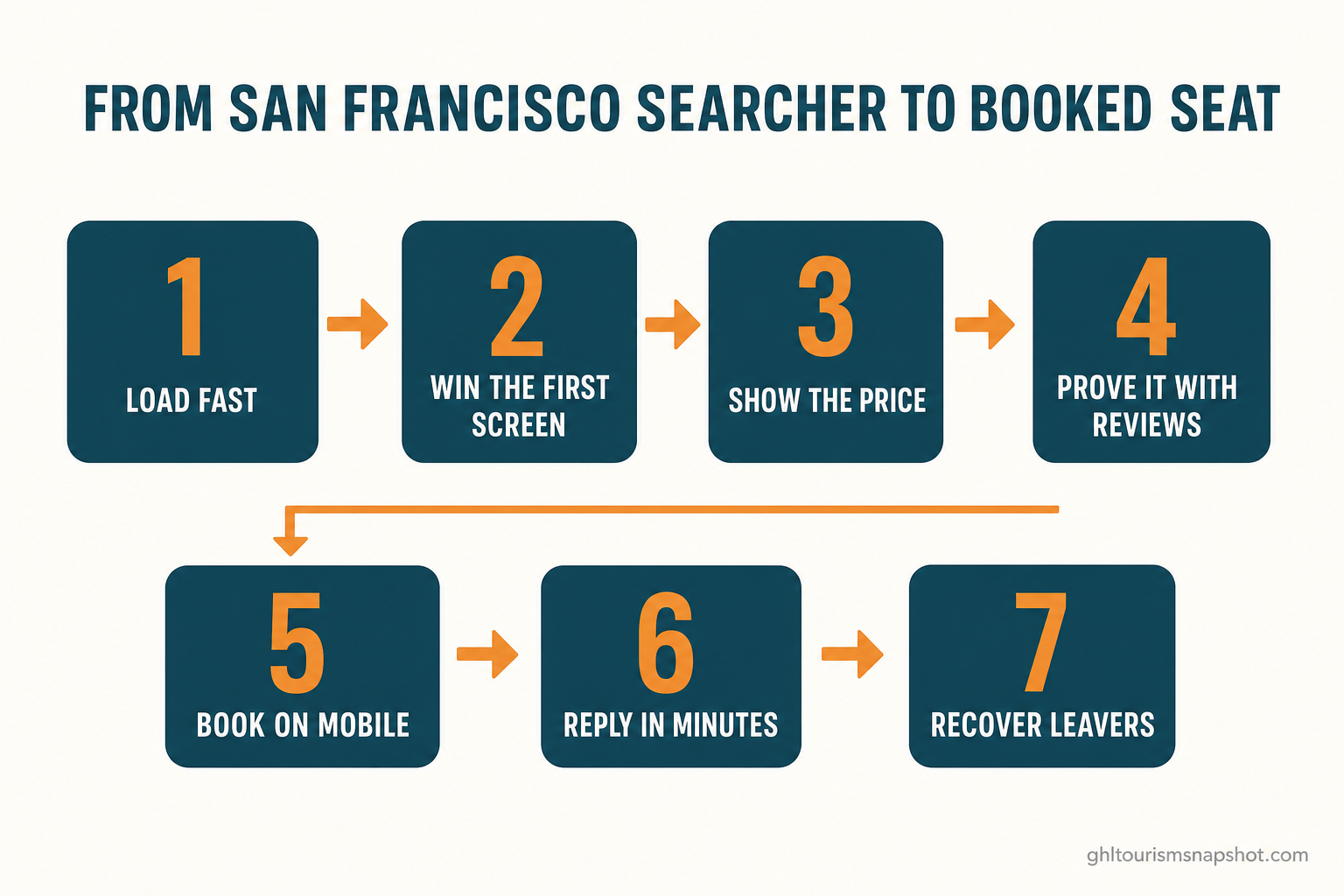
The 7 conversion fixes that book more trips
Fix 1 — Load in under 2.5 seconds
Speed is the first conversion filter because a page that hasn’t loaded can’t convert. 53% of mobile visits are abandoned when a page takes longer than 3 seconds to load (Think with Google), and the flip side is the strongest travel stat there is: a 0.1-second mobile speed gain lifted travel conversions by 10.1% (web.dev / Deloitte). For an international visitor on hotel Wi-Fi or foreign data, WordPress plugin bloat, a heavy page builder, or a GoHighLevel-built page can be the whole difference. Target a Largest Contentful Paint under 2.5 seconds and a 90+ PageSpeed score on mobile. Our step-by-step fast tour website guide covers the how.
Fix 2 — Win the first screen
A traveler decides in seconds whether your page is worth their attention. The first screen — no scrolling — has one job: say what the trip is, where it leaves, roughly what it costs, and give one obvious way to book. That means your signature San Francisco tour, a real photo of the route or viewpoint, a one-line promise (“Small-group Alcatraz-and-bay sunset sail, 2 hours, hotel-area meeting point”), and a single high-contrast Book / Check availability button. Not a slideshow. Not a paragraph of history. One clear trip, one clear action.
The first screen, before and after
A stock hero slideshow, a menu of nine tours, a welcome paragraph, and 'Contact us' as the only action. The traveler has to hunt for the price and the next departure.
One signature tour, a real route photo, a one-line promise with duration and meeting point, this week's per-person price, and a single high-contrast 'Check availability' button — above the fold, on a phone.
Fix 3 — Show the price (and the total)
The single biggest checkout-killer is hidden or surprise costs — cited by 48% of people who abandon (Baymard Institute). Travelers are already doing the math before they contact you: what does it come to for four adults and two kids on Saturday, with the transfer? If your site hides the number until an email exchange, most people leave and go price a competitor who shows it. Put per-person pricing on every tour page, and add a trip-total calculator by party size and date so the traveler gets the full number up front — and you capture their party size and dates as a qualified lead in the same motion.
Fix 4 — Prove it where the decision happens
Around three-quarters of consumers regularly read online reviews for local businesses before choosing one (BrightLocal, 2024), and a quarter of people who abandon a checkout do so because they don’t trust the site with their card (Baymard Institute). For a first-time visitor handing over a card for a trip they’ve planned for months, proof is the deciding factor. Put it at the decision point, not on a buried “Testimonials” page: your star rating and review count next to the Book button, two or three specific recent quotes on the tour page, trust marks (secure checkout, free cancellation window, licensed/insured), and real photos of your actual guides and departures. Keeping that review flow full is its own system — see Get More 5-Star Reviews.
Fix 5 — Make booking mobile-first and frictionless
Travelers research tours on phones far more than they book on them — and that gap is exactly the leak. In tours and activities, roughly 62% of searching happens on mobile, but only around 46% of bookings do (PhocusWire / TourScanner). People want to book on the phone in their hand; clumsy mobile checkout pushes them to “later” — and later often means a competitor. Close the gap: big tap targets, a booking flow that fits a thumb, no forced account creation (a 26% abandonment cause on its own), autofill-friendly fields, and Apple Pay / Google Pay so a card never has to be typed.
Travelers browse tours on mobile more than they book on it — the friction gap to close. Source: PhocusWire / TourScanner.
Fix 6 — Reply in minutes, not hours
Not every traveler books on the spot; many ask a question first — “Is Thursday’s 9am sold out?” “Is the walk okay for my parents?” The window to convert that hand-raise is brutally short. Contacting a web lead within 5 minutes makes you ~21× more likely to qualify it than waiting 30 minutes (MIT / Lead Response Management), and firms that respond within an hour are 7× more likely to qualify than those an hour slower (Harvard Business Review). For SF operators taking inquiries from six time zones, a human can’t sit on chat at 3am. A website chat widget and AI voice/text agent that answer instantly — confirm seats, quote the total, and book the call — turn after-hours curiosity into a booking instead of a missed one. (More on the clock in Speed to Lead for Tour Operators.)
Fix 7 — Recover the ones who leave
Even a great site loses most first attempts — remember, travel abandonment runs high. The difference between operators is what happens next. If a visitor starts a booking or an inquiry and drops, an automated follow-up — a text and email within minutes, then a gentle nudge the next day — recovers a real slice of otherwise-dead bookings. That only works if the enquiry is captured into a CRM the second it happens, with the party size and dates attached, so the sequence can fire on its own. This is the backbone of the Abandoned Booking Recovery playbook.
Your San Francisco conversion checklist
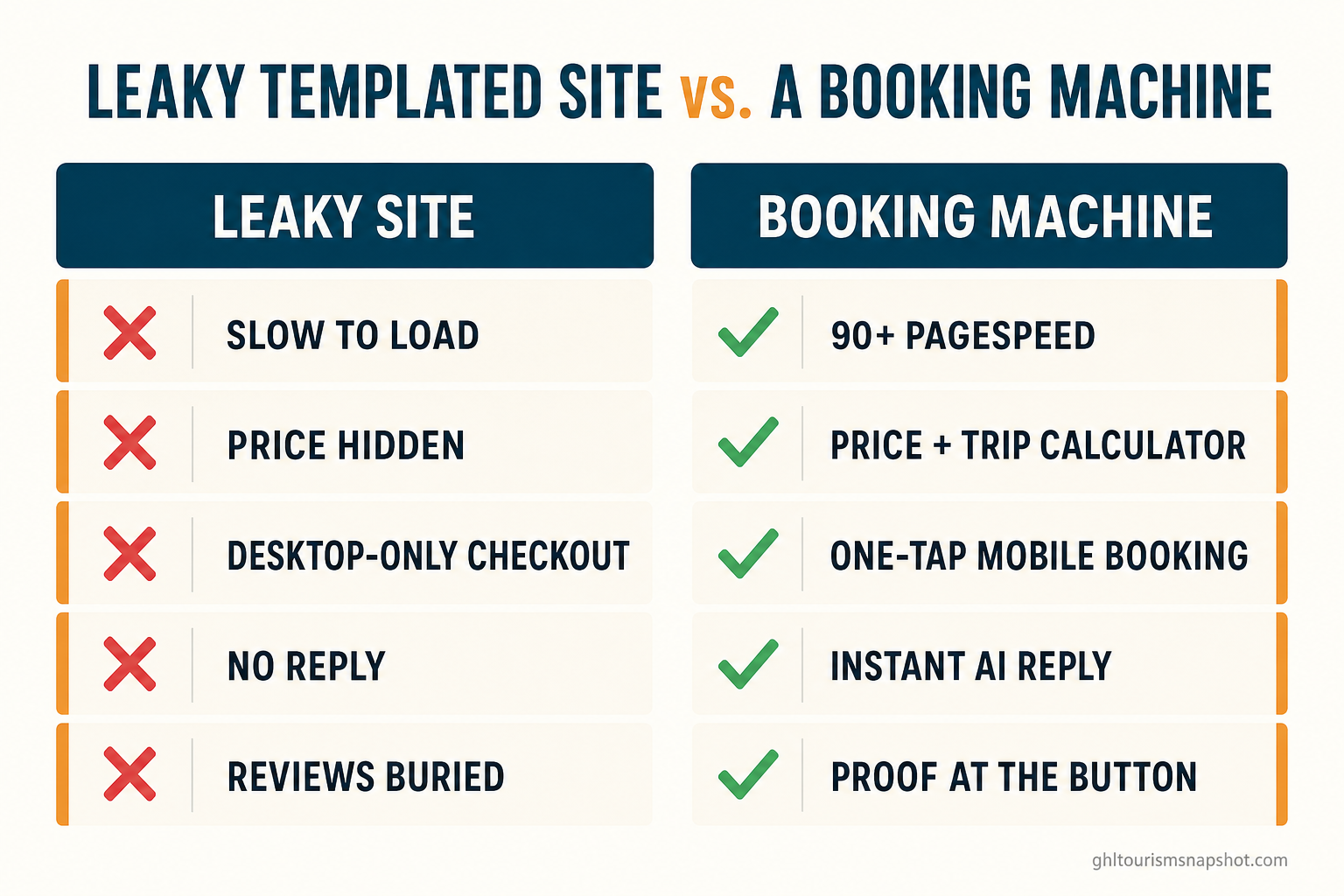
Run your own site against this, top to bottom. Each unchecked box is a measurable leak:
- Loads in under 2.5s on mobile, 90+ PageSpeed — no plugin/page-builder bloat.
- First screen sells one trip: signature tour, real photo, one-line promise, one Book button.
- Price is visible on every tour page, with a trip-total calculator by party size and date.
- Proof at the decision point: star rating + review count and a specific quote beside the button.
- Mobile booking is one-thumb: big tap targets, no forced account, Apple Pay / Google Pay.
- Inquiries get an instant reply via chat + AI agent, 24/7, across time zones.
- Drop-offs are recovered with automated SMS + email, fired from a CRM that captured the lead.
- Every enquiry lands in your CRM with party size and dates attached.
DIY vs. a done-for-you booking machine
You can absolutely do this yourself. The fixes aren’t secret — they’re speed, clarity, price transparency, proof, mobile UX, and instant follow-up. What stops most operators isn’t knowledge; it’s that the busy season is exactly when the site needs work and exactly when you have no time to give it, and that stitching a fast site to a booking calculator, a review flow, a chat widget, and an abandonment-recovery sequence is a real build.
That’s the gap our Get a Website service fills for tour operators: an Astro-built site that clears a 90+ PageSpeed score on mobile, real destination and tour pages written to rank and to convert, a trip-total calculator, weekly rate updates so the price is never stale, and every enquiry delivered into whatever CRM you already run — from $97/mo plus a $447 one-time build fee, live in about a week. Pair it with the AI reply and recovery automations from the Tourism Snapshot and the seven fixes above stop being a to-do list and start being how your site runs by default. Prefer to think it through with a person first? Talk to us.
FAQ
Frequently asked questions
What's a good conversion rate for a tour operator website?
Travel and tours convert lower than general ecommerce because it's a high-consideration purchase — often in the 0.2%–0.7% range, with a strong rate around 2%+ (Littledata). Because the baseline is low, fixing friction like speed, price visibility, and mobile checkout can meaningfully multiply booked seats without more traffic.
Why do San Francisco travelers abandon my booking?
The most common reasons are fixable UX: hidden or surprise costs (48% of abandoners), being forced to create an account (26%), not trusting the site with a card (25%), and a checkout that's too long or complex (22%), per Baymard Institute. Show the full price up front, drop forced accounts, add trust signals, and shorten the flow.
How much does page speed actually affect bookings?
A lot. A 0.1-second improvement in mobile load time lifted travel-site conversions by 10.1% in Deloitte and Google's study (web.dev), and 53% of mobile visits are abandoned when a page takes over 3 seconds to load (Think with Google). For international SF visitors on foreign data, speed is often the whole decision.
Should San Francisco tour operators optimize for mobile first?
Yes. In tours and activities roughly 62% of searching happens on mobile but only about 46% of bookings do (PhocusWire / TourScanner) — that gap is friction. One-thumb checkout, no forced account, and Apple Pay / Google Pay close it, especially for in-destination travelers booking on the phone in their hand.
Is it better to convert on my own site or use OTAs like Viator?
Both have a place, but your own site is far cheaper to convert on. OTAs take roughly 20–30% commission and have been capturing a rising share of experiences bookings (Arival). Every booking your website converts directly is one you don't pay a fifth-to-a-third of away — see our direct bookings guide.
How fast do I need to reply to a website inquiry?
Within five minutes if you can. Contacting a web lead within 5 minutes makes you about 21× more likely to qualify it than waiting 30 minutes (MIT / Lead Response Management). Since no human covers every time zone at 3am, a chat widget plus an AI agent that answers, quotes, and books instantly is how SF operators hit that window.
Editorial note: GHL Tourism Snapshot is a GoHighLevel automation and services product, not a travel agency. We don’t sell, book, or guarantee any tour. Statistics are drawn from the cited sources and reflect industry or study averages; your results will vary with your offer, market, pricing, and traffic.
Related posts
- How to Build a Fast, Bookable Tour Website in Dallas — the speed foundation that Fix 1 depends on.
- Astro vs WordPress vs Wix for Orlando Tour Websites — the platform choice behind a fast, editable site.
- Direct Bookings for Tour Operators — the OTA-commission math that makes converting on your own site pay.
- Abandoned Booking Recovery for Tour Operators — the follow-up system behind Fix 7.
- Speed to Lead for Tour Operators — why the first five minutes decide the booking.
Ready to turn your San Francisco tour website into a booking machine? See Get a Website, explore the full Tourism Snapshot pricing, or talk to a real person about your SF tours.