
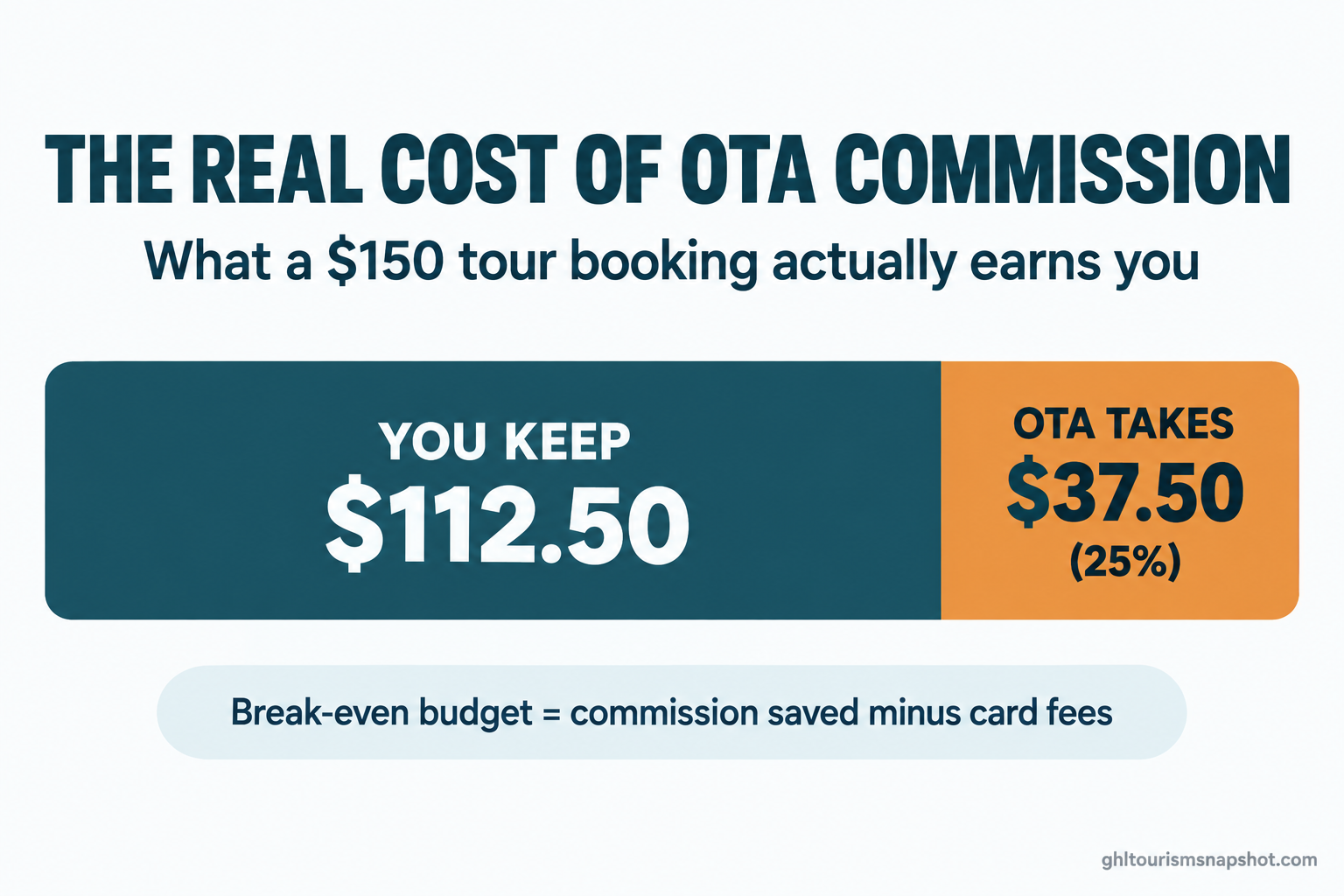
It is the end of the month and you are reconciling payouts. A kayak tour sold for $150 on Viator, the traveler showed up, had a great time, left a five-star review. Then you see the payout: $112.50. The other $37.50 went to the OTA. Do that 300 times a season and you have handed a booking site more than $11,000 for customers who were going to book a kayak tour anyway. Here is the short answer: an OTA booking is worth keeping only when the cost of winning that same customer yourself is higher than the commission you are paying, and for most operators that break-even point sits around $30 to $130 per booking depending on your ticket price. This post gives you the exact formula and a worksheet so you can stop guessing and run your own number tonight.
We work with tour operators, so we look at this the way you do: not “are OTAs good or bad” but “what is this costing me per booked seat, and at what point does doing it myself win.”
What OTAs actually cost you in 2026
An OTA (online travel agency) is a booking marketplace like Viator, GetYourGuide, or Tripadvisor. You list your tour, they show it to travelers, and when someone books you pay a cut. The deal sounds fair until you see the size of the cut.
Viator charges operators a reported 20 to 30 percent commission per booking, with a typical rate around 25 percent (TicketingHub). It gets worse if you want to be seen: Viator’s Accelerate program lets operators voluntarily raise their own commission above the standard rate to buy higher search placement, so the operators paying 30 percent and up outrank the ones paying the base rate. You are not just paying commission, you are bidding against your competitors with it.
GetYourGuide is in the same band. Standard rates run 20 to 35 percent, and in June 2025 the company told many operators their commission was going up, with some rates moving from 20 percent to 30 percent effective that July (Arival). The stated reason was “fairness and current market conditions.” The real effect is a bigger slice of every booking.
Compare that to the cost of taking the money yourself. Stripe, the most common processor, charges 2.9 percent plus 30 cents per online card payment (Stripe). On a $150 booking that is $4.65. The OTA on the same booking takes $37.50 at 25 percent. The gap between $4.65 and $37.50 is the money you are paying the OTA to find the customer for you.
That gap is the whole game. Some travelers truly found you through the OTA and would never have found you otherwise, and those bookings earn their commission. But a large share of OTA bookings are people who could have booked direct, saw your tour on the marketplace, and clicked the first “book now” button they found. You paid 25 percent for a customer you already had. The job is to tell the two apart and win back the second group for less than the commission costs you.
The break-even formula every operator should know
Here is the only calculation you need. It answers one question: how much can I spend on marketing to win a direct booking before the OTA route becomes cheaper?
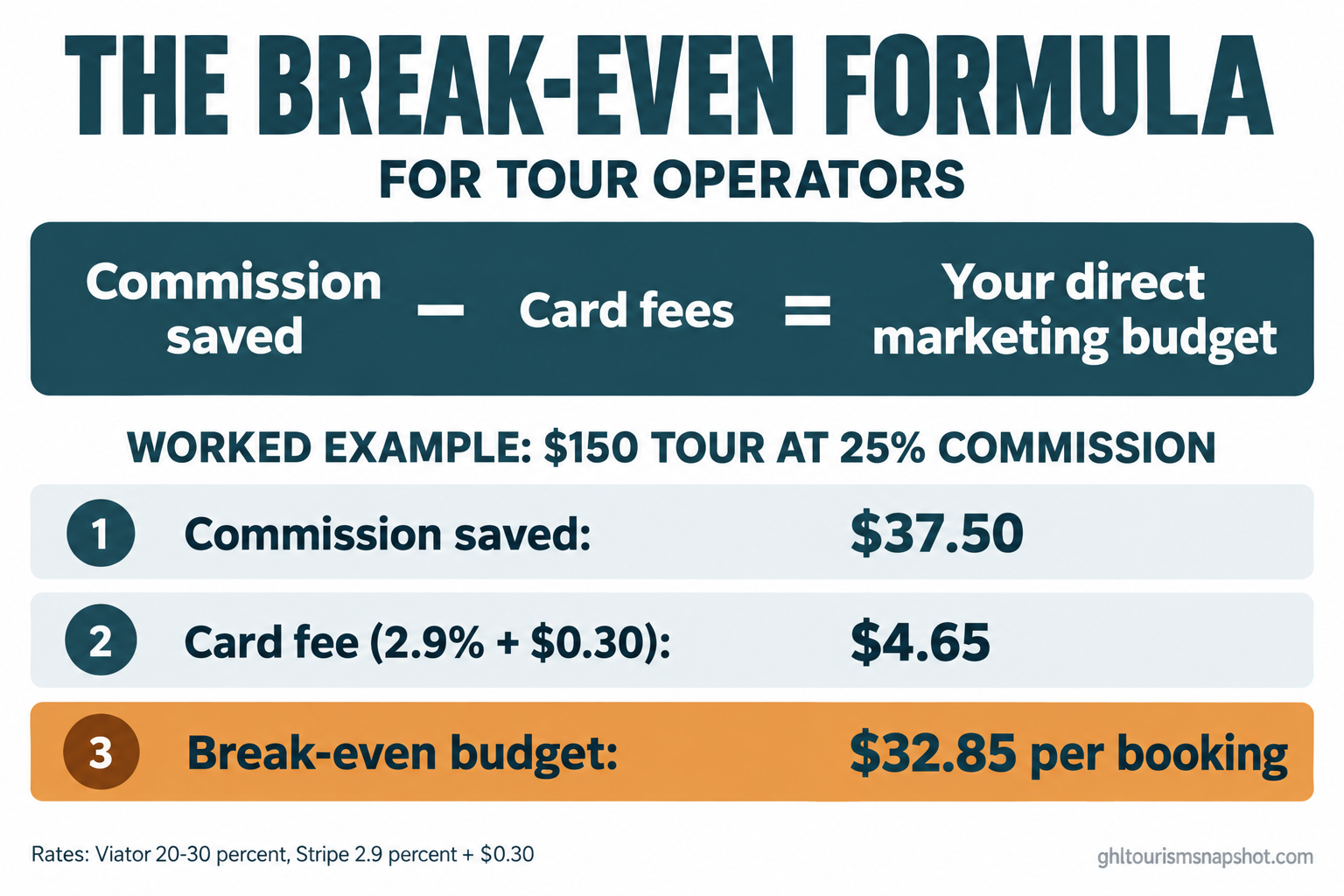
Let us run it on a $150 kayak tour at a 25 percent commission.
- Commission you would save going direct: $150 × 0.25 = $37.50
- Cost to process the card yourself: $150 × 0.029 + $0.30 = $4.65
- Break-even marketing budget: $37.50 − $4.65 = $32.85 per booking
So if you can get a traveler to book that $150 tour directly for less than $32.85 in ad spend, email cost, or whatever else you use to reach them, you come out ahead. That is a generous ceiling. A $32.85 cost to acquire a booking is not hard to beat with repeat customers, email, Google Business Profile, or word of mouth, all of which cost far less than $33 a head.
The number climbs fast with ticket price, because the commission is a percentage but your processing cost barely moves. Here is the break-even marketing budget at four common price points, all at 25 percent commission.
Break-even marketing budget per booking, in dollars, at a 25% OTA commission and Stripe’s 2.9% + $0.30 processing fee. The higher your ticket price, the more you can afford to spend winning the booking yourself. (Author calculation using Viator commission rates and Stripe pricing.)
A $600 private charter gives you about $132 of marketing room per seat. You could run paid ads, pay a referral fee, and send a gift card and still beat the OTA. A $75 walking tour gives you about $16, which is tighter but still beatable with low-cost channels. The lesson is simple: the pricier your experience, the more aggressively it pays to drive direct bookings.
Run the numbers: solo, mid-size, and large operator
The formula is per booking. The decision is annual. Let us scale it up for three real operator shapes so you can find the one closest to yours. We will assume a 25 percent blended OTA commission in each.
The solo operator. You run a single kayak or walking tour, do about $120,000 a year in bookings, and roughly 40 percent of that comes through OTAs. That is $48,000 of OTA sales, so your annual commission bill is about $12,000. For a one-person shop, $12,000 is a guide’s seasonal wages. Shifting even half of those bookings to direct, at a realistic $25 acquisition cost, keeps roughly $6,000 in your pocket.
The mid-size operator. You run several daily departures, do about $500,000 a year, and 50 percent flows through OTAs. That is $250,000 of OTA sales and a commission bill near $62,500 a year. At this size the OTA is effectively a full-time employee you pay $62,500 to send you emails. The break-even math says you could hire an actual marketing person, build an email list, and run a booking funnel for a fraction of that and still move a big chunk of volume direct.
The large operator. You run a fleet, do $1.2 million a year, and 55 percent comes through OTAs. That is $660,000 of OTA sales and a commission bill around $165,000. At this scale the OTA relationship is your single largest line item after payroll, and a 10-point shift from OTA to direct is worth more than $30,000 a year.
Estimated annual OTA commission bill by operator size, assuming a 25% blended commission on 40%, 50%, and 55% of revenue respectively. (Author calculation based on Viator and GetYourGuide commission rates.)
Notice the pattern. The commission bill is not a fixed cost like rent, it grows exactly as fast as you do. The bigger you get, the more the OTA earns from you, and the more a direct-booking system is worth. This is why the growth in the industry is with operators, not agencies: tour and travel guide jobs are projected to grow 8 percent from 2024 to 2034, while travel agent roles grow just 2 percent (BLS, BLS travel agents). The reseller middle is flat. The operators who own their customer are where the money is going.
The hidden costs on both sides (where this breaks)
The formula is clean, but real life has edges. Here is where the simple math misleads you, in both directions, and what to do about it.
Where the OTA side costs more than the commission. The headline rate is not the whole bill. Viator’s Accelerate and GetYourGuide’s Boost both let you pay extra for visibility, so your effective rate creeps above the standard number without you noticing. OTAs also own the customer relationship. You often do not get the traveler’s real email or phone, which means you cannot rebook them next season without paying commission again. One OTA booking can quietly become five years of OTA bookings for the same person. When you run the formula, use your real blended rate including any visibility spend, and remember that a direct booking is a customer you keep, while an OTA booking is one you rent.
Where the direct side costs more than it looks. The trap on the direct side is assuming marketing is free because you are “doing it yourself.” Your time has a cost. If you spend ten hours a week posting and answering DMs and value your time at $40 an hour, that is $400 a week going into direct bookings whether or not you wrote it down. Count it. The other hidden cost is leakage: a slow or clunky booking page loses the customer you paid to attract, and they go book on the OTA anyway.
Where speed decides it. The biggest hidden cost in direct bookings is slow response. A traveler who messages you on a Saturday and hears nothing until Monday has already booked a competitor, often through an OTA, because the OTA replied instantly. Responding to a lead in the first five minutes is the difference between a direct booking you keep and a commission you pay. If you cannot answer fast by hand, that is exactly the job automation is for.
Where no-shows wreck the math. A direct booking that no-shows costs you the seat and the acquisition spend with nothing to show. OTAs often enforce stricter cancellation terms than a small operator does on their own site. If you move bookings direct without a deposit and a reminder sequence, your no-show rate can climb and eat the commission you just saved. Cutting no-shows with deposits and reminders is part of the direct-booking system, not a separate project.
Steal this: the one-page break-even worksheet
Run your own number in five minutes. Fill in the blanks with your real figures.
The fastest way to pull line 6 down is to rebook people who already traveled with you, because they cost almost nothing to reach. Here is the exact text to turn a past traveler into a direct booking. Send it by SMS about a week after their trip, once the good feeling is fresh.
And the email version, for travelers who gave you an address. This one does the quiet work of moving next season’s booking off the OTA.
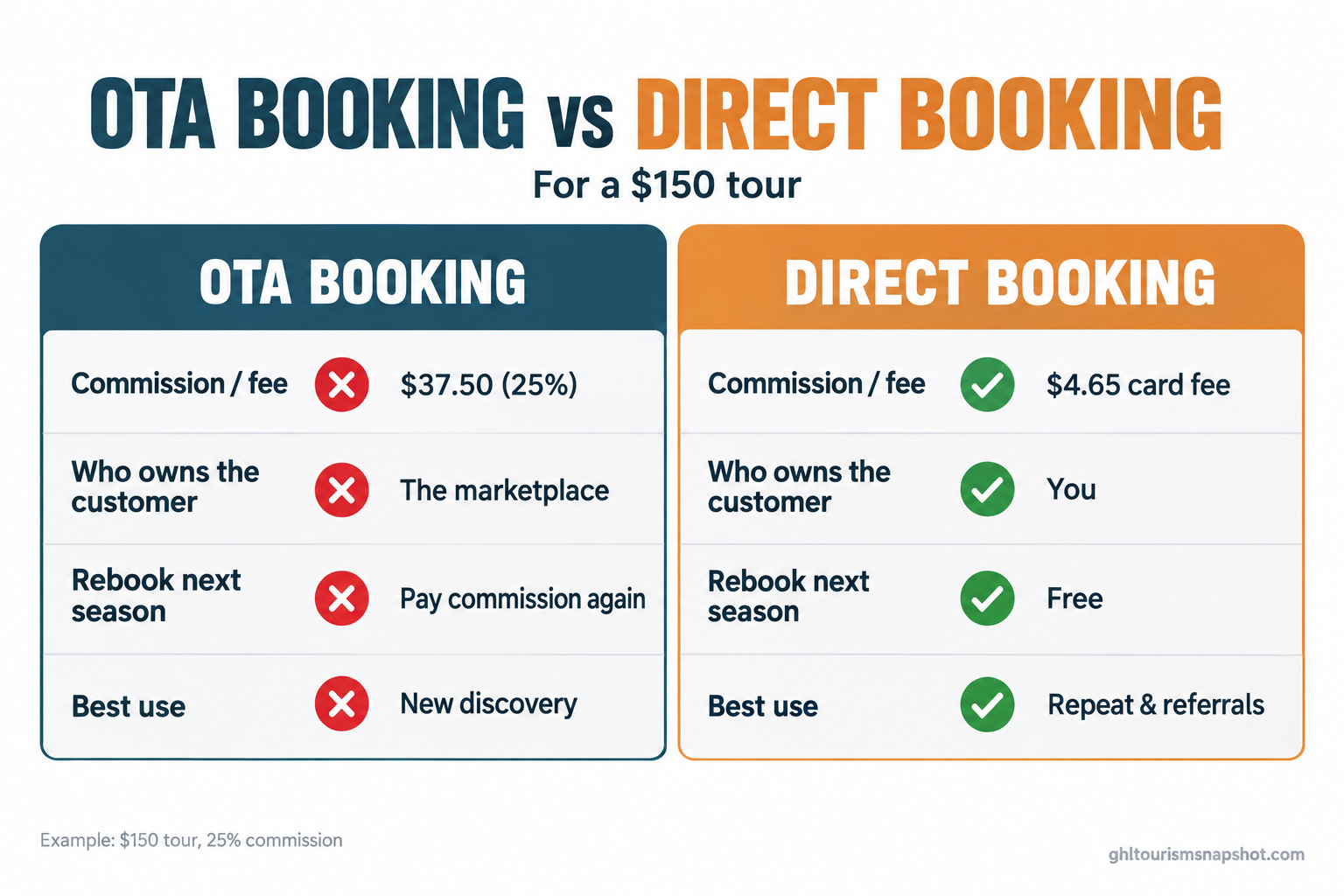
That 15 percent discount is not a loss. You were paying the OTA 25 percent, so a 15 percent direct discount still leaves you 10 points ahead, and now you own the customer for next time. That is the entire strategy in one message: pay the traveler instead of the marketplace.
 To make it run without you remembering to hit send, you need the contact details captured and the messages triggered automatically. For the full playbook on moving volume off marketplaces, see our guide on winning more direct bookings, and if you want to see where booking tools themselves hide per-booking fees, read what tour booking software actually costs.
Common objections
“But the OTA brings me customers I would never reach.” True for some of them, and those bookings are worth every cent of commission. The point of the worksheet is not to quit OTAs, it is to stop paying 25 percent for customers you already had. Keep the OTA for genuine discovery. Win back the repeat and referral bookings direct, where the acquisition cost is near zero.
“I’m not a marketer, I run tours.” You do not need to become one. The cheapest direct bookings come from people who already love you: past travelers, their friends, and anyone who finds your Google Business Profile. A reminder text and a win-back email, sent automatically, beat most paid ads on cost. That is a system you set up once, not a skill you have to learn.
“Setting up my own booking funnel sounds expensive and technical.” It can be, if you stitch together five tools by hand. It does not have to be. A done-for-you system puts the booking page, payment, confirmations, reminders, and win-back messages on one platform for a flat cost, with no percentage skimmed off each sale. Compared to a $62,500 annual commission bill, a one-time setup is the cheap option. See the FareHarbor alternatives for small operators for how the flat-cost route compares.
“If I discount direct bookings, am I just moving the cost around?” No, because the numbers do not match. OTA commission is 20 to 30 percent. A direct discount of 10 to 15 percent still leaves you ahead, and unlike commission, a discount is a one-time cost that buys you a customer you can rebook for free forever. Commission is rent. A direct discount is a down payment.
FAQ
Questions tour operators ask about OTA commission
How much commission does Viator take?
Viator charges operators a reported 20 to 30 percent commission per booking, with a typical rate around 25 percent. Its Accelerate program lets operators voluntarily pay more than 30 percent to rank higher in search, so your effective rate can be higher than the standard band if you buy visibility.
Is GetYourGuide cheaper than Viator?
Not meaningfully. GetYourGuide's standard commission runs 20 to 35 percent, and in 2025 the company raised many operators to 30 percent. Both marketplaces sit in roughly the same 20 to 30 percent range, so the choice between them is about audience and tools, not a lower fee.
What is my break-even cost for a direct booking?
Take the commission you would save by going direct (your booking value times your commission rate) and subtract your card processing cost (about 2.9 percent plus 30 cents with Stripe). The result is the most you can spend on marketing per booking and still break even. On a $150 booking at 25 percent, that ceiling is about $32.85.
Should I stop using OTAs entirely?
No. OTAs are worth their commission for genuine discovery, travelers who would never have found you otherwise. The goal is to keep OTAs for new reach and win back repeat and referral bookings direct, where your acquisition cost is near zero. Use the worksheet to decide channel by channel.
Does a direct discount cancel out the savings?
No. OTA commission is 20 to 30 percent, so a direct discount of 10 to 15 percent still leaves you several points ahead on the sale, and it buys you a customer you can rebook for free next season instead of paying commission again.
What does it take to run direct bookings without hiring staff?
You need three things working automatically: a booking page that takes payment and a deposit, instant confirmations and pre-trip reminders to cut no-shows, and a post-trip text and email that ask for a review and offer a direct rebooking. Set up once, those run on their own and cost far less per booking than OTA commission.
The OTA is not the enemy. It is a sales channel with a price, worth paying only when what you are buying is worth more than the cost. Run your break-even number tonight. For most operators, the moment they see their annual commission bill next to a flat-cost direct system, the decision makes itself.