
It is 7:10am on a Saturday in the middle of your season. You have three departures today, two guides scheduled, and a text just landed: “Sorry, I’m not going to make it in today. Or this week. I’m gonna step back for a bit.” No notice, and 46 people booked across the morning. You are now the guide, the driver, the dispatcher, and the phone, all at once. The fix is not a frantic Craigslist post at 7am. It is a staffing system you build in the quiet months: a pipeline you keep filling, an onboarding that makes a new guide useful in two weeks, and a few small retention moves that stop your best people from walking in July.
Staffing is the part of the business almost no booking tool touches. You can automate every reservation and still watch a season fall apart because a guide quit. Most of that pain comes from doing staffing one crisis at a time. Put it on a calendar instead, and the crises mostly stop.
Why keeping guides is the hardest job in tours right now
Two facts sit uncomfortably next to each other. First, the field is growing. The US Bureau of Labor Statistics projects tour and travel guide employment to grow 6% between 2025 and 2035, faster than the average job, on a base of about 62,200 guides earning a median of $38,120 a year (BLS). Travel agents, the older model, show little or no change over the same decade (BLS). People want guided experiences, which is good for your bookings and bad for your roster: every operator in town is fishing for the same guides.
Second, you are hiring in the hardest sector to hold onto people. Leisure and hospitality leads every US industry in quits, month after month, well above the private-sector average (BLS JOLTS). The work is seasonal, weather-exposed, often part-time, and draws students and travelers who were never staying forever. You are not failing when a guide quits in July. The job is to build a business that expects the churn and runs anyway.
A mid-season quit costs more than a shift. The replacement starts at zero, and the real bill is recruiting, training hours, and a quality dip across a dozen departures, all at the worst time.
Annual pay for US tour and travel guides, 2025. Source: U.S. Bureau of Labor Statistics. The spread is the point: a guide you can grow toward the top has a reason to stay.
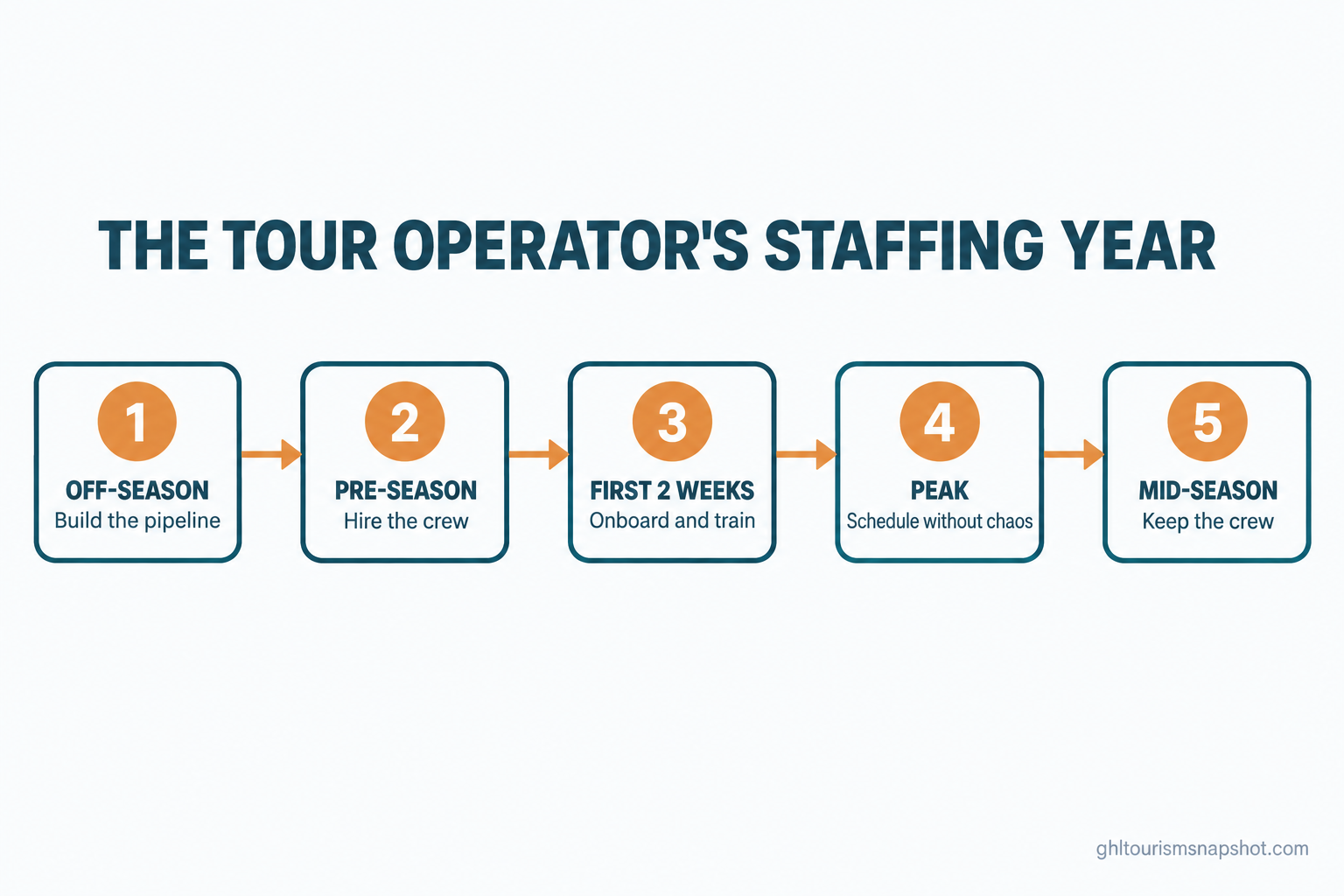
The staffing year: five stages on a calendar
Staffing feels chaotic because most operators only think about it when a shift is on fire. Put it on a calendar and it becomes a predictable set of jobs, each with its own season.
- •Off-season
Build the pipeline
Keep a running list of past guides, applicants, and referrals.
- •Pre-season
Hire for the season
Post early, interview for reliability, and make offers before you need bodies.
- •First 2 weeks
Onboard and train
A checklist and a shadowing path that gets a new guide confident fast.
- •Peak
Schedule without chaos
Publish shifts ahead, confirm by text, and make swaps easy.
- •Mid-season
Keep the crew
Check in, pay on time, catch resentments before they become resignations.
- •Wind-down
Offboard for returns
End the season well so your best people come back.
Stage 1: Build the pipeline before you need it
The biggest staffing mistake is treating hiring as an emergency. The operators who never panic-hire are always quietly recruiting, even with a full roster. In your slow months, when you are also working the off-season for cash flow, spend an hour a week keeping a living list of people you could call: guides who left on good terms, strong applicants you could not hire last year, the names that keep coming up. A simple pipeline in your CRM beats a fading memory, so when a shift opens you send three warm texts instead of starting a cold search.
How this breaks: you tell yourself you will “remember who was good,” then by hiring season two of the three names you recall have moved away. Write it down the week someone impresses you.
Stage 2: Hire for the season, not the day
Post your roles weeks before you need bodies, because every other operator is posting too and the good ones go first. In the interview, reliability beats charisma: a guide who shows up on time and prepared every time beats a brilliant storyteller who no-shows twice a month, like the student “free all summer” who disappears at exams.
Hire slightly ahead of demand. If you need four guides, try to land five, because one will fall through and one may quit, and a small bench is the difference between a covered Saturday and a 7am crisis. Make offers fast, the same way speed to lead wins you customers.
How this breaks: you wait until the first warm week to start, so you interview in a panic and take whoever says yes. Desperation hiring is how you train someone in June who you replace in July.
Stage 3: The first two weeks decide the season
A new guide decides whether they are staying in roughly their first two weeks, and so do you. Most operators wing it, hand over a script, point at a van, then act surprised when the guide is gone by August.
Build a real onboarding path. A checklist covers the mechanics: paperwork, safety training, the route, the stories, weather, an injured or angry guest. Pair it with a shadowing ladder, watch two trips, co-guide two, then lead one with a senior guide along. Automate the admin so it happens: a welcome sequence that sends the handbook, schedule, and forms before day one, so the first morning is about guiding, not paperwork.
How this breaks: onboarding lives in your head, so it is thorough when you have time and nonexistent when you are slammed. Write it down once, and every hire gets the same solid start.
Stage 4: Schedule without chaos
When the season hits, scheduling becomes the daily grind that eats your mornings. Publish the schedule as far ahead as you can, because a shift dropped at 9pm for 7am is a fast way to lose people. Confirm every shift by text the day before, so a missed shift is rare. And make swaps easy: a guide who can hand off cleanly when life happens is a guide who stays, while one forced to choose between their kid’s recital and their job just quits.
This is where automation earns its place: the same system that texts a customer a booking reminder can text a guide their shift confirmation, nudge an unconfirmed one, and ping the bench when a hole opens.
How this breaks: the schedule lives in a text thread only you can follow, so gaps show up when nobody arrives. Keep the roster and confirmations in one place everyone can check.
Stage 5: Why they quit and how to keep them
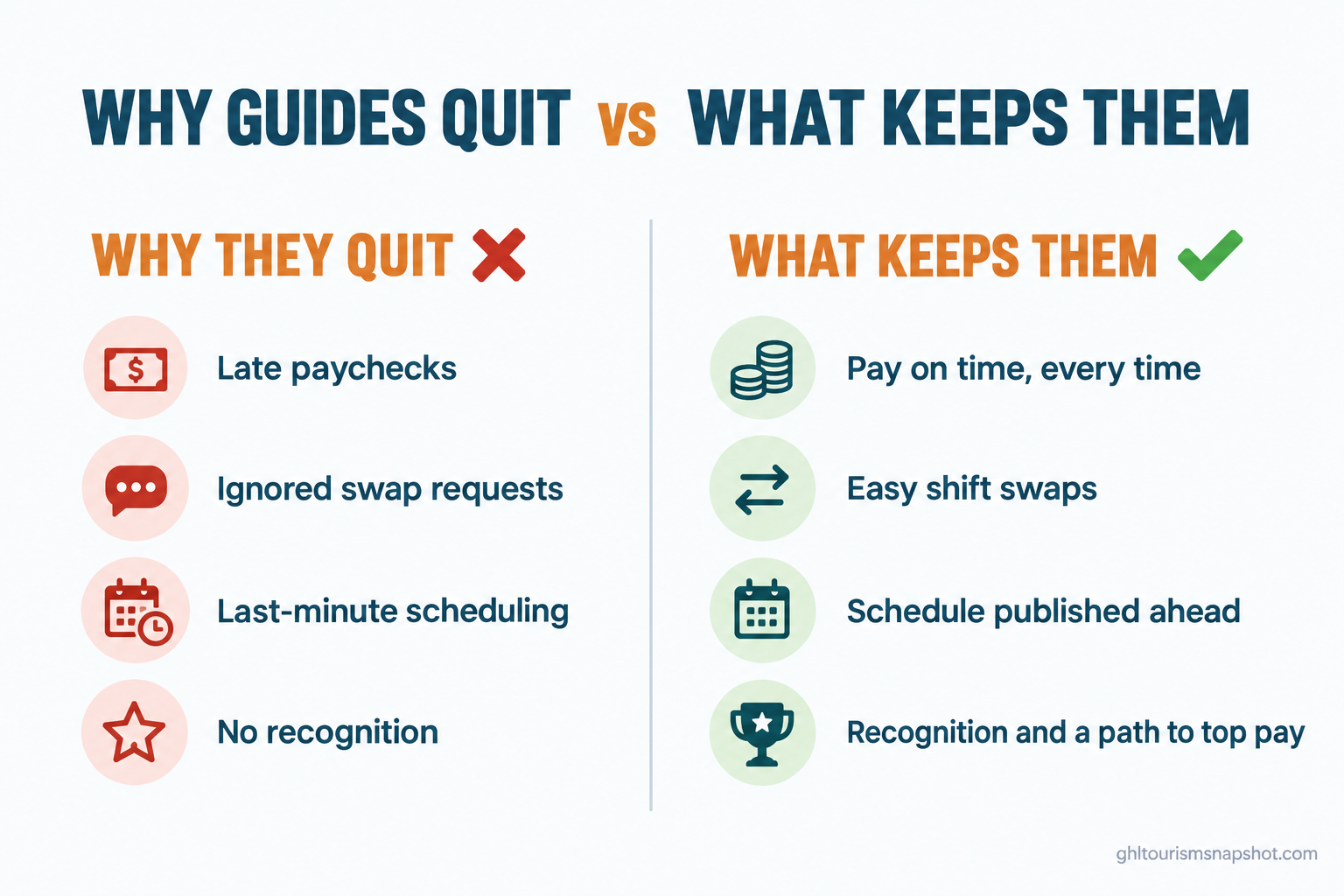
This is the stage that decides your season, and the one most operators handle worst. By midsummer the novelty is gone, everyone is tired, and small resentments nobody addressed in June turn into resignations in July. People rarely quit over one big thing. They quit over a pile of small ones: the paycheck that was late twice, the ignored swap request, the sense nobody notices good work.
The fixes are not expensive, just consistent. Pay on time, every time, because a late paycheck to someone earning near the median guide wage is not an annoyance, it is rent. Notice good work out loud; a text after a great review that names the guide lands hard. Do a real mid-season check-in with each guide, then fix one thing they mention. Catch the small stuff and most of your crew stays.
A word on pay, because no reminder sequence fixes a wage that does not cover someone’s life. The operators who keep guides pay toward the top of their local band (which runs to about $60,930, per BLS) and offer a path up. Software buys you the time to be a good boss. It does not replace being one.
How this breaks: you assume no news is good news, so you never check in, and the first you hear of a problem is the resignation. A standing mid-season check-in turns silent resentment into fixable feedback.
Stage 6: Offboard so they come back
The cheapest guide you will ever hire is the one who already worked for you and liked it. A returning guide needs almost no training and is productive on day one, which makes how you end the season a staffing investment.
Do an exit conversation with everyone, even the seasonal folks you expect back. Thank them specifically, say plainly that you want them back, and give a rough date you will reach out. Keep the door open with first pick of shifts for returners, and keep that alumni list in your CRM right next to your win-back list for past travelers. The logic is identical: a warm past relationship beats a cold new one, guest or guide.
How this breaks: the season ends, everyone scatters, and you do not reach out until you are panic-hiring in spring, by which point your best returners have taken other jobs. A single “save the date” in late winter keeps them yours.
Steal these: the messages that hold a crew together
Adapt these to your voice and names, then load them into your automations.
New-hire welcome (SMS or email, before day one):
Hi {first name}, welcome to the crew! First day is {date} at {time}, meet at {location}. I’ve emailed the handbook and safety forms, please skim them first. Wear {dress} and bring {items}. Text me with questions. Glad to have you. {owner name}
Shift confirmation (SMS, day before):
Hey {first name}, confirming your shift tomorrow: {tour} at {time}, {number} guests. Reply Y to confirm or call me if anything’s changed. Thanks!
Open-shift fill to the bench (SMS blast):
Crew, {date} {time} just opened up, {tour}, {number} guests. First to reply gets it, paid at {rate}. Who’s in?
Mid-season check-in (personal text, not automated):
Hi {first name}, you’ve been crushing it this season and I appreciate it. Got 15 minutes this week for a quick coffee? Want to hear how it’s going and what I can do better. On me.
End-of-season thank-you and save-the-date (SMS):
{first name}, that’s a wrap on the season, thank you for everything. Guests noticed. I’d love you back next year and I’ll reach out around {month} with dates. Stay in touch. {owner name}
Solo, mid-size, and large
The stages are the same at every size. What changes is how many people you juggle and how much you lean on systems instead of memory.
The solo operator or independent contractor. You may be the only guide, or working under a host agency. Your staffing problem is a capacity problem: you are the single point of failure, and one sick day cancels a trip. Build a tiny bench before you need it, one or two trained backups you can call on a freelance basis, so a fever is not a refund.
The mid-size shop (1 to 3 year-round staff, seasonal guides). This is where the playbook matters most and where things usually fall apart: enough people to need a system, not enough to afford a manager who runs it. The risk is scattered tools, applicants in email, schedule in a group chat, training in your head. Pulling hiring, onboarding, scheduling, and team messaging onto one platform instead of a patchwork keeps the season off your memory. If admin is still eating your week, a trained VA handling the front office frees you to manage the crew.
The large operator (many guides, multiple trip types). At volume, staffing is a pipeline you run continuously, not a seasonal sprint. Retention shows up directly in your margins, because a few points of extra churn is a real payroll line in constant recruiting. Formalize everything: a standing pipeline, a fixed onboarding path, scheduled check-ins, and clear pay bands with a path up, so your best guides stay rather than leave for the operator across town.
The employment rules you cannot skip
Hiring people brings rules that hiring software does not. This is an operations guide, not legal advice, so confirm specifics with an employment attorney or your accountant, and see our broader tour operator compliance checklist.
The one that trips up most operators is worker classification. It is tempting to call every seasonal guide a 1099 contractor to skip payroll taxes, but the US Department of Labor uses an economic-reality test under the Fair Labor Standards Act, and a guide you schedule, train, and direct usually looks like an employee (U.S. Department of Labor). Getting it wrong means back taxes and penalties. Overtime is part of the same law: non-exempt employees are generally owed time-and-a-half past 40 hours a week. You also verify work authorization for every hire with Form I-9 (USCIS).
If your local labor pool is genuinely too thin, the H-2B visa covers seasonal nonagricultural workers, and tourism roles can qualify. It is capped at 66,000 visas a year, with 35,000 supplemental visas added for fiscal 2026, and the first-half 2026 cap was reached early (USCIS). It is slow and paperwork-heavy, so treat it as a plan-ahead option, not a mid-season fix.
Common objections
“Guides just quit, there’s nothing I can do.” Some churn is structural, and the BLS turnover data says you are not imagining it. But “some” is not “all.” The operator who loses a guide a week and the one who keeps the same crew for five seasons hire from the same labor market. The difference is the basics done consistently: pay on time, schedule ahead, notice good work.
“I don’t have time to build hiring systems.” That is the trap. You are too busy because you have no systems, so every day is reactive. Automation breaks the loop: the hours you save not chasing the same confirmations are the hours you spend hiring ahead and checking in with your crew.
“Do I need special software for this?” You need a place for your applicant pipeline and alumni list, a way to send onboarding and shift messages automatically, and one calendar everyone can see. A spreadsheet and a group chat work at the smallest scale but fall apart fast with a real crew. Many operators run a platform like GoHighLevel for the customer side and lean on the same system for team messaging. (That is our GoHighLevel partner link; if you start a plan through it we may earn a commission, at no extra cost to you.)
FAQ
Why do tour guides quit mid-season?
Rarely one big thing. It is a pile of small ones: late paychecks, ignored swap requests, last-minute scheduling, and never being recognized. Leisure and hospitality has the highest quit rate of any US industry (BLS JOLTS), so some churn is structural. The preventable part is paying on time, scheduling ahead, and checking in before resentment becomes a resignation.
Should seasonal tour guides be W-2 employees or 1099 contractors?
Usually W-2 employees. The US Department of Labor applies an economic-reality test under the FLSA, and a guide you schedule, train, and direct typically counts as an employee, not a contractor. Misclassifying to dodge payroll taxes can mean back taxes and penalties, so confirm your situation with an employment attorney or accountant.
Can I hire foreign workers as seasonal tour guides?
Potentially, through the H-2B visa for seasonal nonagricultural workers, which tourism roles can qualify for. It is capped at 66,000 a year, with supplemental visas in some years, and caps are often reached early. It is slow and paperwork-heavy, so plan ahead rather than use it as a mid-season fix.
How do I get seasonal guides to come back next year?
End the season well. Do an exit chat with everyone, thank them specifically, say you want them back, and give a rough date you will reach out. Keep the door open with a save-the-date and first pick of shifts for returners. A returning guide needs almost no training, so a warm alumni list is one of the highest-return moves you have.
Does automation actually help with staffing, or just customer bookings?
Both. The system that sends customers confirmations and reminders can send guides shift confirmations, nudge unconfirmed ones, run onboarding sequences, and ping the bench when a shift opens. More importantly, automating customer admin frees the owner's hours, which is what lets you hire ahead and manage the crew instead of firefighting.
Back to that 7am Saturday. The operators who never get that text are not luckier than you, and they are not hiring from a better pool. They built a pipeline in the quiet months, onboarded properly, published the schedule ahead, paid on time, and ended last season by asking this year’s crew back. It just has to happen on a calendar instead of in a crisis, and the admin that stops you from getting to it can run itself.