
Your booking software takes the booking and then goes quiet. FareHarbor, Rezdy, Bokun, Checkfront, and Peek Pro are excellent at the transaction — availability, seats, deposits, waivers — but they were never built to send review requests, recover no-shows, follow up on inquiries, or win back last season’s travelers. For a Charlotte tour operator, that gap is where the money leaks: bookings pile up in a system that can’t market you, so the highest-value work in travel — turning one trip into a review, a referral, and a rebooking — simply doesn’t happen. A two-way GoHighLevel integration closes that gap by piping every booking into a CRM that does market you, automatically.
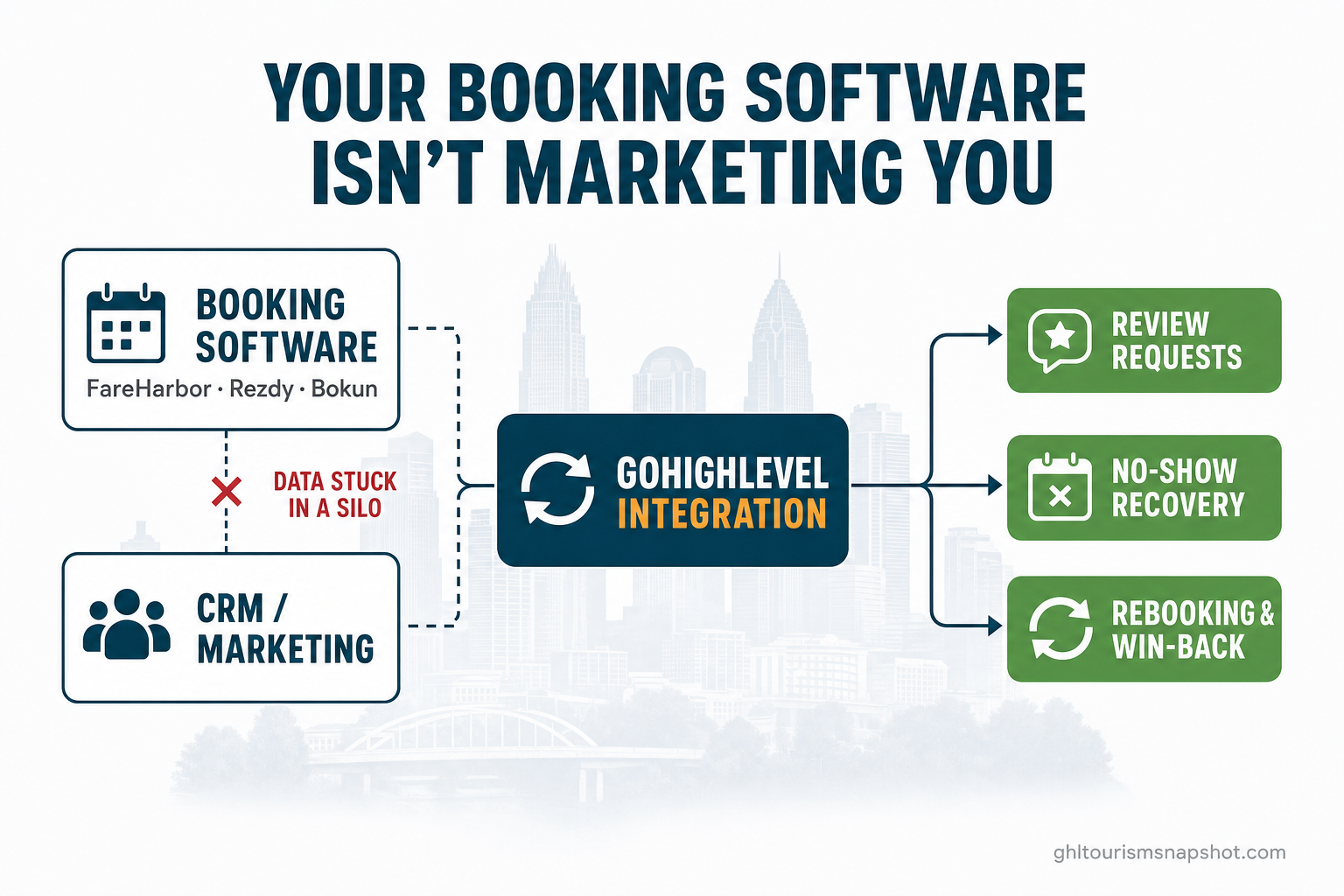
This is a straight, practical guide for tour and activity operators in Charlotte and across the Carolinas — not a sales pitch for switching platforms. We’ll put real 2026 industry data next to the problem, show exactly what the disconnect between your booking tool and your marketing costs a travel business, and explain what a proper GoHighLevel integration does differently. If you’d rather run trips than wire up APIs, the last section covers how to get it done for you.
Booking software books — it doesn’t market you
Ask what your booking platform is for and the honest answer is: taking the booking. FareHarbor, Rezdy, Bokun, Checkfront, and Peek Pro are very good at that job — live availability, seat counts, deposits, waivers, manifests, channel distribution. That’s reservation software, and it earns its place.
But look at the work that actually compounds a tour business, and almost none of it is a booking:
- Asking every happy traveler for a Google review at the right moment — and catching unhappy ones privately first.
- Texting a reminder the night before so the seat you sold actually shows up.
- Recovering a no-show or an abandoned checkout with a nudge instead of a shrug.
- Following up on the inquiry that came in at 9 p.m. before a competitor answers it.
- Winning back last season’s travelers with an offer, at near-zero acquisition cost.
That’s marketing and lifecycle work, and your booking software doesn’t do it. It was never supposed to. So operators end up with a reservation tool on one side, a pile of spreadsheets, a personal inbox, and maybe a half-wired email tool on the other — and a canyon in between. Bookings land on one side of the canyon; the growth work waits on the other, and mostly never gets done.
The Charlotte context: a big market, one tap away
Charlotte is not a small pond. Visitors to Mecklenburg County spent a record $6.4 billion in 2024 — the most of any county in North Carolina — supporting nearly 38,000 direct tourism jobs (Charlotte Regional Visitors Authority). Statewide, travelers spent a record $36.7 billion, keeping North Carolina the fifth most-visited state in the country with around 40 million visitors (NC Department of Commerce).
That’s the good news and the pressure at once. There is real demand moving through Charlotte — history and NASCAR tours, brewery and food crawls, day trips to the mountains and the lake — but there is also a wall of operators and OTA listings competing for the same phone-in-hand traveler. In that market, the operator who responds first, reminds reliably, and shows up with the most fresh 5-star reviews wins the booking. Every one of those is a follow-up action — and follow-up is exactly what dies in the gap between your booking tool and your marketing.
What the gap actually costs a tour operator
“Disconnected systems” sounds like an IT footnote. It isn’t — it’s a revenue problem, and each piece of it is measurable.
Reviews you never ask for. Roughly 71% of consumers regularly read online reviews when choosing a local business, and only about 4% never do (BrightLocal, 2025). Reviews are the currency of tour bookings, and they decay — travelers weight recent ones most. If your booking tool can’t trigger a review request the moment a trip ends, you’re leaving your single most persuasive asset to chance.
No-shows you could have prevented. Reminders work, and the evidence is strong: a systematic review found that 97% of studies reported better attendance when reminders were sent, with roughly a 34% relative reduction in no-shows (NCBI/PMC, 2020); one randomized study cut no-shows from 21.1% to 14.2% with a better-worded text (The Permanente Journal, 2022). Those studies are from appointment-based businesses, but the mechanism is identical for a tour departure — a timely, automated reminder turns a sold seat into a boarded one.
Leads that go cold in the inbox. Speed-to-lead is brutal in its math. Contacting a new lead within 5 minutes rather than 30 makes you 21× more likely to qualify them (MIT / InsideSales). Yet analysis of over a million leads found the average first response took 42 hours, and 23% of companies never responded at all (HBR, 2011). If an inquiry lands somewhere your automations can’t see it, you’re on the wrong side of that curve.
Repeat travelers you never bring back. This is the quiet one. A 5% increase in customer retention can lift profits by 25–95%, and acquiring a new customer costs 5–25× more than keeping one (HBR / Bain). Your past travelers are the cheapest bookings you’ll ever get — but only if a system remembers them and reaches out. A booking tool doesn’t run win-back journeys.
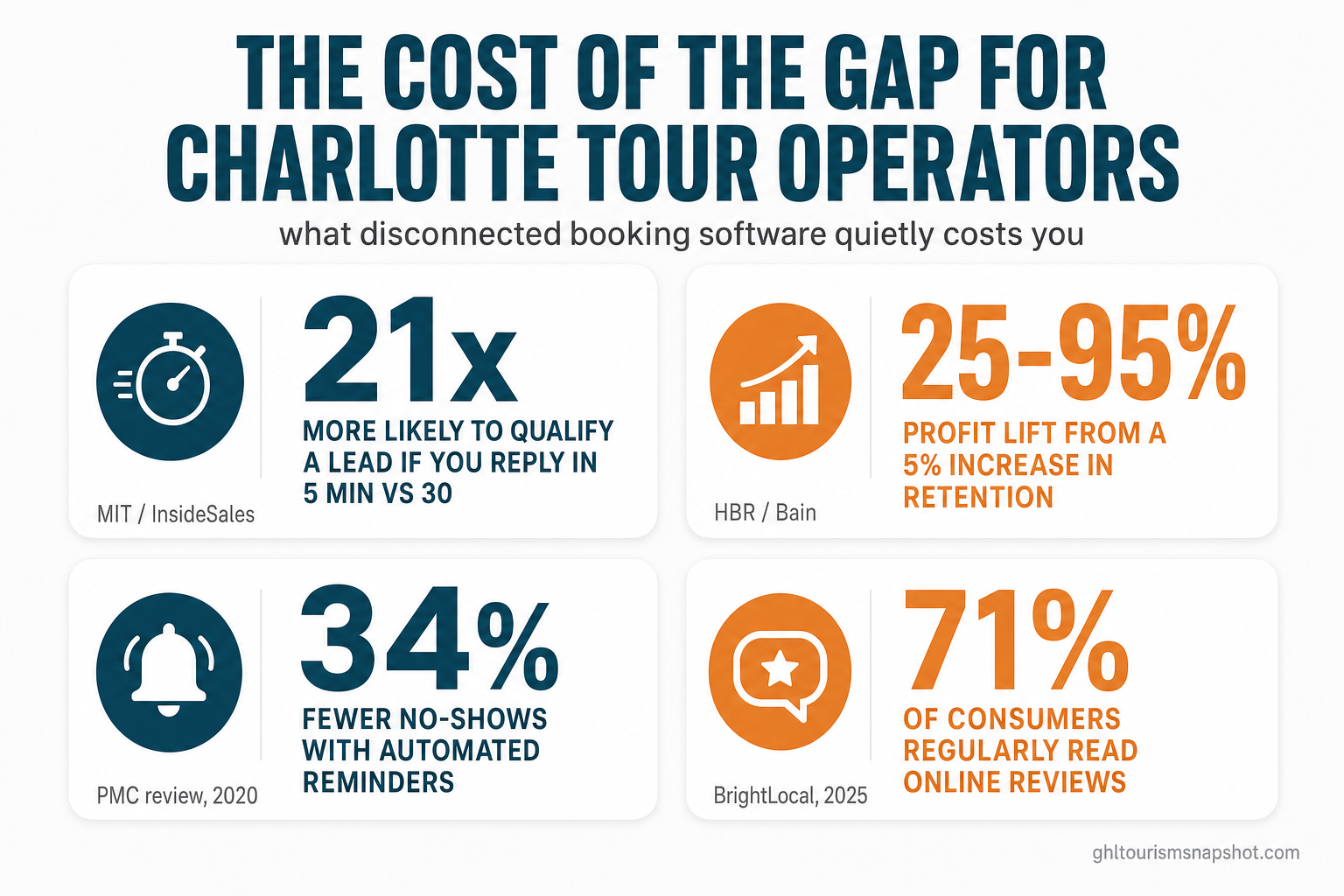
None of these are exotic tactics. They’re the basics of a healthy tour business — and every one of them requires a system that can act on a booking, not just record it.
The tours industry runs on disconnected tools
If this feels familiar, it’s because the whole experiences sector is behind on digitization — this isn’t a you problem. According to Arival’s research with Phocuswright, only about 33% of experiences bookings happen online, compared with roughly 64% across travel as a whole (Arival, 2026). Tours and activities is a huge market — around $271 billion in 2025 gross bookings, heading toward $342 billion by 2029 (Arival) — but it’s the least digitized major slice of travel, in part because 70%+ of operators are small or micro-businesses without a marketing stack.
Here’s why that under-digitization is dangerous: when operators don’t build their own connected system, the OTAs happily fill the void. OTAs captured about 37% of experiences bookings in 2025, up from 33% in 2024 and 28% in 2023, while operator direct-website bookings slid from 29% toward 25% (Arival). And OTAs don’t just take a 20–30% commission — they keep the customer relationship. The traveler is their customer, not yours, which means you can’t easily remind, review-request, or rebook them at all.
Owning your bookings and, crucially, owning the follow-up on them is how you claw margin and relationships back from the OTAs. That’s the strategic case for integration, and it’s the same logic behind chasing direct bookings instead of renting traffic from OTAs.
What a GoHighLevel integration actually does
Integration isn’t “move everything to a new platform.” You keep FareHarbor, Rezdy, Bokun, Checkfront, or Peek Pro — they stay your reservation engine. Integration means building a two-way sync so the data that was trapped in that engine flows automatically into a CRM that can act on it. Here’s the loop:
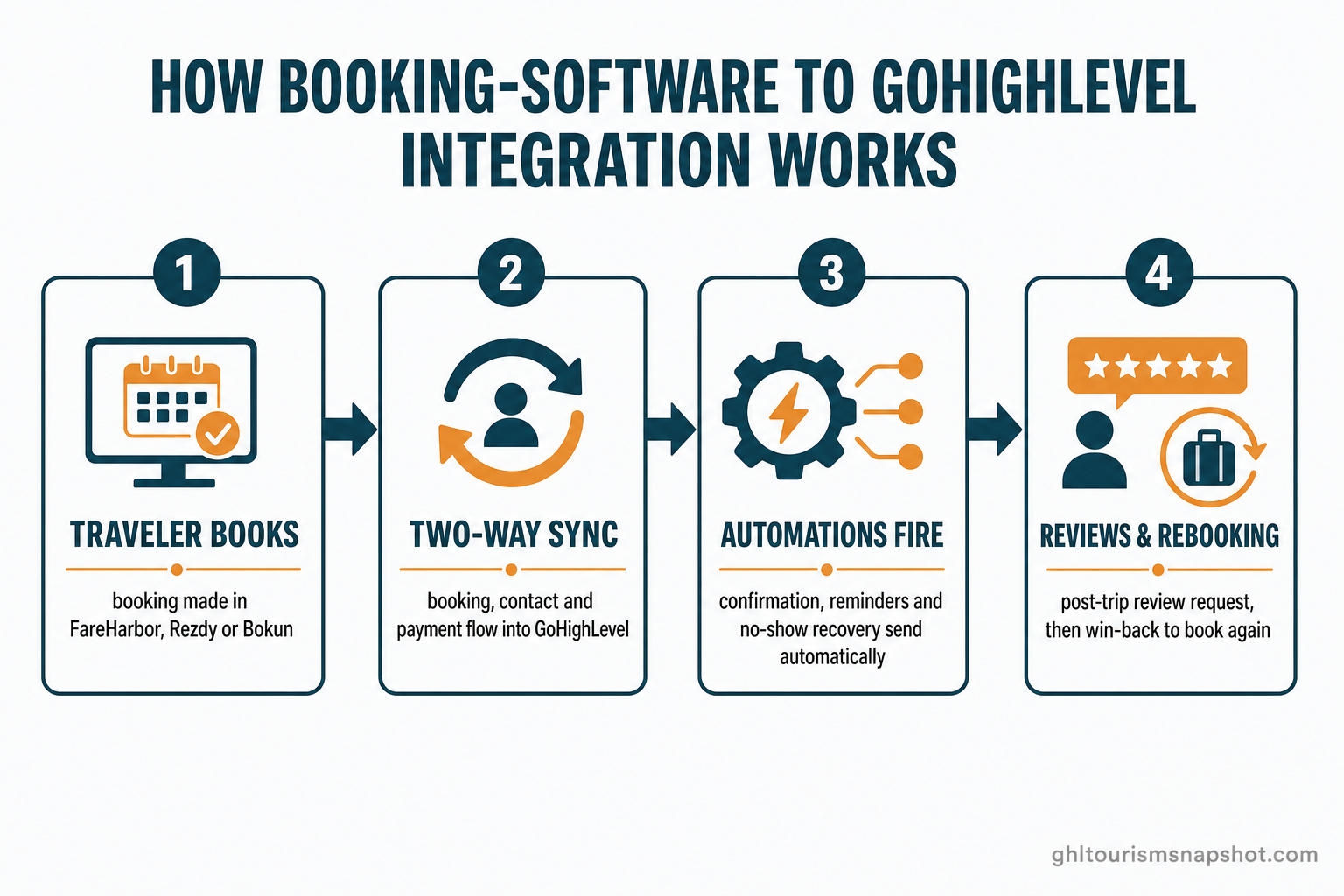
- A traveler books in your existing platform — nothing changes for them or your ops team.
- A two-way sync creates or updates that contact in GoHighLevel with the real details: which tour, seat count, departure date, deposit paid, pickup point.
- Automations fire on complete data — instant confirmation, a night-before reminder, no-show recovery if they miss it, and a pipeline stage your team can see.
- After the trip, the relationship continues — a review request at the perfect moment (5-star to Google, unhappy caught privately), then a seasonal win-back weeks later to book the next trip.
“Two-way” matters: when a stage changes in GoHighLevel — say a traveler upgrades or cancels — that can push a note back to the booking platform, so the two systems stay honest instead of drifting apart. Most operators try to fake this with a chain of Zapier zaps, and it works until peak season, when volume spikes, a field changes, and the whole brittle chain breaks on your busiest weekend. A purpose-built integration is designed for that load. This is precisely the kind of work our custom GoHighLevel development service exists for: connecting FareHarbor, Rezdy, Bokun, Checkfront, Peek Pro, Stripe, or any tool with an API into GHL so your automations finally run on complete, live data.
How to close the gap without becoming a developer
The honest build-vs-buy: if you have engineering skills, you can wire the booking-platform APIs to GoHighLevel’s API v2, handle the webhooks, map the fields, and maintain it as both tools change. Some technical operators do, and it’s a fine path.
But if your day is running departures, managing guides, and handling weather curveballs, maintaining an integration pipeline is not the best use of your hours — and a broken sync during peak season is the most expensive kind of DIY. The faster path is to have it built and maintained for you.
That’s exactly what our GoHighLevel Development service does. We build two-way syncs between GoHighLevel and your booking platform — FareHarbor, Rezdy, Bokun, Checkfront, Peek Pro, plus Stripe, QuickBooks, or a custom database — so bookings, contacts, and payments flow into GHL automatically. From there we wire the automations that grow the business: confirmations and reminders, no-show recovery, review harvesting, and win-back journeys. A typical platform-to-GHL integration ships in about 2–3 weeks, scoped up front with a fixed timeline. If you’re not on GoHighLevel yet at all, that’s a migration to GoHighLevel first; if you are, this is the connection that makes it earn its keep.
Same tours, two different back offices
Bookings live in FareHarbor. Reviews get asked for 'when I remember.' Reminders are manual, so no-shows quietly pile up. The 9 p.m. inquiry sits unanswered until morning — after a competitor replied. Last season's travelers are a spreadsheet nobody emails. Growth work waits, and mostly never happens.
Every booking syncs into GoHighLevel the moment it's made. Confirmations and reminders send themselves, no-shows get an automatic nudge, inquiries get an instant reply, and a review request goes out the moment a trip ends. Weeks later, a win-back offer rebooks last season's travelers — all without you touching it.
Frequently asked questions
Do I have to leave FareHarbor, Rezdy, or Bokun to use GoHighLevel?
No. Integration keeps your booking platform as your reservation engine — travelers and your ops team see no change. We build a two-way sync so booking, contact, and payment data flows into GoHighLevel, where your marketing and lifecycle automations run. You get the best of both: a purpose-built booking tool and a CRM that actually markets you.
Why can't I just use Zapier to connect my booking software to my CRM?
You can, for simple, low-volume cases — and plenty of operators start there. The problem is durability: Zapier chains are brittle, break when a field changes, and tend to fail under peak-season volume, which is exactly when you can least afford it. They also struggle with true two-way sync and complex field mapping. A purpose-built integration is designed for your real booking volume and stays reliable when it matters most.
What can I automate once the integration is in place?
Everything that depends on the CRM knowing about a booking: instant booking confirmations, night-before departure reminders, no-show and abandoned-checkout recovery, speed-to-lead replies to new inquiries, post-trip review requests (routing 5-star to Google and unhappy travelers to private feedback), and seasonal win-back campaigns to rebook past travelers. Integration is the prerequisite that makes all of it possible.
How long does a booking-software-to-GoHighLevel integration take?
A typical platform-to-GHL integration ships in about 2–3 weeks, scoped up front with a fixed timeline. More involved builds — a custom booking-and-manifest dashboard, or an availability-aware AI booking bot — take longer, but a straight two-way sync between your booking tool and GoHighLevel is a well-trodden path.
Is this relevant if I'm a small Charlotte operator with just a few guides?
Especially then. Most tour and activity operators are small businesses, which is exactly why the follow-up work slips — there's no one whose full-time job is chasing reviews and rebookings. Automation is how a small team runs the lifecycle work of a much bigger one. And in a market as competitive as Charlotte, responding first and showing up with fresh reviews is how a small operator punches above its weight.
We already run GoHighLevel but our bookings don't flow into it — can you fix that?
Yes — that's the most common version of this project. If you have GHL but bookings still live in FareHarbor, Rezdy, Bokun, Checkfront, or Peek Pro, your automations are firing on incomplete data (or not at all). We build the two-way sync so GHL finally sees every booking, then turn on the automations you set it up for in the first place. Book a call and we'll scope it.
About the author
Lucia Ontiveros is a Tour Operations & Automation Lead based in Santa Fe, New Mexico. She spent eleven years running guided desert and cultural day-tours across the Southwest before moving full-time into systems work, and has rebuilt the back office for small operators more times than she can count. She writes about the unglamorous machinery — booking funnels, deposits, reminders, and the integrations that connect them — that keeps departures full and guides paid. Her north star is simple: automation should give operators their weekends back, not bury them in dashboards.
Editorial note: GHL Tourism Snapshot is a GoHighLevel automation and development product for tour operators, not a travel agency. We don’t sell, book, or guarantee any tour. Statistics are drawn from the cited sources and reflect industry or study averages; the no-show reduction figures are from appointment-based research and are presented by analogy to tour departures. Your results will vary with your offer, market, and traffic.
Related posts
- Migrate a Tour Business to GoHighLevel with Zero Data Loss — the step before integration if you’re not on GHL yet.
- Direct Bookings for Tour Operators: How to Stop Losing 20–30% to OTAs — why owning the booking and the follow-up beats renting traffic.
- Review Response Automation for Tour Operators — one of the first automations to switch on once bookings sync.
- Speed to Lead for Tour Operators — how a connected system answers inquiries before a competitor does.
- 6 Automations Every Tour Operator Should Run — where integration fits in the full booking-and-marketing engine.
Want your booking software and your marketing finally talking to each other? See GoHighLevel Development, explore the full Tourism Snapshot pricing, or talk to a real person about your Charlotte tours.