
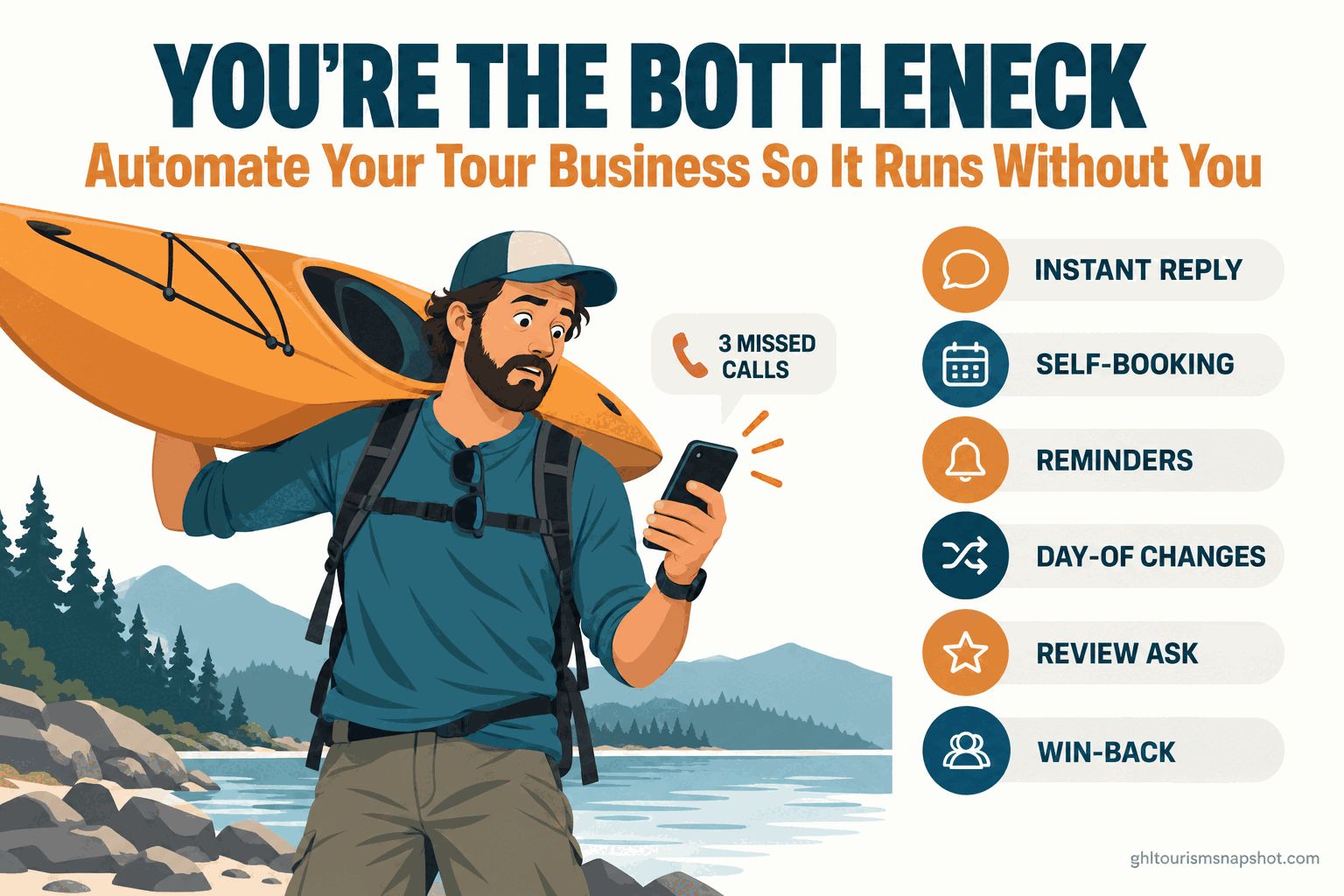
It is 7:52 on a Saturday in July. You have a double kayak on your shoulder and twelve guests at the launch, and your phone is buzzing in the dry bag with a booking inquiry you will not see for three hours. By the time you check it, that traveler has booked the shop down the road. You are the reason the business works, and the reason it cannot grow. Here is the fix: a system that answers, books, confirms, reminds, reschedules, and follows up without you, so the repetitive 80% of your week runs itself and you stay on the water.
What being the bottleneck actually costs you
Nobody warned you that running a tour business means being the receptionist, the booking agent, and the customer service line all at once, usually while guiding. When you are the only one who can confirm a booking or ask for a review, each job waits for a gap in your day. The gaps are when you lose money.
A 2024 study of 837 US micro-businesses (five or fewer staff) found owners work a median of 60 hours a week, with roughly a fifth of that time going to admin and compliance rather than the thing they actually sell. (UENI research) For a tour operator, that admin is bookings, reschedules, and chasing payments, the part a machine should do.
Then there is the leak you cannot see. Across different studies, small businesses miss between a third and a half of their inbound calls, and a missed call from a traveler with a card out is usually a booking the shop down the road takes instead.
It is not just calls. The traveler who fills out your form at 9pm wants an answer now, and research on web leads found the odds of reaching a prospect were far higher within five minutes than within thirty. (Harvard Business Review) You cannot hit five minutes on a river. Software can. And demand is not the problem: the US Bureau of Labor Statistics projects tour guide jobs to grow 6% through 2035. (BLS) The constraint is you being the only one who can respond.
The system that runs the repetitive 80%
Here is the good news: you do not need to automate everything, and you should not try. Keep the parts that need you, the guiding, the judgment calls, the real problems, and hand off the repetitive jobs that happen the same way every time.
Those jobs follow the traveler from first contact to repeat booking, and there are six. Set them up once and they run on every booking, whether you are asleep or on the water.
| When this happens | You, doing it manually | The system, doing it for you |
|---|---|---|
| An inquiry comes in | Missed, or answered hours later | Answered in seconds, 24/7 |
| They want to book | They wait for you to confirm | They self-book and pay a deposit |
| Booking confirmed | You text the details yourself | Confirmation sent automatically |
| The day before | You remember, or you don’t | Reminder with what to bring |
| Weather or a change | You text each guest one by one | One message to the whole departure |
| After the trip | You forget to ask for a review | Review request fires on its own |
| Next season | They never hear from you again | Win-back offer re-books them |
None of this is exotic. It is the customer journey you already run in your head, written down so it stops living there. Most operators run it on GoHighLevel, which bundles texting, booking, and follow-up, but the principle holds whatever you use. Here are the six stages.
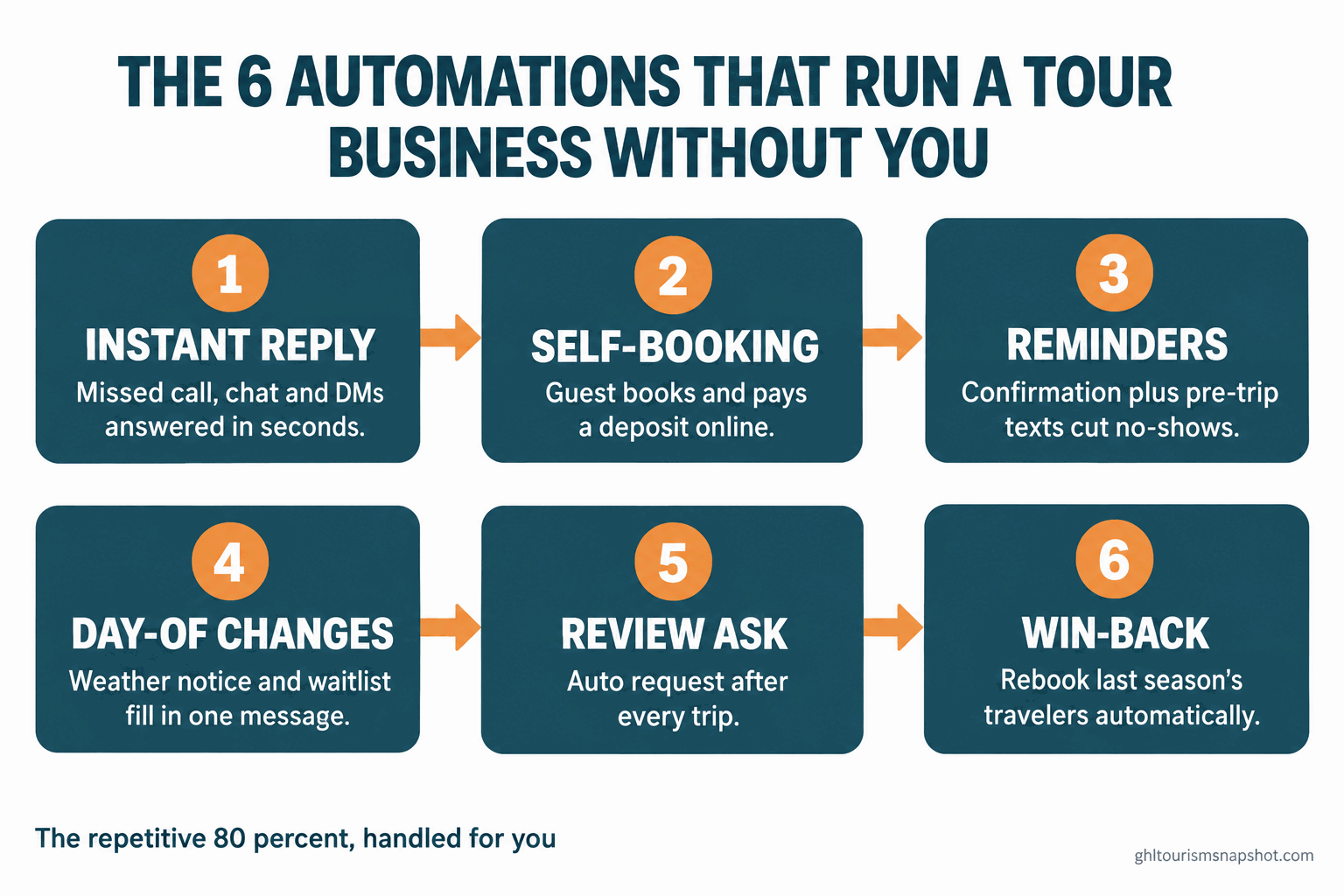
Stage 1: Answer every inquiry in seconds
This is the highest-value automation you will set up, because it plugs the biggest leak: every inquiry gets an instant reply, whatever the channel or hour. A missed call triggers an automatic text back within seconds. Your website chat and your Instagram and Facebook messages get an instant first response that answers common questions and points toward booking. The traveler feels caught, not ignored.
The setup. Turn on missed-call text-back on your business number, add a chat widget, connect your social inboxes to one place, and write one friendly first reply per channel. An afternoon of work, once.
Where it breaks. If the auto-reply sounds like a robot it backfires. Keep it short and human, use your name, and ask one question that moves toward a booking. See speed to lead for tour operators for the deeper version.
Stage 2: Let them book and pay without you
The second leak is the back-and-forth. A traveler asks about Saturday, you reply, they ask about times, you reply, they go quiet, and the booking dies in your inbox. Every step you sit in the middle of can lose them. A booking page shows your live availability and takes the booking and a deposit without you. The traveler picks a date, pays, and is confirmed, and you find out when it is done.
The setup. Put your departures and capacity into a booking calendar, set a deposit so a booking means something, connect your payment processor, and link it everywhere: your site, your social bios, your auto-replies.
Where it breaks. Two classic mistakes: not taking a deposit, which turns a booking into a maybe and feeds no-shows; and letting the online calendar drift out of sync with a phone booking, which causes double-bookings. Keep one calendar as the source of truth. If overbooking is already biting, we wrote the full fix in how to stop double-booking your tours.
Stage 3: Confirmations and reminders that cut no-shows
A no-show on a 12-person boat is not small: it is a seat you could have sold. Most no-shows are not flakes. They forgot, or were never told clearly what to do. So the moment someone books they get a confirmation, then reminders run up to the trip: one a couple of days out with what to bring, and a short one the morning of the departure with the meeting point.
The setup. Write three messages: one triggered on booking, two scheduled (two days out, two hours out). Add a map link and a reschedule option so a change does not become a cancellation.
Where it breaks. Too many messages and people tune out or reply STOP, so keep it to a confirmation plus two reminders. And a reminder with no easy reschedule pushes a “can’t make it” into a no-show instead of a moved booking. Full playbook: how to reduce tour no-shows.
Stage 4: Reschedules, weather, and waitlist fill on autopilot
This is the stage that eats your Saturdays. The wind picks up, or a guide calls out, and you are texting fourteen people one at a time while trying to launch a boat. Meanwhile a seat opens and nobody fills it because you are too slammed to notice. So one message goes to the whole departure when something changes, and a waitlist automatically offers an open seat to the next person in line.
The setup. Build a waitlist form for sold-out departures, create a one-tap “notify this departure” message, and write a weather-change template with reschedule and refund options built in, so the traveler self-selects instead of you negotiating fourteen times.
Where it breaks. A refund-or-reschedule message with no deadline leaves you chasing replies at 10pm, so always add a “reply by” time, and make the reschedule the easy, default option. A clean cancellation policy backs this up, covered in the weather cancellation playbook.
Stage 5: The review ask that fires after every trip
Reviews are how new travelers decide to trust you, and the best time to get one is the hour after a great trip, while the glow is still on. That is also when you are busiest and least likely to ask. So automate it, with a safety valve that routes unhappy guests to you privately first, so a bad day becomes a conversation instead of a one-star.
The setup. Trigger a message a few hours after the departure, point the link at your Google profile, and add a simple fork: a quick “how was it?” that sends happy guests to the public review and anyone unhappy to reply to you directly.
Where it breaks. The mistake to avoid is a generic ask, so name the trip and keep it human. Our guide to getting more 5-star reviews has the full sequence.
Stage 6: Win back last season’s travelers
The cheapest booking you will ever get is from someone who already paddled with you and loved it. They know you and cost nothing to reach. Yet most operators never contact a past guest again, then pay an OTA a fifth of the next booking to rent back a customer they already had. A win-back sequence reaches last season’s travelers at the right moment: the anniversary of their trip, the start of a new season, or a slow midweek stretch you need to fill.
The setup. Tag every guest by trip and date, then build a short sequence that fires at the right time with a reason to return: a new route, peak foliage, a returning-guest discount. Keep a list you actually own, not one locked inside a booking platform.
Where it breaks. You cannot win back travelers whose details you never captured, which is why Stage 1 and Stage 2 matter so much. If an OTA booked them, you may not even have their email. The fix is to own the relationship: capture the contact, then bring the next trip home yourself. More in repeat bookings and winning more direct bookings.
Three scenarios: solo, small shop, large operator
The same six stages apply to everyone, but what you automate first depends on your size.
The solo operator. A single-kayak guide, a one-van food tour, or a contractor under a host agency. You guide and sell at once, so the bottleneck is sharpest for you. Start with Stage 1 and Stage 3: instant replies so you stop losing inquiries while you work, and reminders so you stop eating no-shows. Those two can hand you back a full day a week.
The small shop (one to three staff). A couple of guides and a seasonal crew, with everything still routing through you or the front desk. You need the whole chain, because the handoffs are where things fall. Self-booking frees the desk, reminders cut the no-shows that wreck a small boat’s margin, and the Stage 4 waitlist fill turns sold-out Saturdays into recovered midweek seats. This is where automation starts paying a guide’s wages.
The large operator. Multiple departures a day, several locations, a team. Your bottleneck is not the phone, it is consistency: every guest getting the same experience no matter who is on shift. The review engine and win-back in Stages 5 and 6 compound hardest here, and you most need the one-calendar discipline in Stage 2, since scale makes double-bookings expensive.
Keep the texting legal
The moment you automate texting, you take on real rules. Get them right and it is painless. Get them wrong and carriers block your messages or a lawyer comes calling.
Consent. You need permission before you text someone marketing, and a booking does not automatically grant it. Add a clear opt-in at the point of booking:
STOP and HELP. Every program must honor STOP and HELP automatically; good tools do this for you, but confirm yours does. The TCPA allows damages of $500 to $1,500 per unsolicited message, which add up fast. (FCC)
A2P 10DLC. To send business texts in the US you register your brand and campaign through the carrier system, and since early 2025 carriers block unregistered business texting outright, so it is not optional. (CTIA) A done-for-you setup usually files this for you; if you DIY, budget a few business days for approval. Keep marketing texts within reasonable hours, and check your state’s own rules too. None of this is legal advice.
Objections, answered straight
“Won’t automated texts feel robotic and annoy my guests?” They will if you write them like a robot. The messages above are the ones you would send if you had the time. A warm, well-timed text is a service, not spam. The annoying version has no name, no opt-out, and five messages where one would do.
“I’m not technical. I can barely keep my calendar straight.” That is the strongest reason to use a done-for-you setup rather than wiring it yourself. You should not have to learn a CRM to answer a phone that rings while you are guiding. It gets built once, then it runs. Your job afterward is to edit the messages to sound like you.
“I already pay for FareHarbor or Peek Pro. Doesn’t that cover this?” Your booking software is the checkout: it takes payment and holds the calendar. What it does not do well is the relationship around the booking, the instant reply to a cold inquiry, the review engine, the win-back to last year’s guests. Those live in a CRM, and they fill your slow dates. See the best FareHarbor alternatives if you are rethinking the booking layer too.
“My customers are older and prefer a phone call.” Then the missed-call text-back matters even more: it catches the ones you cannot pick up for, and you can still call them back. It does not replace the call, it just makes sure nobody falls through.
FAQ
Automating a tour business: questions operators ask
How do I automate my tour business without losing the personal touch?
Automate the predictable jobs (confirmations, reminders, review asks, win-back) and keep the human moments (guiding, the hard calls, real problems). Write every message in your own voice, use the guest's and the trip's name, and always leave a way to reach a real person.
What is the first automation a solo tour operator should set up?
Missed-call text-back plus an instant reply to web and social inquiries. It plugs the biggest leak, inquiries that arrive while you are guiding and go cold, and it is the fastest to set up, so you stop losing bookings the same day.
Is it legal to send automated booking texts to customers?
Yes, if you follow the rules. You need consent, you must honor STOP and HELP automatically, and in the US you must register through A2P 10DLC or carriers block you. The TCPA allows $500 to $1,500 per non-compliant message, so collect a clear opt-in at booking.
Do I need GoHighLevel to automate my tour business?
No single tool is mandatory, but you need one place that ties texting, booking, and follow-up together, or the automations do not talk to each other. GoHighLevel bundles all of it, which is why the Tourism Snapshot is built on it. The principle works on any CRM-plus-messaging platform.
How long does it take to set all this up?
Doing it yourself, a few focused weeks to build and test the six stages, plus a few business days for A2P 10DLC approval. A done-for-you install puts the whole system in your account in about 24 hours and files the registration for you.
It is 7:52 on a Saturday again, and your phone is buzzing in the dry bag. This time it does not matter. The inquiry already got a warm reply, the morning’s guests got their meeting-point text, and last night three past guests got a note about the fall colors. You are on the water with twelve people, running the trip you got into this to run, while the repetitive 80% handles itself. For more on filling quiet dates, read how to fill empty departures, or see what the Tourism Snapshot includes.