
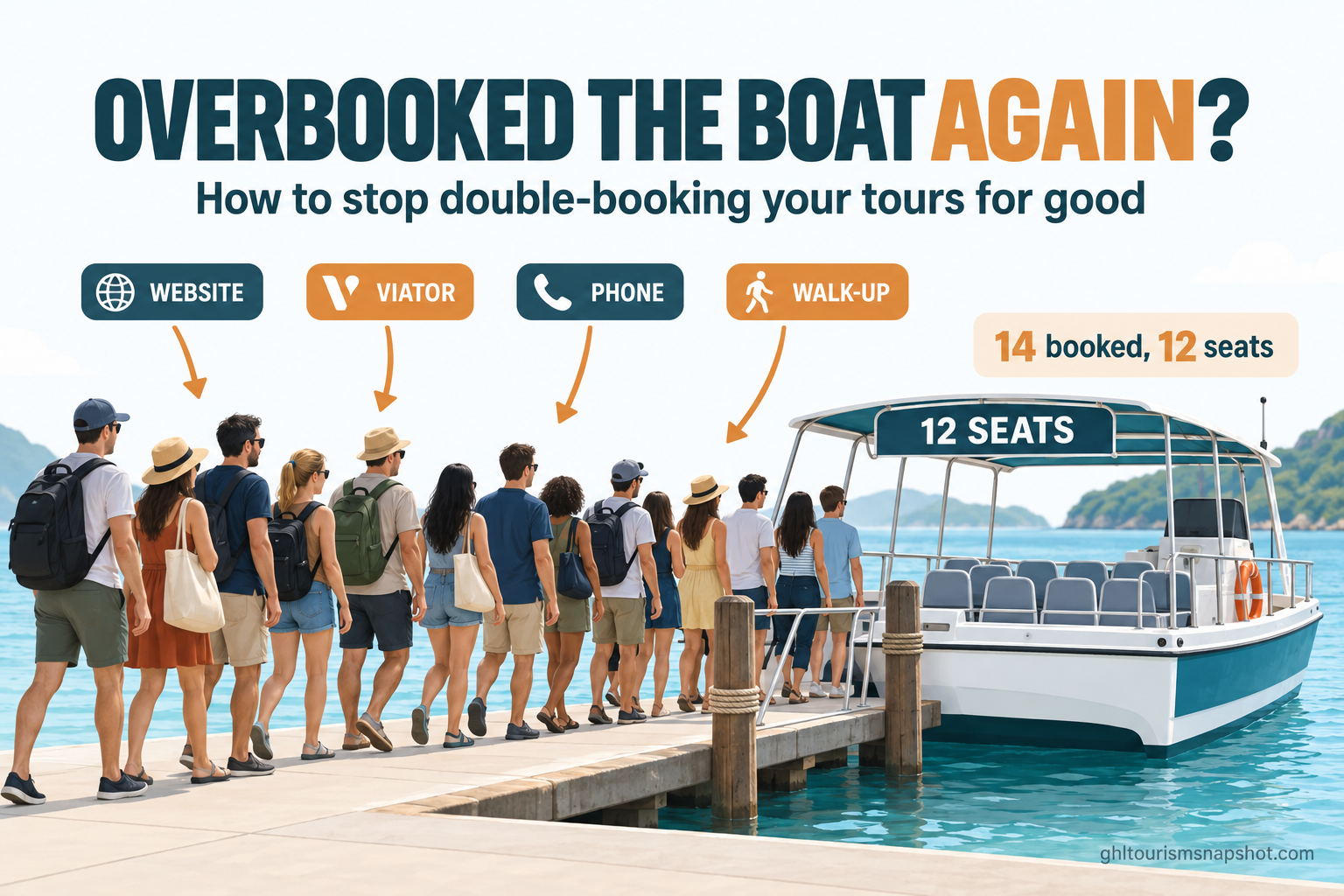
It is 8:52am on a Saturday and the 9am kayak tour has twelve seats. Standing on the dock are fourteen people, all with a confirmation in hand. Two booked on your website. Ten came through Viator. One called Thursday and your guide wrote the name on a sticky note. One walked up because the sign said “tours daily.” Somebody is going home. Here is the short answer: overbooking is almost never bad luck, it is a sync problem, and it has a fixable cause every time. This guide walks through the system that stops the oversell before it happens, and the recovery play for the morning it slips through anyway.
We build back-office systems for tour and activity operators, so we see this from your side of the dock. An oversold seat does not just cost you one booking. It costs you the trust of a customer who did everything right.
What one oversold seat actually costs you
Walk the math. You refund the booking, so the revenue is gone. You comp a future trip, because you cannot send a disappointed family off with nothing. And you burn twenty minutes of apology on your busiest morning.
Now the part that never shows up on the refund receipt. That family tells their bank they were charged for a trip they never took, and you get a dispute. Stripe pulls the money back and staples a $15 dispute fee to it, with a second $15 if you contest it, refunded only if you win (Stripe). All in, fraud research puts the cost at roughly $5 for every $1 disputed (LexisNexis), covered in our chargebacks guide.
And the part that outlasts all of it: the review. A family bumped in front of their kids writes about it that night. About 96% of consumers read reviews at least occasionally, and 63% lose trust in a business after reading mostly negative ones (BrightLocal, 2025). One oversold seat can quietly cost you the next ten bookings from people who read it and scrolled on by.
Why tours get overbooked in the first place
The oversell almost always comes from one of five places, and the booking platform Rezdy names most of them outright (Rezdy).
One: sync lag between channels. Someone books the last two seats on Viator at 8:40am. Your website does not know yet, so it sells those same seats to a couple browsing at 8:41am. Rezdy flags exactly this: a “time lag between confirming a booking and updating your availabilities on your website.”
Two: bookings that never enter the system. A guest calls, your guide writes the name on a sticky note, and it never reaches the software that counts your seats, which still shows them open and sells them again. Rezdy calls it “forgetting to input a booking placed over the phone into the system.”
Three: a capacity number set wrong. Someone set the twelve-seat session to fourteen last peak season and never set it back. Or a rule changed, an insurance cap or a Coast Guard passenger limit, and the software now carries more than you are allowed.
Four: deliberate overbooking that backfires. Some operators oversell on purpose, like airlines, betting a no-show evens it out. On a twelve-seat boat there is no cushion: one extra booking and a full turnout, and you are the airline bumping a family at the gate.
Five: walk-ups against a full session. Sold out online, but the sign still says “tours daily” and nobody at the desk can see the live count, so they take the walk-up’s cash.
Illustrative share of tour overbookings by cause. The two biggest are both about information not traveling fast enough. Categories per Rezdy’s overbooking guidance.
Four of the five are the same problem in different clothes: a seat sold in one place, and the rest of your operation not knowing fast enough. Fix the speed and honesty of that one number and you close almost the whole list.
The anti-overbooking system, stage by stage
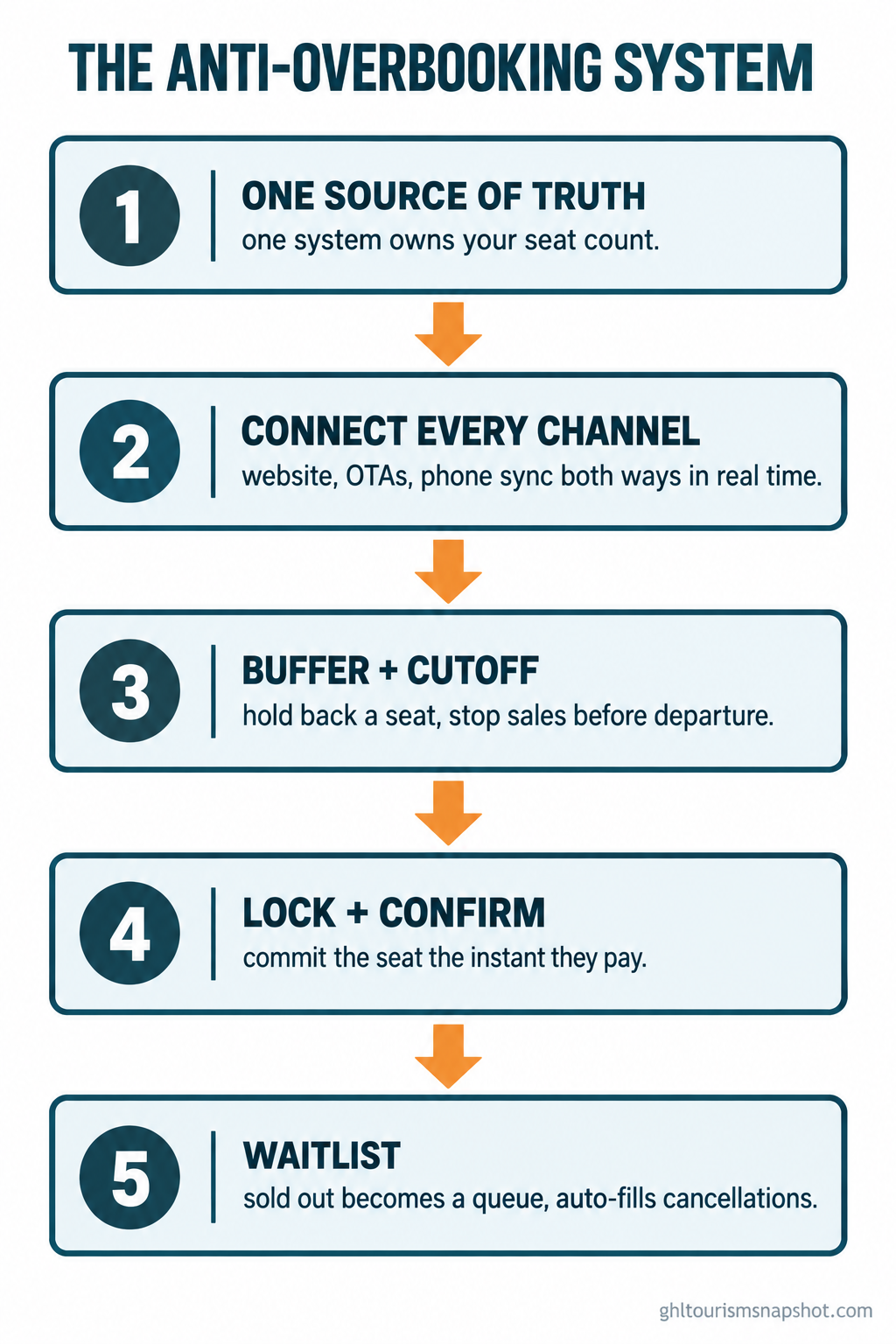
Here is the system we set up for operators tired of the dock conversation. Each stage closes one of the causes above, with the setup, how it breaks, and the copy you can steal.
Stage 1: Pick one place that owns your seat count
Most operators skip this, and every fix starts here. You need one system that is the final word on how many seats are left on any departure, not a booking widget plus a spreadsheet plus whatever your lead guide remembers. A real tour booking platform does this, and if choosing one feels like a maze, our breakdown of what tour booking software actually costs lays out the options.
How it breaks: you keep a side spreadsheet “just for phone bookings.” The moment two systems both think they can sell a seat, you are back to square one. If it holds seats, it has to be the one system, or feed it.
Stage 2: Connect every channel to it, both directions
Now plug every way a seat can sell into that source of truth, both directions. When Viator sells a seat, your website’s count drops in the same breath, and the other way around. This is what a channel manager is for. Bokun describes its job as a way to “sync and manage bookings across platforms” (Bokun), and Rezdy keeps “all your sales channels updated and ready to take bookings in real-time” (Rezdy). The channels are your website, the OTAs like Viator, GetYourGuide and Expedia, and the one everyone forgets, your phone and front desk.
How it breaks: one channel is left out, usually an OTA on a manual feed where an agency emails a booking and someone types it in. If a connection is not two-way and near-instant, it is not solving the problem.
Stage 3: Build in a buffer and a booking cutoff
Two rules take most of the remaining risk off the table. A buffer: hold back a seat or two on departures that run tight, so a sync hiccup lands in the cushion instead of on the dock. A booking cutoff: stop online sales a set time before departure, say ninety minutes, so a last-second sale cannot collide with a guest already checking in.
How it breaks: no cutoff, so your site sells a seat at 8:58 for the 9:00 departure, after your guide has counted heads and pushed off. Treat the buffer as a seasonal dial: up when channels are busy, down when they are quiet.
Stage 4: Lock the seat the instant they pay, and confirm it
The seat should commit the moment money changes hands, not when someone gets around to entering it, and the traveler should get an instant confirmation naming the exact departure. That reassures the guest so they do not re-book out of doubt, and creates a timestamped record of which seat they hold if anything is disputed.
How it breaks: the phone booking. A guest calls, you promise a seat, hang up, and the “enter it” step waits until after lunch. For those hours the system thinks the seat is open and sells it. Book the call into the real system while the guest is on the line, not onto a notepad.
Stage 5: Turn “sold out” into a waitlist
Here is where you flip overbooking from a risk into a revenue tool. Operators oversell out of fear of running with empty seats after a late cancellation, and a waitlist kills that fear without the gamble. When a departure fills, the booking page stops selling and offers to add the traveler to a waitlist. When a seat frees up, the system offers it to the next person in line automatically. You never carry more passengers than seats, and you still fill the gaps. Rezdy recommends exactly this, “a waiting list feature to your tours that have reached full occupancy” (Rezdy). It pairs with cutting no-shows: every recovered no-show is a waitlisted guest who gets to go.
How it breaks: a waitlist that lives in your head. If filling a freed seat means remembering to text six people in order, it will not happen on a busy morning. It has to offer the seat on its own, with a short claim window, then roll to the next person if nobody answers.
The recovery play for when it happens anyway
Even a tight system has an off morning. A manual booking slips in, a sync lags on the day it matters, and you are two over. What separates a shrug from a one-star review is whether you have a plan or you are improvising in front of a crowd. Here is the play, in order, so you never improvise.
Pick who moves before you speak. Do not ask for volunteers in a panic. A fair rule: the most recent bookings move first, and walk-ups and un-entered phone bookings move ahead of anyone with a real confirmed seat. Do not split a group.
Lead with the apology and the make-good in the same breath. Never deliver bad news and then negotiate. Give the bad news and the generous fix together, so the guest never sits in the gap feeling cheated. A full refund plus a free future trip costs you one empty seat later, far cheaper than a dispute and a review.
Protect the review before it is written. Give the guest a private channel to be upset at you instead of the public line to Google. Same muscle as our five-star reviews playbook: route the unhappy guest to you, the happy one to your profile. The BrightLocal survey found only 7% of consumers do not expect a reply, so respond well when it does post.
What this looks like for a solo, mid-size, and large operator
The system is the same at every size. How much you build depends on where you are.
The solo operator. One boat, maybe 300 bookings a season, run from your phone. You sell on your website and one OTA and take the odd phone booking, so your whole risk lives in the gap between those three. Do the cheap basics: make your booking software the one source of truth, put your OTA on a live two-way connection instead of copy-pasting emailed bookings, and never promise a phone seat you have not entered while the caller is on the line. Two or three channels drawing from the same number, not twenty integrations.
The mid-size operator. Three to six tour types, a couple of staff, several OTAs, real weekly volume. This is where it gets dangerous: more channels, more gaps, and manual entry can no longer keep up. You want the full stack: a channel manager syncing every OTA both directions, buffers and cutoffs per tour type, an automated waitlist, and the recovery play written down so any staffer can run it. It is also where a disconnected toolset bleeds you, and pulling your booking, follow-up and recovery onto one connected platform stops the leaks you cannot see one login at a time.
The large operator. Multiple locations, thousands of bookings. Here overbooking is a managed metric, not a surprise. You track an oversell rate per location, set buffers by season and demand, and review the reconciliation weekly with someone who owns the number. A single stubborn sync gap is dozens of bumps a season across sites, so it earns an owner and a dashboard.
A quick word on the texts you will be sending
The confirmation and waitlist offer are transactional messages, which sit on easier ground. But the moment a text drifts toward promotion, “come back for 20% off,” you are in TCPA territory, which generally requires prior express written consent and a working opt-out (47 CFR 64.1200). The practical version: collect consent at checkout, register your number for A2P 10DLC so your texts deliver, and honor STOP instantly. Our SMS marketing playbook covers the setup.
Common objections
“I only sell on my own website, so this can’t happen to me.” It can, and it is often worse, because operators who feel safe skip the basics. You still take phone calls, still get walk-ups, still have a guide writing names on a clipboard. Any seat promised outside the system is an oversell waiting for its morning.
“My booking tool already prevents overbooking.” It prevents it on the channels it actually controls. The question is whether every channel is on it. Most oversells we see come from the one that is not: an OTA on a manual feed, a charter calendar on the side, a phone booking waiting to be entered. The tool is only as honest as the least-connected channel feeding it.
“Do I need to be technical to set this up?” No. None of it is code. It is connecting channels you already use, setting a buffer and a cutoff, and turning on a few message templates. You can wire it yourself over a slow week, or have it built and installed for you so it all runs on its own.
Back to that Saturday morning
Picture the dock again, with the system in place. The 9am boat filled on Thursday, so your website and your OTA both showed it sold out and offered a waitlist. When a guest canceled Friday night, the waitlist offered the seat automatically and the next person grabbed it within the hour. This morning, twelve confirmed travelers show up for twelve seats. Nobody goes home, and there is no refund, no dispute, no review to dread tonight.
Overbooking feels like chaos, but it is one of the most solvable problems you have, because it comes down to a single honest number traveling fast enough. Give your seats one home, connect every channel both ways, add a buffer, a cutoff and a waitlist, keep a recovery play in your back pocket, and reconcile what sold against what ran once a week. Do that and the dock conversation you have been dreading simply stops happening.
Stopping tour overbooking: FAQ
What actually causes most tour overbooking?
Not bad luck. The two biggest causes are a lag between a seat selling on one channel and the count updating on the others, and phone or desk bookings that never get entered into the system that counts your seats. A wrong capacity number, deliberate overselling to offset no-shows, and walk-ups against a full session make up the rest.
How do I stop double-booking across my website and OTAs like Viator?
Connect every channel to one source of truth with a two-way, real-time sync, usually through a channel manager. When a seat sells anywhere, the live count has to drop everywhere in the same moment. Any channel on a manual or one-way feed is the gap where double-bookings happen, so the fix is getting every channel onto the live connection.
Is it ever okay to overbook a tour on purpose?
On a small boat or vehicle, rarely. The airline tactic assumes a big cushion of seats and frequent no-shows. On a 12-seat boat there is no cushion: one extra booking and a full turnout means you bump a real guest. A waitlist gives you the same protection against empty seats without ever carrying more passengers than you have room for.
What should I do when I've already oversold and people are on the dock?
Run a pre-decided play. Move the most recent bookings or un-entered walk-ups first, never split a group, and lead with the apology and a generous make-good together, a full refund plus a free future trip. Take it off the dock, get their details, and send the fix in writing within minutes so it never becomes a chargeback or a public review.
Do I need technical skills to set up overbooking protection?
No. It is connecting the channels you already use to one booking system, setting a small buffer and a booking cutoff time, and turning on a few message templates for confirmations, the waitlist and recovery. You can do it yourself over a quiet week or have it installed done-for-you.