
If you run whale-watching cruises off Point Loma, e-bike tours through Balboa Park, or a taco crawl in Barrio Logan, Instagram Reels are the cheapest seat-filler you’re not using well enough. The playbook is simple to say and harder to run: shoot one hook-worthy trip moment as a vertical video under 30 seconds, lead with a scroll-stopping first two seconds, add captions and a clear on-screen call to action, post 3–5 times a week, and then — this is the part most operators skip — answer every comment and DM fast enough to actually book the seat. This guide walks a San Diego tour operator through each step, with the real 2026 reach data behind it.
Reels aren’t a vanity metric for the travel business. In San Diego — a market that hosted 32 million visitors last fiscal year — the operator whose reel makes tomorrow’s trip look unmissable is the one who gets the 9 p.m. “any spots this weekend?” DM. The one with a dusty, quarterly-posting grid gets scrolled past. Here’s how to be the first operator, step by step.
Why Reels, and why San Diego right now
Travel discovery has moved into the feed. Social media’s share as a trip-inspiration source keeps climbing — Phocuswright pegged it rising from 16% in late 2023 to 19% in 2025 (Phocuswright) — and younger travelers in particular now expect to see an experience before they book it. That’s a gift for tour operators, because your product is inherently visual: the breach of a gray whale, the golden hour over the Gaslamp, the first bite on the food tour.
The reason Reels specifically matter is reach. On Instagram, Reels are the format the algorithm pushes hardest to people who don’t already follow you — which is exactly the audience a tour operator needs. Static grid photos mostly reach your existing followers; Reels are the format that finds tomorrow’s traveler.
Average Instagram reach rate by post format (% of audience reached). Source: Socialinsider, 2026 Instagram Benchmarks.
And it’s not a niche behavior anymore. Reels now account for roughly half of all the time people spend inside Instagram, per Meta’s own reporting (via Digital Music News). If your San Diego tour brand isn’t in that half of the app, you’re invisible during the exact moments travelers are deciding what to do this weekend.
Now layer on the market. San Diego is one of the most visited destinations in the country, and the numbers are worth internalizing before you spend a single evening filming:
Source: San Diego Tourism Authority, FY2024.
Thirty-two million visitors is a lot of “things to do in San Diego” searches and a lot of thumbs scrolling for something to book. Reels are how a small operator competes for that attention without an ad budget the size of a cruise line’s. The catch: reach is only step one. Let’s build the whole engine.
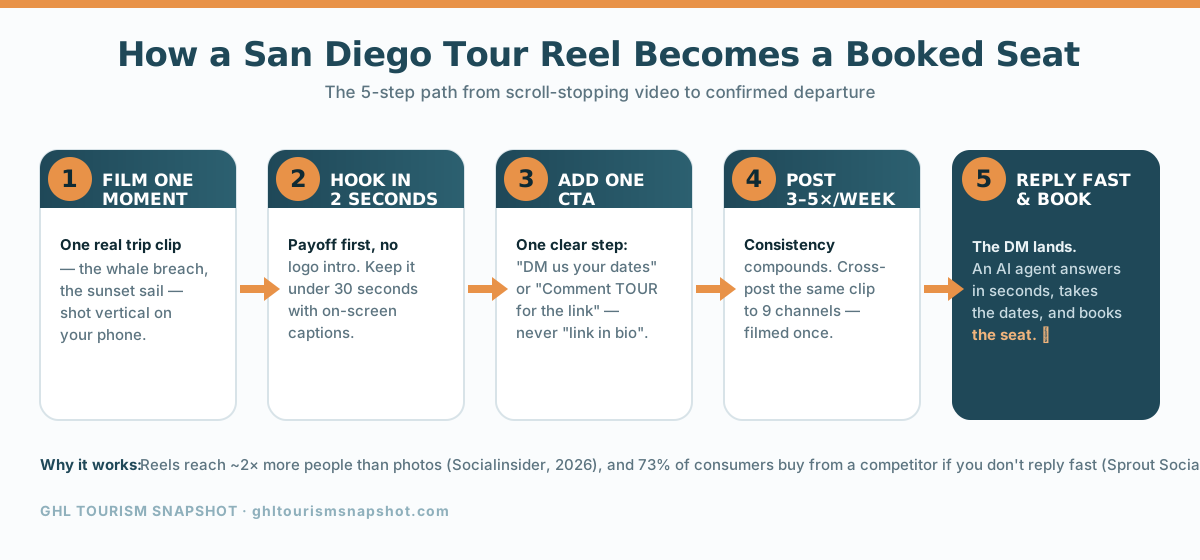
The 7-step Reels playbook for tour operators
You don’t need a videographer or a studio. You need a phone, a repeatable format, and the discipline to post consistently. Here’s the exact sequence.
Step 1 — Film one hook-worthy trip moment (not the whole tour)
The mistake is trying to summarize the entire experience. Reels reward a single, visceral moment: the whale surfacing, the sunset from the sailboat, the reaction to the first taco, the view when the e-bike crests Cabrillo. Shoot it vertically (9:16), hold the phone steady, and capture 3–4 short clips of that one moment. You’re not making a documentary; you’re making a two-second reason to stop scrolling.
Keep a running “capture list” for your guides — a shared note that says film the whale breach, film the group’s reaction, film the plate arriving. Real trip footage, filmed by the people running the trip, consistently outperforms polished agency b-roll because it looks like the real thing travelers will actually get.
Step 2 — Win the first two seconds
On Reels, the first two seconds decide whether the algorithm keeps showing your video. Open on motion or payoff — the breach, the drone reveal, the reaction — not a title card or a slow pan. If you must use words, put a curiosity-driven line on screen immediately: “The best 90 minutes on San Diego Bay” or “POV: your first gray whale.” No logo intros. No three-second fade-ins. The payoff comes first; the context comes second.
Step 3 — Keep it under 30 seconds and add captions
Short wins. Wyzowl’s 2026 data shows short-form video is the format audiences and marketers rate most effective, and HubSpot ranks it the #1 ROI format. Aim for 15–30 seconds. Then add on-screen captions — a large share of feed video is watched on mute, and captions keep the viewer watching (and make the reel accessible). Add a spoken or written voiceover only if it earns its place; the visual is the star.
Step 4 — End with one clear call to action
Every reel needs a single next step, and “link in bio” is the weakest one you can pick. Stronger CTAs for a tour operator:
- “Comment DATES and we’ll send the booking link.” Comments boost reach and start a booking conversation.
- “DM us the word SUNSET for this weekend’s times.” A keyword DM is a warm lead you can automate a reply to.
- “Save this for your San Diego trip.” Saves are a strong ranking signal and keep you top of mind.
Pick one CTA per reel. Two options split the action and you lose both.
Step 5 — Post consistently (3–5 times a week)
Consistency is the whole game, and it’s where solo operators fall down in peak season. Buffer’s analysis of more than two million posts found a sweet spot around 3–5 posts per week for reach — enough that the algorithm learns your account is active, not so much that quality drops (Buffer). The compounding is real: post twice in July and disappear, and you start from zero every time. Post four times a week for a season, and one of those reels eventually catches — and because you post often, you get dozens of shots at that breakout.
Step 6 — Cross-post to every channel that matters
A vertical reel isn’t just an Instagram asset. The same 30-second clip becomes a TikTok, a YouTube Short, a Facebook Reel, a Pinterest Idea Pin, and a Google Business Profile video — each one another surface where a traveler discovers you. You filmed it once; publish it five places. This is exactly the multi-channel motion that turns one shoot into a week of reach across the platforms travelers actually plan on.
Step 7 — Read the right metrics and repeat what works
Ignore vanity likes. For a tour operator, the metrics that predict booked seats are, in order: reach/plays (did it find new people?), saves and shares (did it resonate enough to keep?), and DMs/comments started (did it start a booking conversation?). Once a month, look at your top three reels by reach, notice what they had in common — a specific hook, a specific trip, a specific time of day — and make more of that. This is a flywheel, not a lottery.
A one-week San Diego content calendar
Here’s what a realistic, repeatable week looks like for a San Diego operator running a couple of tour types. The point isn’t to copy it exactly — it’s to see that “post 4–5 times a week” is very doable when you have a simple template.
| Day | Format | San Diego example |
|---|---|---|
| Monday | Reel | Whale breach off Point Loma — “POV: your first gray whale” |
| Tuesday | Carousel | “5 stops on our Barrio Logan taco crawl” (swipeable mini-guide) |
| Wednesday | Reel | Golden-hour sail on the bay — “The best 90 minutes in San Diego” |
| Thursday | Q&A / text | “Is the sunset sail good for kids?” — answer a real traveler question |
| Friday | Reel | Guest reaction montage — “What our travelers said this week” |
| Weekend | Story + reply | Repost travelers’ tags, answer every DM about weekend availability |
Notice three reels, one carousel, one Q&A post, and a weekend focused on replying. That’s the mix: enough video to feed discovery, enough variety to keep the feed human, and dedicated time to convert the interest into bookings. If you’d rather not run this yourself, it’s the exact cadence our done-for-you social team publishes across nine channels.
The step everyone skips: answer fast or lose the booking
Here’s the uncomfortable truth that separates reels that fill departures from reels that just rack up views: the reach is worthless if the reply is slow. A traveler who comments “dates?” or DMs “any spots Saturday?” is a booking with a short shelf life. If you’re out running a tour and don’t see it until that night, they’ve already booked the operator who answered in ten minutes.
The data is blunt about it. Sprout Social’s 2025 Index found that 73% of consumers will buy from a competitor if a brand doesn’t respond on social media, and the majority expect a response within 24 hours — with practical first-response benchmarks for Instagram DMs measured in minutes, not hours (Sprout Social). In a fast-moving, high-intent market like San Diego travel, “I’ll reply tonight” is a booking handed to a competitor.
Sources: HubSpot 2026, Wyzowl 2026, Sprout Social 2025 Index.
This is why the smartest operators pair their content engine with automation that answers instantly. An AI comment-and-DM agent replies to “any spots this weekend?” in seconds, qualifies the traveler, collects their dates and group size, and books the reservation onto the calendar — 24/7, in your brand voice — so a reel that pops at midnight doesn’t go cold by morning. (We go deep on the DM side in Instagram DM Automation for Tour Operators and on the broader principle in Speed to Lead for Tour Operators.)
Turning a view into a booked seat
A reel that reaches 40,000 people and books zero seats has a funnel problem, not a content problem. The path from scroll-stopped to paid deposit needs to be short and obvious:
- The reel gets the attention with a real trip moment and a clear CTA.
- The CTA routes them somewhere frictionless — a keyword DM, a comment auto-reply, or a link to a booking page (not a generic homepage).
- The instant reply answers the question and offers the next available departure with a booking link or a one-tap call to book.
- The booking page takes the deposit and confirms the seat, then triggers reminders so they actually show up.
Own that whole path and you keep the direct booking. That matters more every year: Arival’s data shows online travel agencies captured 37% of experience bookings in 2025, up from 33% in 2024 and 28% in 2023, while operators’ own websites slipped from 29% to 25% (Arival).
OTA share of experience bookings, % (rising as operators’ direct-website share slips from 29% to 25%). Source: Arival, 2025.
Reels are your antidote to that trend. When you create the discovery moment and you answer the DM and you own the booking page, you keep the margin the OTA would have taken. Reels + fast replies + a direct booking funnel is how a San Diego operator captures the demand and keeps the sale. For more on winning back that direct-booking share, see Direct Bookings for Tour Operators.
When to hand it off (and what that costs)
Everything above is doable yourself, and plenty of operators run it well. But there’s a reason “post 4–5 times a week across nine channels and reply to every DM in minutes” quietly falls apart in July: you’re out running trips. The content that fills September gets filmed in your spare time, which in peak season doesn’t exist. So the feed goes quiet exactly when demand peaks, and the automation you meant to set up never gets built.
That’s the gap a done-for-you service closes. Instead of you finding time to film, edit, caption, schedule, and reply, a team turns your raw trip clips into a steady stream of reels and carousels, publishes them 5 days a week across all 9 channels, and runs the AI agents that answer comments, DMs, and website chat — booking travelers straight onto your calendar while you’re on the water.
Frequently asked questions
How often should a San Diego tour operator post Reels?
Aim for 3–5 posts a week, with at least 2–3 of them Reels. Buffer's analysis of more than two million posts found reach tends to peak in that 3–5 per week range — frequent enough that the algorithm treats your account as active, without sacrificing quality. Consistency compounds: posting steadily for a season gives you dozens of chances at a breakout reel, whereas posting in bursts resets your momentum each time.
How long should a tour Reel be?
Keep it between 15 and 30 seconds. Short-form video is the format audiences rate most effective and marketers rank #1 for ROI (HubSpot, 2026). Open with the payoff moment in the first two seconds, show 2–4 quick clips of the real experience with on-screen captions, and end with one clear call to action like 'DM us your dates.'
Do Reels actually get more reach than photos on Instagram?
Yes. Socialinsider's 2026 Instagram benchmarks show Reels reach an average of about 30.8% of an account's audience, versus roughly 14.5% for carousels and 13.1% for static images — and a large share of Reel views come from non-followers, which is exactly the new-traveler audience a tour operator wants. Reels are Instagram's strongest organic discovery format.
What should I film if I don't have a videographer?
Film with your phone, vertically, on real departures. Capture single moments — a whale surfacing, the sunset from the boat, a guest's reaction to the first taco, the view at the top of the climb. Authentic clips shot by your guides usually outperform polished agency footage because they look like the actual experience a traveler will get. Keep a shared 'capture list' so filming becomes a habit on every trip.
How do I turn Reel views into actual bookings?
Give every reel one clear next step (a keyword DM, a comment auto-reply, or a link to a booking page — never a generic homepage), then answer instantly. 73% of consumers say they'll buy from a competitor if a brand doesn't respond on social (Sprout Social). Pairing reels with an AI comment/DM agent that replies in seconds, qualifies the traveler, and books the seat onto your calendar is how views become confirmed departures.
Is this only for San Diego tour operators?
No — the playbook works for any tour, activity, or travel operator in the USA. We framed it for San Diego because it's a high-volume, high-competition visual market where Reels and fast replies make an outsized difference, but the same steps apply whether you run tours in San Diego, Sedona, or Savannah.
About the author
Priya Anand is a Travel CRM & Guest Experience writer based in Portland, Oregon. She started in adventure-travel guest services — handling the rebookings, the packing-list questions, and the weather curveballs — before becoming a CRM specialist for activity providers. She writes about the human side of tourism tech: how the right message at the right moment turns a nervous first-timer into a five-star review and a repeat traveler. She is allergic to jargon and a stickler for content that actually sounds like a person made it.
Editorial note: GHL Tourism Snapshot is a GoHighLevel automation and services product, not a travel agency. We don’t sell, book, or guarantee any tour. Statistics are drawn from the cited sources and reflect industry or study averages; your results will vary with your offer, market, content, and audience.
Related posts
- Instagram DM Automation for Tour Operators — turn the DMs your Reels generate into booked seats automatically.
- Speed to Lead for Tour Operators — why the first five minutes after a message decide the booking.
- Facebook & Instagram Ads for Tour Operators — when to put budget behind the reels that are already working.
- Direct Bookings for Tour Operators — keep the margin OTAs would take by owning your funnel.
- 6 Automations Every Tour Operator Should Run — where content fits in the full booking engine.
Ready to keep your feed full while you’re out running trips? See done-for-you Social Media from $397/mo, explore the full Tourism Snapshot pricing, or talk to a real person about your San Diego tours.