
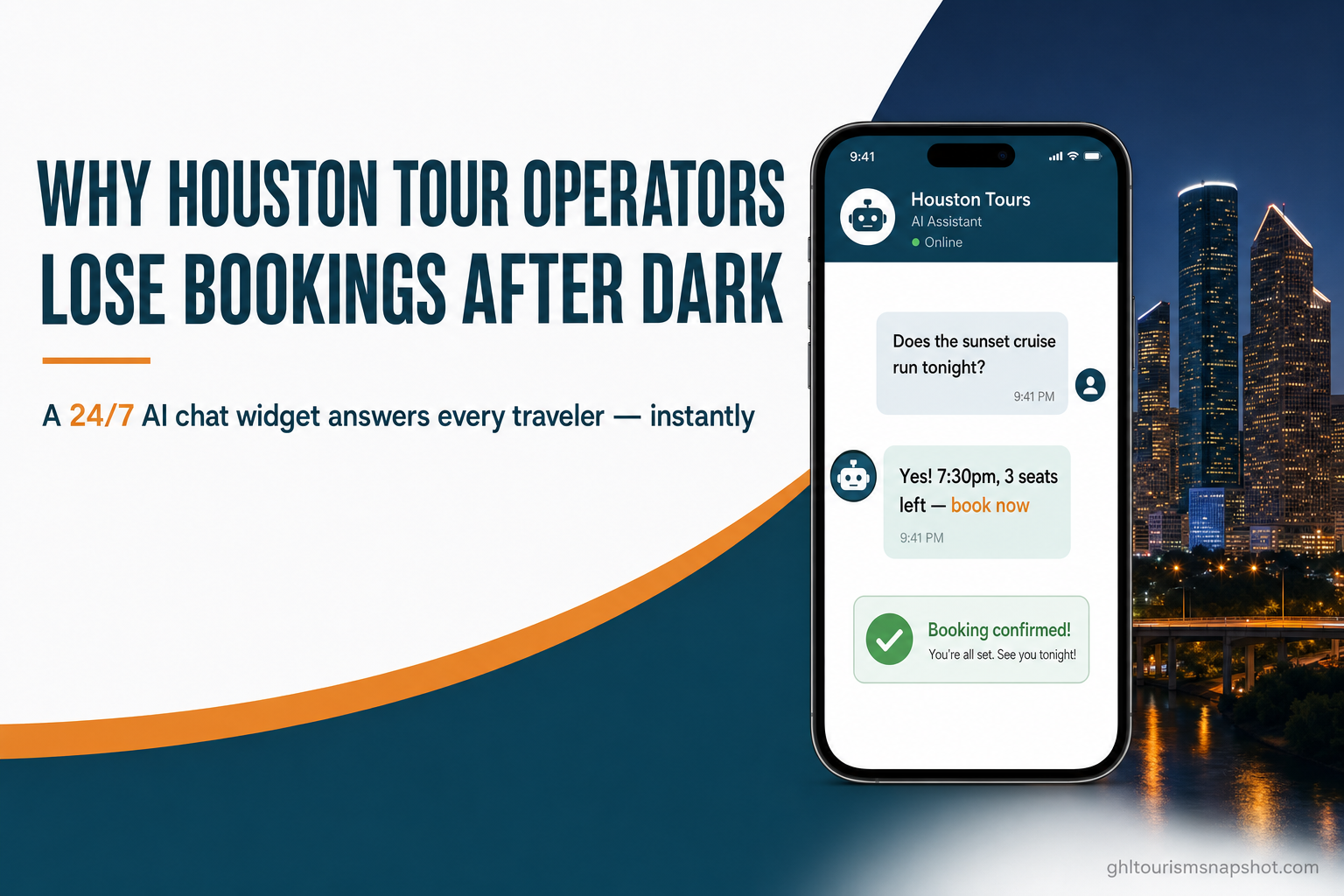
For a Houston tour operator, the most expensive booking you’ll ever lose is one you never even see. It’s the traveler who lands at IAH at 9 p.m., opens your website from the back of a rideshare, has one question — does the bayou kayak tour run if it drizzles? — and finds no one to answer it. By the time you read the contact form the next morning, they’ve already booked the operator whose site replied in ten seconds. A 24/7 AI chat widget closes that gap: it answers every question the moment it’s asked, on your website and social channels, qualifies the traveler, and books the trip while you’re asleep or out leading a group.
This is a straight look at what those after-hours, unanswered inquiries actually cost a tour and activity business in Houston — with real, sourced numbers — and what to do about it without hiring a night-shift front desk or chaining yourself to your inbox. It’s written for operators who’d rather be running trips than triaging messages, and for the agencies that serve them.
Why after-dark inquiries are Houston’s quietest booking leak
Tour operators lose bookings in loud, obvious ways — a canceled departure, a no-show, a bad-weather day. But the biggest leak is silent: the inquiry that arrives when there’s no one to catch it. You never hear the phone ring, no form gets submitted, nothing lands in your inbox. The traveler simply asks a question, gets nothing back, and moves on. Because it leaves no trace, it never makes your list of problems to fix — which is exactly why it quietly drains the most money.
Think about when travel decisions actually get made. It’s the family scrolling activities from a hotel bed after a long flight. It’s the couple on the Kemah Boardwalk at 8 p.m. deciding between your sunset cruise and two others, phones out, right now. It’s the group organizer comparing food-tour options on a Sunday. These are the highest-intent moments a traveler ever has — and they overwhelmingly happen outside the nine-to-five, on a small screen, with a competitor’s booking button one tab away.
The cruel twist is that this happens most during your busiest, best stretches. Peak season is exactly when you’re out on the water or on the trail and least able to sit by a screen — and also exactly when the most new travelers are researching and trying to book the next trip. The desk is unattended because, for most small operators, the desk is you.
The data: how few businesses actually answer in time
Here’s the uncomfortable part: even during business hours, most companies are painfully slow to respond — and travelers have zero patience for it. Two numbers tell the whole story.
First, the expectation. 64% of consumers and 80% of business buyers now expect companies to respond and interact with them in real time, according to Salesforce’s State of the Connected Customer (Salesforce). “Real time” means seconds, not “sometime tomorrow.”
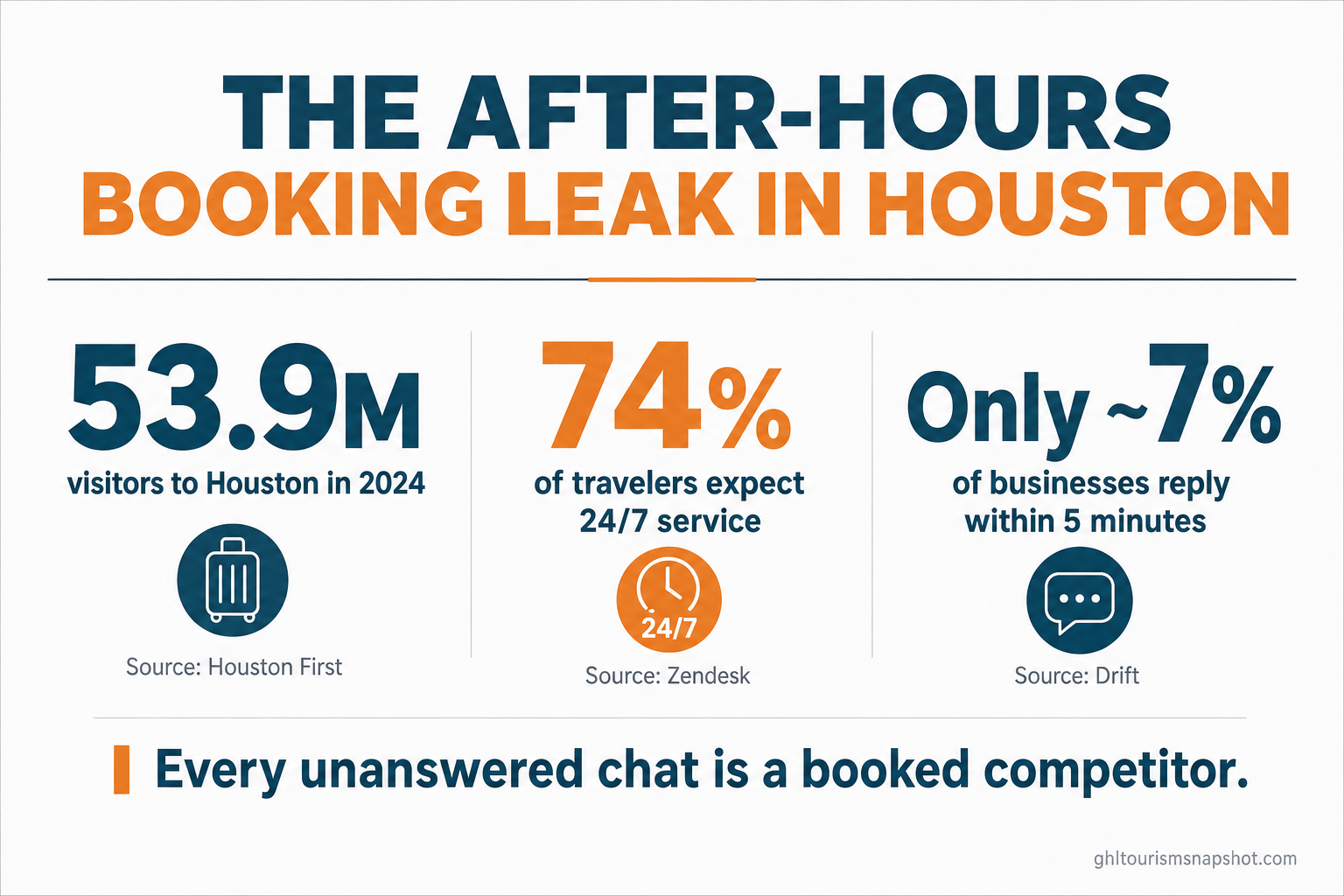
Second, the reality. Drift’s research on conversational marketing found that only about 7% of companies respond to an inbound web lead within five minutes — while 55% take five or more business days, and many never respond at all (Drift, via MarketingProfs). Harvard Business Review’s audit of 2,241 U.S. companies put the median first response to an online lead at 42 hours, with 23% never responding (HBR).
Now put speed next to outcome. The landmark MIT / InsideSales Lead Response Management study found that contacting a web lead within 5 minutes made a business roughly 21× more likely to qualify it than waiting just 30 minutes, and about 100× more likely to reach the person at all (InsideSales / MIT). The reward for answering in the moment is enormous; the field is answering in days. That spread is the opportunity — and for an operator with no night receptionist, an AI chat widget is the only way to capture it on every inquiry, at every hour.
In Houston, an unanswered chat is a booked competitor
Houston is not a small market where one missed message rounds to zero. The city welcomed a record 53.9 million visitors in 2024, who spent $10.8 billion, generating a $16.6 billion total economic impact and supporting roughly 121,800 jobs — every figure an all-time high (Houston First Corporation). Zoom out to the state and the backdrop is just as big: Texas drew 62 million travelers who spent $97.5 billion directly in 2024 (Travel Texas, Office of the Governor).
Here’s why that scale cuts against you when you’re slow: in a deep, competitive market, an unanswered inquiry is almost never a lost inquiry — it’s a redirected one. The traveler who didn’t hear back from you didn’t give up on a Houston tour. They booked one. Just not yours. Every unanswered midnight chat is essentially a warm lead you handed to the operator down the street who happened to answer. In a thin market you might get a second chance; in Houston, there’s always another option one search away.
Travelers now expect an instant answer — at any hour
This isn’t just about speed — it’s about a genuine shift in what travelers consider normal. People now expect to get help the second they want it, day or night, and they’ve decided that typing a quick question is the easiest way to do it.
The numbers are blunt. 74% of consumers expect customer service to be available 24/7, and 88% expect faster response times than they did a year ago (Zendesk CX Trends 2024). When it comes to how they’d rather get answers, 62% say they’d rather use a chatbot than wait for a human agent, and 64% name always-on, 24-hour service as chat’s single biggest benefit (Tidio).
Read those together and the message to operators is clear: the traveler doesn’t care that you’re a two-person crew who was on the boat all day. They compare your response time to the last great app they used, and they judge accordingly. An always-on assistant that answers instantly isn’t a luxury add-on anymore — it’s the baseline experience travelers already expect, and the operators who meet it win the booking before the “slow but lovely” operator has even seen the message.
The self-serve shift: bookings are moving online and to mobile
The reason after-hours matters more every year is that travelers increasingly want to complete the whole booking themselves, on their phone, without talking to anyone. If your site can’t answer their question and take the booking in that moment, you’re not just losing a conversation — you’re losing the sale to whoever can.
Two data points from the tours-and-activities sector make this concrete. First, mobile: roughly two in five direct online bookings for operators now happen on mobile, and mobile already accounts for 52% of attraction-site bookings, up from 37% in 2019 (Arival). Second, the online shift itself: the share of experiences bookings made online has climbed from about 17% in 2019 to roughly 33% in 2025, and is projected to reach ~42% by 2029 (Arival / Phocuswright).
There’s a margin story here too. As operators leave money on the table with slow, hard-to-use booking flows, OTAs have grown to capture about a third of experiences bookings — up from 24% in 2019 (Arival). Every booking a traveler completes on an OTA instead of your own site is a booking you paid commission on because your direct channel couldn’t answer a question in time. Making your own website answer instantly is one of the most direct ways to defend both the booking and the margin. (For the deeper playbook, see our guide on winning more direct bookings.)
What a 24/7 AI chat widget actually does for a tour operator
“AI chat widget” can sound abstract, so here’s exactly what it does, in order, every time — the same flow whether it’s 2 p.m. or 2 a.m.
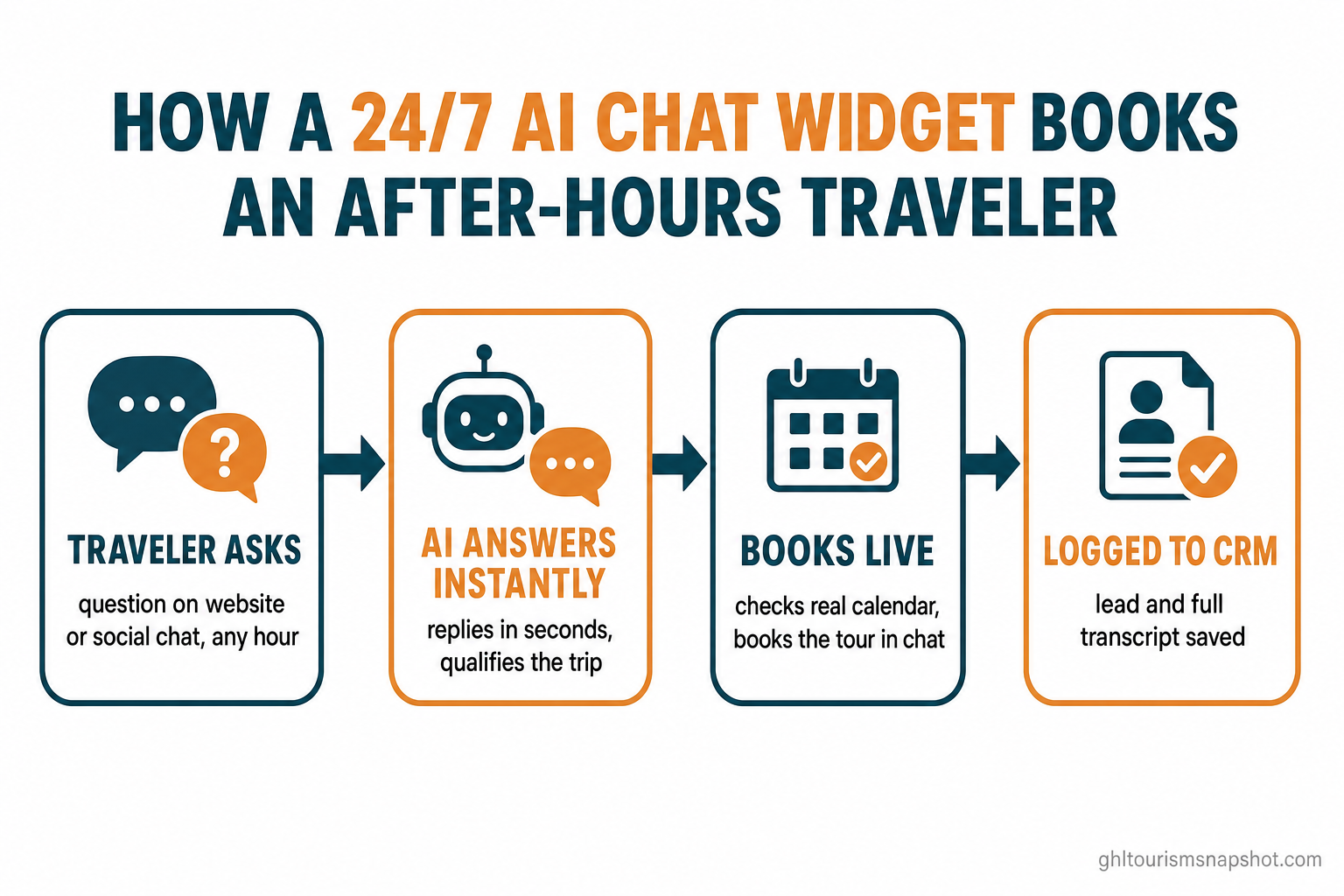
- It greets and answers, instantly. A traveler on your website, Instagram, Facebook Messenger, or Google Business chat asks anything — dates, price, meeting point, refund policy, “is it kid-friendly?” — and the widget replies in seconds, in your brand’s voice, using your real trip facts.
- It qualifies without an interrogation. It gently learns group size, preferred date, and trip type, so the conversation moves toward a real booking instead of a dead-end FAQ.
- It books, live. When the traveler is ready, it checks your actual calendar availability and books the trip or a planning call right inside the chat — not a “someone will email you” promise.
- It hands you a clean lead. Every conversation is logged to your CRM as a tagged contact with the full transcript, so nothing falls through the cracks and genuine edge cases get routed to a human with full context.
Inside the Tourism Snapshot, the chat widget is one of eleven automations that share a single CRM and calendar — so a typed inquiry, a phone call caught by the AI voice agent, and a Facebook or Instagram DM all land in the same place, follow the same speed-to-lead rules, and get the same instant, on-brand response.
Why a contact form and “we’ll get back to you” can’t keep up
Most tour websites still rely on a contact form or a “Request info” button that quietly emails the owner to reply “when you get a chance.” That setup is structurally designed to lose in a world where travelers expect real-time answers.
Think about the sequence. A traveler fills out your form at 9:40 p.m. It lands in an inbox you’ll open at 8 a.m. By then they’ve had eleven hours to keep browsing — and given that most competitors are also slow, the booking goes to whoever answered first, not whoever was best. The form didn’t capture a lead; it added a step between an interested traveler and a fast competitor.
None of this means firing your team or sounding like a robot. The best setup is human-first: the widget handles the instant, repetitive, after-hours load — the “what time does it start” and “do you run in light rain” questions — and hands the nuanced, high-value conversations to a real person with the full transcript already in hand.
Putting a dollar figure on your after-hours leak
You don’t need perfect analytics to size this — a back-of-napkin estimate is enough to make the decision obvious. Try it with your own numbers:
- Say your site gets 20 inquiry-intent visits a day (chats started, form views, “check availability” clicks).
- Conservatively, 40% arrive outside the hours you can respond in minutes — that’s 8 after-hours inquiries a day.
- If even 2 of those would have booked had they gotten an instant answer, and your average booking is $180, that’s $360/day walking out the door — over $10,000 a month in bookings your competitors are catching.
Those are illustrative inputs, not a promise — plug in your real traffic, close rate, and average trip value. But the shape holds for almost every operator: because booking abandonment across e-commerce averages around 70% (Baymard Institute) — and trips are high-consideration, easy-to-abandon purchases — a meaningful slice of those abandons are simply one unanswered question. Answer it in the moment and a real fraction of them convert. The widget doesn’t need to win every chat to pay for itself many times over; it needs to catch the ones you’re currently losing in silence.
How to get an AI chat widget without becoming a GHL admin
The catch with most tour software is that the tool is only as good as the person configuring it — and you didn’t get into tourism to become a CRM administrator. That’s the whole point of a done-for-you snapshot: the AI chat widget arrives already wired into a complete GoHighLevel system — trained on your trips, connected to your real calendar, branded in your voice, and logging every conversation as a lead — installed in about 24 hours, not built by you over months.
If you’d rather see it work on your own trips before deciding, that’s the right instinct. Watch it answer a real after-hours question and book against a live calendar, then judge.
You can go deeper on the mechanics in our companion piece on the AI chatbot for tour operators, or see how instant answers fit the bigger picture of recovering abandoned tour bookings. And if your website itself is slow or hard to update, a fast, purpose-built tour website is what makes an instant-answer chat feel effortless to the traveler.
FAQ
What is an AI chat widget for a Houston tour operator?
It's an always-on chat bubble on your website and social channels (Instagram, Facebook Messenger, Google Business) that answers travelers' questions about dates, pricing, meeting points, and policies in seconds, qualifies the inquiry, and books the trip or a planning call live in the chat — then logs the full conversation to your GoHighLevel CRM as a tagged lead. Unlike a contact form, it replies instantly, 24/7, so a Houston traveler browsing at midnight gets an answer before they have a reason to leave for a competitor.
Does the chat widget actually book trips, or just collect questions?
Both. It answers trip FAQs and, when the traveler is ready, books the trip or a consult live inside the chat against your real calendar availability — then drops the lead and full transcript into your CRM. It is not a passive form that just emails you a name to chase the next morning.
Will it sound like a robot to my travelers?
Only if you set it up that way. The widget takes on the tone, trip names, and local Houston color you give it, so it can sound like the friendliest person at your meeting point rather than a support script. The keys are feeding it your real voice and accurate trip facts, being transparent that it's a booking assistant, and setting clean handoff rules so genuine edge cases pass to a human with full context.
How is a chat widget different from an AI voice agent?
The chat widget handles typed conversations on your website and social DMs; the AI voice agent answers your phone. They catch different travelers — mid-research browsers who'd never call versus high-intent callers who want to talk. The strongest setup runs both on the same CRM and calendar so every inquiry, typed or spoken, lands in one place. See our companion posts on the AI chatbot and AI voice agents for tour operators.
How fast can a Houston tour operator get this running?
Inside the done-for-you Tourism Snapshot, the AI chat widget is installed into your GoHighLevel account — trained on your trips, connected to your calendar, and branded in your voice — in about 24 hours, alongside ten other automations. You don't build or configure it yourself.
Is it compliant and safe to use for bookings?
Yes, when configured correctly. The widget captures explicit consent before collecting contact details, honors STOP requests on any SMS handoff, and follows TCPA-style consent rules. Conversation data lives in your own GoHighLevel CRM under your account controls, so you decide retention and access. It is a marketing and booking-assistance tool and makes no guarantees about specific booking volumes.
Related reading