
When a traveler standing on Ocean Drive pulls out their phone and searches “boat tour near me” or “food tour South Beach,” Google shows them three businesses in a little map box before anything else. That box — the Map Pack — is where Miami tour bookings are won or lost, and the single biggest lever you control over who lands in it is your Google reviews. For Miami tour operators, a steady stream of recent, high-rated, well-answered reviews is what pushes you into that top-three box and turns the click into a booked seat. This guide breaks down exactly how reviews rank and convert, with current 2024–2026 data, and how to make them arrive on autopilot instead of hoping happy travelers remember.
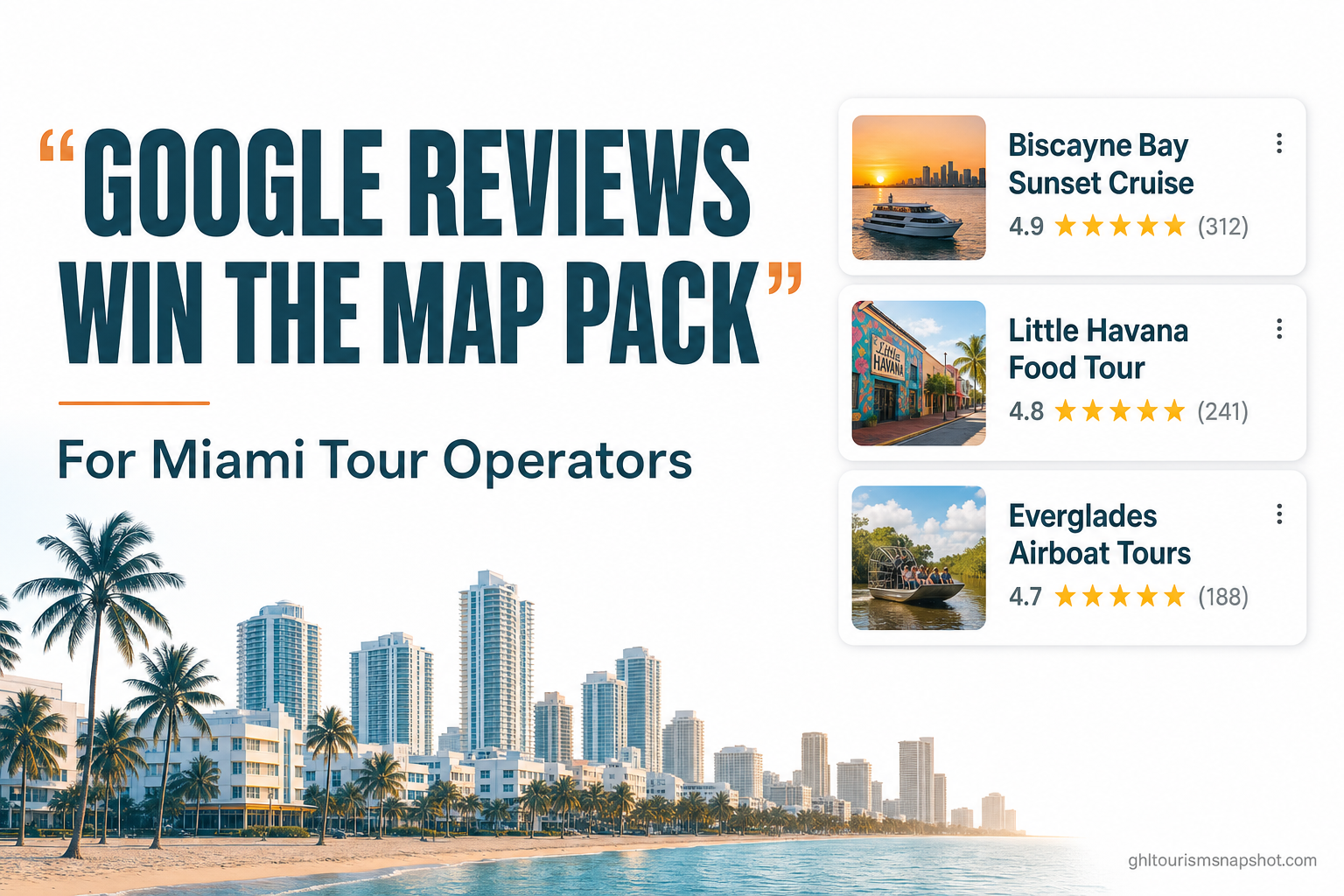
Here’s the honest, operator-to-operator version: Miami is one of the most crowded tour markets in the country, the travelers researching you are reading reviews before they ever call, and the operators who win the Map Pack are rarely the ones with the best tours — they’re the ones with the best review engine. Let’s fix that.
What “winning the Map Pack” means for a Miami tour operator
The Map Pack (also called the local 3-pack) is the block of three business listings with a map that Google shows at the top of local, intent-heavy searches — “things to do in Miami,” “Everglades airboat tour,” “Little Havana food tour,” “sunset cruise Biscayne Bay.” For a tour operator, it is the most valuable real estate on the internet, because it sits above the regular blue links and captures the traveler at the exact moment they’re deciding what to book.
Getting into that box isn’t about paying more or having the flashiest website. Google assembles the Map Pack from your Google Business Profile and the signals attached to it — and reviews are one of the loudest signals it reads. Three things about your reviews feed the ranking directly:
- Quantity — how many reviews you have relative to nearby competitors.
- Velocity and recency — whether new reviews keep arriving, or whether your last one was eight months ago.
- Rating and sentiment — your star average and the words travelers actually use (“guide,” “sunset,” “family,” “worth it”).
A Miami operator with 340 recent 4.9-star reviews and a reply under each one looks, to Google and to the traveler, like the safe choice. An operator with 60 reviews and nothing since spring looks like a gamble. Same tours — very different booking calendars.
Miami’s tourism boom: the opportunity and the crowd
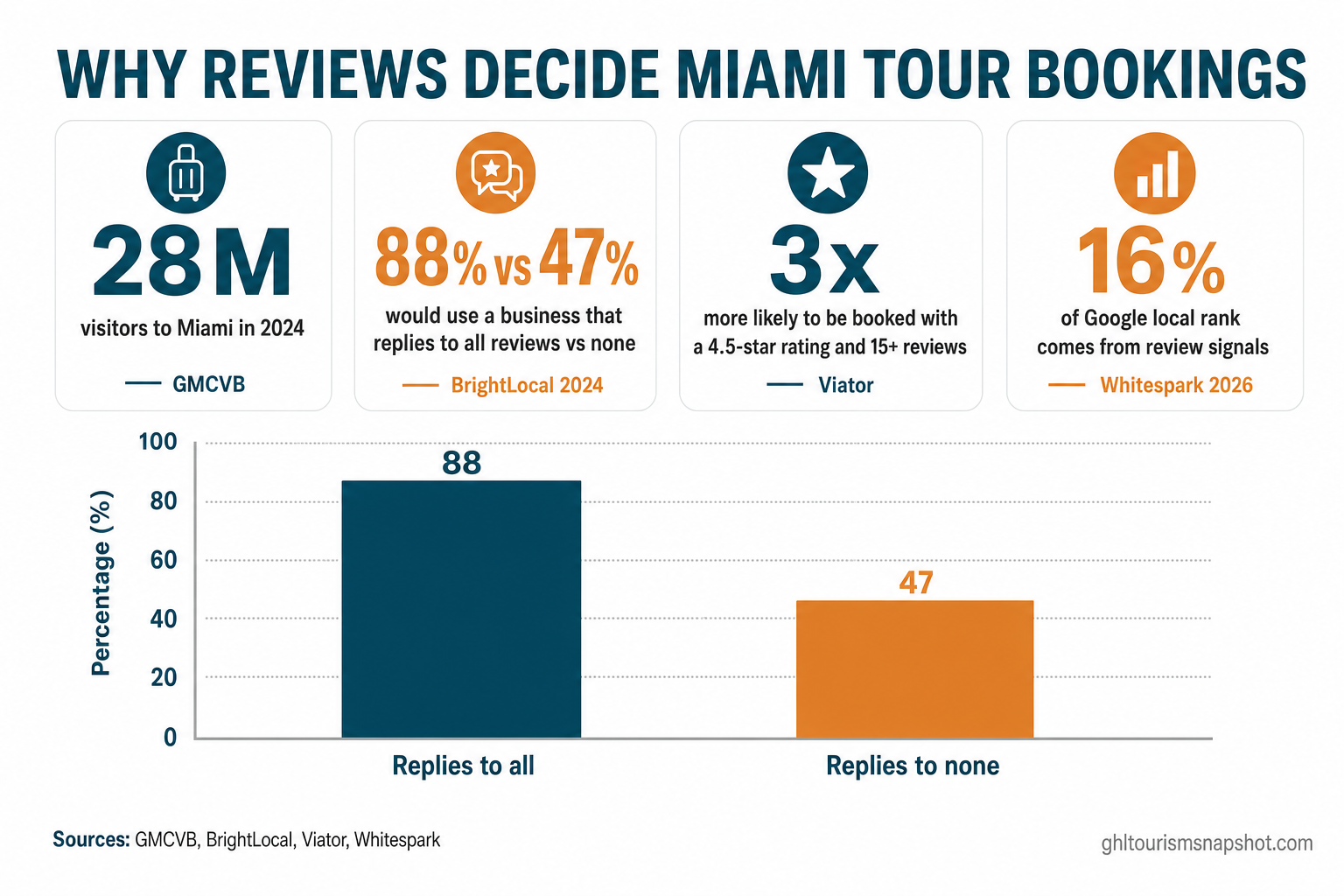
Miami is not a market where demand is the problem. According to the Greater Miami Convention & Visitors Bureau, Greater Miami & Miami Beach welcomed a record 28 million visitors in 2024, who spent $22 billion, generated $2.2 billion in state and local taxes, and supported more than 209,000 tourism-related jobs (GMCVB via PR Newswire). Both domestic and international visitors came in higher numbers than 2023 — up 2% and 4% respectively — with international visitors from Colombia, Brazil, and the UK all posting double-digit or near-double-digit gains.
That’s the gift. The trap is that all of that demand is discovered the same way: on a phone, through Google, in a moment of decision. Travel discovery went local and mobile years ago — Google reported that mobile searches for “things to do” or “activities near me” grew roughly 6× over two years as far back as 2018 (Think with Google), and the behavior has only deepened since. Meanwhile the experiences category itself is booming: Arival and Phocuswright size the global experiences market at $253 billion in 2024, growing 17% that year — nearly three times the ~6% growth of travel overall — and heading for $342 billion by 2029 (Arival).
So a traveler planning tomorrow’s Miami itinerary from a hotel room in Brickell has more great options than they can process — and they’ll resolve that overload by trusting the operators the crowd already trusts. In a city this dense with competitors, reviews are how you become the obvious pick instead of one of forty tabs.
How Google reviews actually decide your local ranking
Reviews aren’t just social proof for humans — they’re a ranking input for Google. Whitespark’s Local Search Ranking Factors study, the industry’s long-running expert survey of what moves the local pack, puts Google Business Profile signals at about 32% of local-pack ranking weight and review signals at about 16% — and flags reviews (along with behavioral signals) as the factor rising fastest heading into 2026 (Whitespark). Add the two together and roughly half of your Map Pack fate runs through your Google Business Profile and the reviews attached to it.
The nuance that trips up most operators is that reviews are not a one-time achievement. Whitespark repeatedly names review recency and velocity as some of the most underrated local-ranking factors — a business that earned 200 reviews two years ago and stopped is treated very differently from one adding a handful every week. Google reads a live stream of recent reviews as evidence that you’re active, popular, and safe to surface. That’s why “we already have great reviews” is not a finished project; the operators winning Miami’s Map Pack are the ones still adding fresh ones every departure.
This pairs directly with the fundamentals in our local SEO guide for tour operators — reviews are the fuel, and a complete, accurate Google Business Profile is the engine they run.
Why reviews convert Miami travelers into bookings
Ranking in the Map Pack gets you seen. Reviews are also what turn that visibility into a paid booking. Travelers lean on reviews harder than almost any other buying decision. In the landmark Ipsos MORI study for Tripadvisor — which surveyed more than 23,000 travelers worldwide — 72% said they always or frequently read reviews before deciding where to go or what to do, 78% focus on the most recent reviews, and users read an average of nine reviews before booking (Tripadvisor).
The effect on bookings is measurable, not vague. Viator’s own operator data shows that experiences earning its Badge of Excellence — at least 15 reviews and a 4.5+ average rating — are about 3× more likely to be booked than lower-rated, lower-volume listings (Viator). Rating and review count aren’t a vanity metric; they’re a conversion multiplier. For a Miami operator competing against dozens of similar sunset cruises or Wynwood art walks, the gap between a thin 4.2 and a deep 4.8 is the difference between “maybe” and “booked.”
The response gap that’s costing Miami operators trips
Here’s where most operators leave bookings on the table: they treat reviews as something that happens to them, and they rarely reply. That’s a mistake, because the reply is its own ranking and conversion signal.
The data is blunt. BrightLocal’s 2024 Local Consumer Review Survey found that 88% of consumers would use a business that responds to all of its reviews, compared with just 47% for a business that responds to none (BrightLocal). In travel specifically, Tripadvisor’s research found 77% of travelers are more likely to book when the owner responds to reviews, and 89% said a thoughtful response to a negative review actually improved their impression of the business (Tripadvisor).
A reply does three jobs at once: it tells Google your profile is active, it shows the next traveler you’re attentive, and — when the review is negative — it publicly demonstrates how you handle a problem. The catch is time. Replying thoughtfully to every review, requesting a review from every happy traveler, and catching the occasional unhappy one before it goes public is a real daily job — and it’s the first thing that slides when you’re guiding trips all season. This is exactly the work our review response automation guide is built to systematize, and it’s why leaving it to memory quietly caps your Map Pack ranking.
The automated 5-star review system
The operators who dominate Miami’s Map Pack aren’t asking for reviews by hand. They run a system that asks every traveler at the perfect moment, routes feedback intelligently, and answers every review — automatically. Inside a GoHighLevel setup like the Tourism Snapshot, that system has five steps:
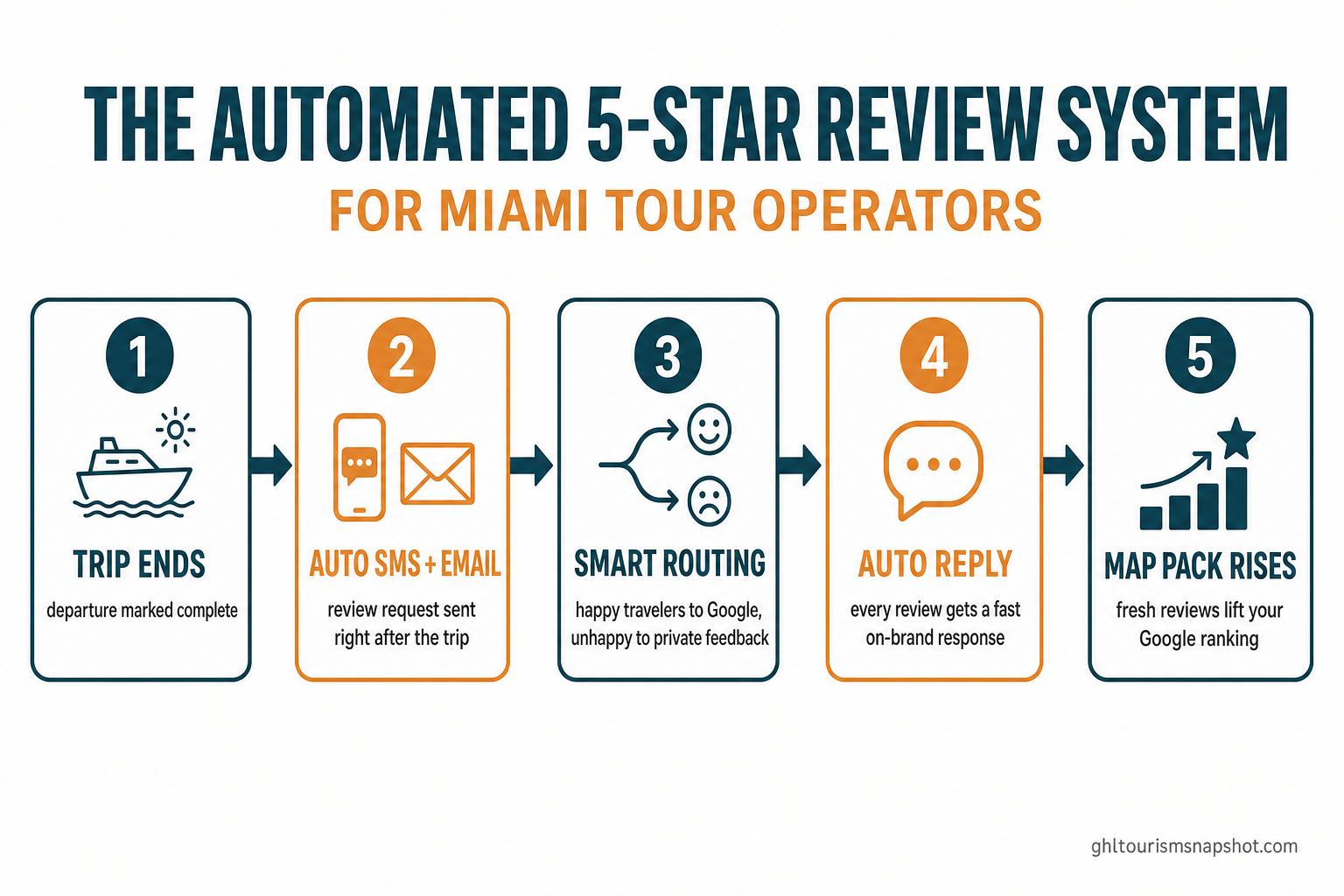
- Trip ends → trigger fires. The moment a departure is marked complete, the traveler enters a review sequence — while the sunset cruise or food crawl is still fresh in their mind.
- Automatic SMS + email ask. A short, on-brand text and email invite them to leave a Google review, with a one-tap link. Asking every traveler, every time, is what builds the velocity Google rewards. (See the full get-more-5-star-reviews playbook for the exact timing and message.)
- Smart routing. Delighted travelers are sent straight to your Google Business Profile; anyone who signals a problem is routed to a private feedback form first — so you catch and fix it before it becomes a public one-star.
- Every review gets a reply. New reviews trigger an AI-drafted, human-approved response — warm for the five-stars, calm and specific for the critical ones — so you never miss the 88%-vs-47% opportunity. This is powered by Google My Business reply automation.
- Reviews compound your ranking. Fresh, high-rated, answered reviews keep flowing into your profile, lifting you in the Map Pack — which drives more visibility, which drives more reviews.
That loop is the difference between hoping for reviews and manufacturing them. It’s one of the eleven features in the snapshot, and it works alongside the rest of your booking engine — see the six automations every tour operator should run for how it fits.
Same Miami tours, two very different review engines
You ask for reviews when you remember — which is rarely, mid-season. New reviews trickle in a few a month, your last reply was in spring, and a lukewarm 3-star from a rainy-day tour sits on top with no response. In the Map Pack you're stuck at #6, below two operators with half your quality but triple your recent reviews.
Every traveler gets an automatic ask the day their trip ends, so 5–10 fresh reviews land each week. Happy guests go to Google; the occasional unhappy one reaches you privately first. Every review — good or bad — gets a same-day reply. Within a season you've climbed into the 3-pack, and the bookings follow.
The ROI math for a Miami operator
Keep it concrete. Say your average Miami tour books at $75 per seat and a typical booking is two seats — $150 per booking. The Tourism Snapshot that installs this review system (plus ten other automations) is a one-time $997, not a monthly bill.
At $150 a booking, the review engine pays for the entire snapshot if it wins you about seven extra bookings — once. Given that a stronger review profile can make an experience roughly 3× more likely to be booked, and that climbing even one position in the Map Pack meaningfully increases the clicks you get, seven incremental bookings across a Miami season is a conservative floor, not a stretch. Everything after that — the ranking lift, the higher conversion, the negative reviews you caught privately — is margin.
How to get started
You don’t need to rebuild anything to start winning the Map Pack. The fastest path for a Miami operator is:
- Claim and complete your Google Business Profile. Right categories, real photos, current hours, correct booking link — this is the engine your reviews feed.
- Turn on an automatic review request for every completed trip. Velocity is the lever most operators are missing; asking every traveler is where the compounding starts.
- Reply to every review, fast. Warm for the good ones, specific and calm for the critical ones. If you can’t keep up by hand, automate the drafts and approve them.
If that sounds like a job you don’t have time for mid-season, that’s the point of doing it as a system rather than a chore. The Tourism Snapshot installs the whole review engine — request, routing, and replies — in about 24 hours, or you can book a quick demo to see it running before you buy. Prefer to talk it through first? Talk to a real person about how your Miami tours book today and where reviews are leaking.
Frequently asked questions
How many Google reviews does a Miami tour operator need to rank in the Map Pack?
There's no fixed number — the Map Pack is relative to your competitors in Miami. What matters is having more recent, higher-rated reviews than the operators near you, and keeping them coming. Whitespark's research puts review signals at roughly 16% of local-pack ranking weight, and flags review recency and velocity (a steady stream of new reviews) as especially important. Practically, a Miami operator should aim to add several fresh reviews every week, not hit a one-time milestone and stop.
Do Google reviews really affect where I show up in local search?
Yes. Review signals — quantity, velocity, recency, rating, and sentiment — are a documented local-ranking factor, and they've been rising in importance. Combined with your Google Business Profile signals, they account for nearly half of local-pack ranking weight in Whitespark's 2026 study. Reviews influence both whether you appear in the Map Pack and whether travelers click and book once you do.
Should I respond to every review, even the good ones?
Yes. BrightLocal found 88% of consumers would use a business that responds to all its reviews versus just 47% for one that responds to none, and Tripadvisor found 77% of travelers are more likely to book when the owner replies. Responding also signals to Google that your profile is active. Warm, brief replies to positive reviews and calm, specific replies to critical ones both help — and both can be automated with human approval.
How does automated review harvesting work without feeling spammy?
The system asks each traveler once, at the right moment — right after their trip ends, when the experience is fresh — with a short, on-brand SMS and email and a one-tap link. Happy travelers are routed to Google; anyone who signals a problem goes to a private feedback form first. It's the same polite ask you'd make by hand, just done consistently for every departure instead of only when you remember.
Is asking travelers to route unhappy feedback privately against Google's rules?
The system asks every traveler for feedback and makes it easy for satisfied guests to review you on Google, while giving anyone with a complaint a direct private channel to reach you first. You never buy, fake, or gate reviews — you simply make it effortless for happy travelers to share their experience and give unhappy ones a fast way to be heard. That's how you build a genuine, high-rated profile that holds up.
Is this only for Miami tour operators?
No — the same review system works for tour, activity, and travel operators across the USA. This guide is framed for Miami because it's one of the highest-volume, most-competitive tour markets in the country, where the Map Pack and reviews make an outsized difference. The Tourism Snapshot installs the same engine for operators anywhere.
About the author
Desmond Clarke is a GHL Agency Strategist based in Savannah, Georgia, who runs a boutique GoHighLevel agency serving travel and hospitality clients — from harbor cruise companies to multi-day expedition outfitters. He came up through paid media and conversion copywriting, so he looks at every automation through the lens of cost-per-booked-seat. He writes about the systems that quietly decide which operators fill their departures: review engines, lifecycle SMS, and proving ROI to operator clients.
Editorial note: GHL Tourism Snapshot is a GoHighLevel automation and services product, not a travel agency. We don’t sell, book, or guarantee any tour. Statistics are drawn from the cited sources and reflect industry or study averages; some travel-review figures date from the cited study years. Your results will vary with your offer, market, staffing, and traffic.
Related posts
- Get More 5-Star Reviews — the exact ask-and-route system that fills your Google profile.
- Review Response Automation for Tour Operators — how to reply to every review without living in your inbox.
- Local SEO for Tour Operators — the Google Business Profile fundamentals reviews run on.
- Speed to Lead for Tour Operators — why the first five minutes decide the booking.
- 6 Automations Every Tour Operator Should Run — where the review engine fits in the full system.
Ready to win the Miami Map Pack with reviews that arrive on autopilot? See the Tourism Snapshot, book a demo, or talk to a real person about your Miami tours.