
For Seattle tour operators, YouTube is the only social channel that behaves like a search engine instead of a feed — which means a single good video keeps getting found, watched, and booked for years, not hours. A whale-watching reel on Instagram peaks in 48 hours and disappears; a “Best Seattle whale watching tour — what to expect” video on YouTube shows up every time a traveler searches that phrase next month, next season, and next year. That difference — evergreen, searchable discovery versus a disappearing feed — is why YouTube is the highest-leverage, lowest-decay booking channel most Seattle operators are still ignoring. This guide breaks down the 2026 numbers, why they matter specifically for a Seattle activity business, and how to turn views into confirmed seats without living inside a video editor.
This is the agency-strategist version of the pitch, written through a cost-per-booked-seat lens: what YouTube actually does that Reels and TikTok can’t, backed by current data, and the system that turns a Seattle operator’s trip footage into a channel that fills departures while they’re out on the water.
Why YouTube beats Reels and TikTok for tour bookings
Instagram Reels and TikTok are feed platforms. Their algorithms reward freshness: a clip spikes for a day or two while it’s being pushed to strangers, then it’s effectively gone. That’s genuinely useful for reach — we’ve written the Instagram Reels playbook for San Diego operators and the TikTok playbook for Chicago operators, and both work. But feed platforms have a structural flaw for a booking business: their content has a half-life measured in hours.
YouTube is different in one decisive way — it’s built on search and intent. People don’t just scroll YouTube; they go to it and type things like “Seattle whale watching worth it,” “Pike Place food tour review,” or “what to wear kayaking Lake Union.” Those are travelers actively planning to spend money, and the video that answers them keeps showing up in results for months or years. A Reel is a billboard you rent for 48 hours. A YouTube video is a booking asset you own — one that compounds.
There’s a second advantage that agency owners love: YouTube is owned by Google. Its videos appear in Google’s main search results, in the video carousel, and increasingly in AI answer summaries. One large analysis of thousands of video-heavy queries found the overwhelming majority of videos ranking in Google’s top positions came from YouTube (Search Engine Land). So a single well-titled Seattle tour video can rank on YouTube and on Google at the same time — two of the three biggest discovery surfaces on the internet, from one upload. This is the same being-found-everywhere logic behind our local SEO and AI answer-engine playbooks; YouTube is the video half of that story.
The Seattle context: huge demand, high-intent search
Seattle is one of the strongest activity markets in the country, and the recovery is real. According to Visit Seattle, Seattle and King County welcomed 40 million visitors in 2024 — up 5.3% year over year and back to roughly 95% of the pre-pandemic peak. Those visitors spent a record $8.8 billion, producing a $12.3 billion total economic impact and supporting 68,089 local jobs.
That demand is a gift and a trap. A gift because a whale-watching cruise out of Elliott Bay, a Bainbridge Island ferry-and-food day trip, a Pike Place Market tasting tour, a seaplane flightseeing hop, or a Mount Rainier day tour never runs short of interested travelers. A trap because a Seattle visitor planning tomorrow is one search away from a dozen competitors — and the way they de-risk the decision is by watching. They want to see the boat, the guide, the portions, the views, and the other travelers’ faces before they hand over $90 to $300 a seat. A photo grid can’t do that. A video can.
Here’s the part most operators miss: those searches happen on a schedule you can’t predict, at 10 p.m. three weeks before arrival, on a phone, in a hotel bed. A Reel you posted last Tuesday is invisible to that traveler. A YouTube video titled for exactly what they typed is right there — which is why YouTube behaves less like social media and more like an always-open storefront on the busiest street in town.
The 2026 data behind video for tour operators
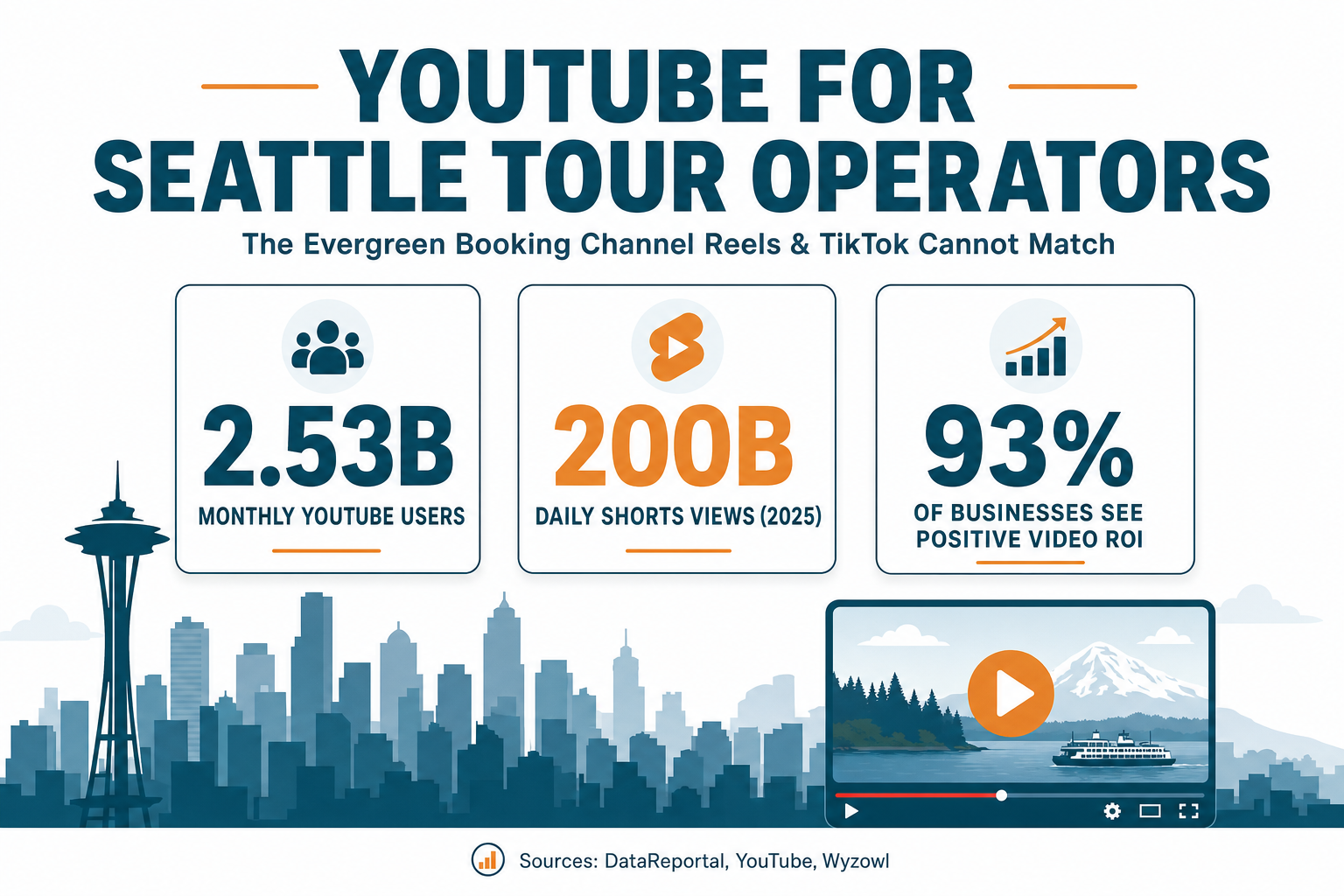
The case for video isn’t a hunch anymore; it’s one of the best-documented trends in marketing. Start with scale. DataReportal puts YouTube at roughly 2.53 billion monthly logged-in users, second only to Google itself in global web traffic and functioning as the world’s second-largest search engine. And short-form has exploded inside YouTube: the platform announced that YouTube Shorts crossed 200 billion daily views in 2025, nearly triple the 70 billion it reported in early 2024 (YouTube Official Blog).
Reach is only half the story — the other half is whether video actually moves someone to book. It does. In Wyzowl’s 2026 State of Video Marketing report, 85% of people said watching a video convinced them to buy a product or service, and 63% said their most-preferred way to learn about a new product or service is a short video — far ahead of text articles, infographics, or sales calls. On the business side, 93% of companies reported a positive ROI from video (a record), 85% said video helped them generate leads, and 83% said video directly increased sales (Wyzowl).
That “prefer a short video” number is the whole ballgame for a tour business. Your product is an experience — the exact thing video was built to sell. And short-form video is now the format marketers rate the single highest for ROI across all of social (HubSpot). YouTube is the rare place you get that short-form performance and long-form, searchable staying power, instead of choosing one.
Evergreen vs. feed: the channel comparison
None of this means abandoning Reels or TikTok — it means understanding what each channel is for so you spend effort where it compounds. Here’s the honest breakdown of how the three video channels behave for a booking business.
YouTube vs. Reels / TikTok for tour operators
| Plan | YouTube | Reels / TikTok |
|---|---|---|
| Price | Evergreen search asset | Reach & top-of-funnel |
| Feature 1 | Discovery: search + suggested — travelers find you on purpose | Discovery: algorithmic feed — you interrupt the scroll |
| Feature 2 | Content lifespan: months to years (keeps ranking) | Content lifespan: hours to days (then it's gone) |
| Feature 3 | Also appears in: Google Search + AI answers | Also appears in: mostly just the app |
| Feature 4 | Best content: 'is it worth it?' reviews, what-to-expect guides, FAQs | Best content: scroll-stopping trip moments, trends, behind-the-scenes |
| Feature 5 | Buyer intent: high — they're actively planning | Buyer intent: low to medium — you create the craving |
The strategy that wins is to treat them as one pipeline: shoot the trip footage once, cut the best 15–30 seconds for Reels and TikTok to create demand and reach cold travelers, and publish the fuller, keyword-titled versions on YouTube to capture the travelers who go searching afterward. The same day of filming feeds every channel — which is exactly how a done-for-you social media system is built to run.
The 5 videos every Seattle operator should have on YouTube
You don’t need a studio or a hundred uploads. You need a small set of videos that match what Seattle travelers actually search, each titled in plain language:
- The “what to expect” walkthrough. “What to Expect on a Seattle Whale Watching Tour” — the single most-searched reassurance query. Show boarding, the boat, the guide, the wildlife, and a real traveler reaction. This is the video that closes hesitant first-timers.
- The honest review / “is it worth it?” Travelers literally type “is the Pike Place food tour worth it.” Answer it yourself, honestly, and you own the result instead of a review site.
- The FAQ video. “What to wear, what to bring, and where to park” for your specific tour. It kills the objections that cause abandoned bookings and doubles as a pre-trip reminder you can send every booked guest.
- The destination highlight. “5 Things You’ll See on a Bainbridge Island Day Trip.” Broad, inspirational, and highly shareable — great as both a YouTube video and a Shorts/Reels cutdown.
- The social-proof reel. A 30-second montage of real guests, real smiles, real views. Post it everywhere; on YouTube it becomes an evergreen trust-builder that ranks under your brand name.
Notice the pattern: every one of these targets a search a traveler is already making. That’s the mindset shift — you’re not making “content,” you’re answering the questions that stand between a curious traveler and a paid seat.
From YouTube view to booked seat
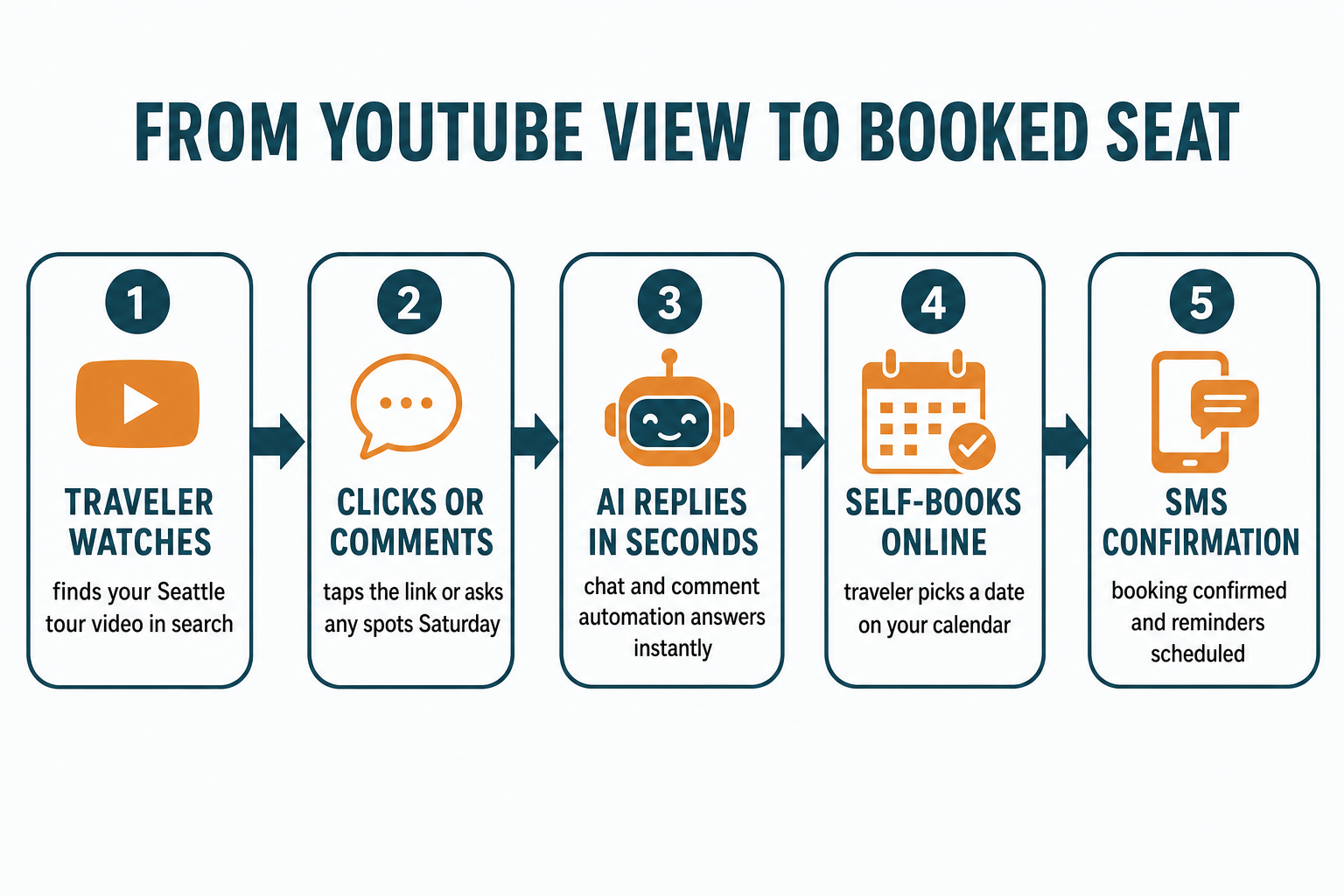
Views are vanity until they turn into bookings, and this is exactly where most operators leak. The chain has to be tight: a traveler watches, clicks your description link or comments a question, and then someone or something has to respond fast enough to catch them while they’re still holding the phone. That last step is where video quietly dies for busy operators — the comment lands at 9 p.m. while you’re closing out the day’s trip, and by the time you see it, they’ve booked the operator who answered.
The reason this matters is the same reason speed to lead decides so many bookings. In the landmark MIT/InsideSales Lead Response Management study, contacting a fresh web lead within 5 minutes versus 30 minutes made you about 21x more likely to qualify it and 100x more likely to even connect (MIT/InsideSales). Yet a Harvard Business Review audit of 2,241 companies found the average first response took 42 hours, and 23% never responded at all (Harvard Business Review). Your YouTube channel can be flawless and you’ll still lose the booking if the reply is slow.
That’s why the video engine and the response engine have to be one system. When a comment or DM comes in, an AI chatbot and comment/DM automation answer instantly in your brand voice, handle the “what to bring / any spots Saturday” questions, and route the traveler to self-book — then SMS automation fires the confirmation and reminders. The video creates the demand; the automation catches it before it cools.
Doing it without living in an editor
Here’s the catch every operator feels immediately: YouTube compounds, but only if you actually publish consistently — and you’re running trips, not a media company. Filming, editing, titling for search, writing descriptions with booking links, cutting Shorts for reach, and answering every comment fast is a real job. Done sporadically, it doesn’t compound; it just eats your evenings.
That’s the gap we fill. A done-for-you social media system turns your raw trip footage into a running channel: search-titled YouTube videos, short cutdowns for Reels and TikTok, captions and descriptions in your brand voice, published on a real cadence across up to nine channels — plus the AI agents that answer comments, DMs, and web chat and book travelers straight onto your calendar. You shoot the trip; we run the channel and catch the leads. For a Seattle operator, that’s the difference between “we should really do YouTube” and a booking asset that fills departures every week without adding a single hour to your plate.
Frequently asked questions
Is YouTube better than Instagram Reels or TikTok for a tour operator?
It's not better — it's different, and most operators need both. Reels and TikTok are feed platforms built for reach: a clip spikes for a day or two, then disappears. YouTube is a search platform: a well-titled video keeps getting found for months or years and also surfaces in Google Search. Use Reels and TikTok to create demand and reach cold travelers, and YouTube to capture the high-intent travelers who go searching 'is this tour worth it?' before they book. Film once, publish to all three.
How many YouTube videos does a Seattle tour operator actually need?
Fewer than you'd think — quality and titling beat volume. A focused set of five works: a 'what to expect' walkthrough, an honest 'is it worth it' review, an FAQ video (what to wear/bring/park), a destination highlight, and a social-proof montage. Each should target a real phrase Seattle travelers search. From there, one or two new videos a month keeps the channel active and compounding.
Why does YouTube keep sending bookings long after I post, when Reels don't?
Because YouTube is powered by search and suggested-video intent, not a freshness-based feed. When a traveler searches 'Seattle whale watching worth it,' your video can rank and get watched whether you posted it yesterday or last year. A Reel, by design, is shown to people while it's new and then fades. That's why YouTube behaves like an owned asset that compounds, while feed content behaves like advertising you have to keep re-buying.
Do YouTube views actually turn into tour bookings?
Only if you catch the traveler fast. Video is proven to drive purchase — 85% of people say a video convinced them to buy, per Wyzowl 2026 — but the booking is won or lost on response speed. The MIT/InsideSales study found replying within 5 minutes made you about 21x more likely to qualify a lead than waiting 30. The fix is pairing the video with AI chat and comment/DM automation that answers instantly and routes the traveler to self-book, so views become confirmed seats instead of unanswered comments.
I don't have time to film and edit YouTube videos — what are my options?
That's the most common blocker, and it's solvable. You film the raw trip footage (a phone is fine); a done-for-you social media service handles the editing, search-optimized titles and descriptions with booking links, Shorts cutdowns for Reels and TikTok, and a consistent publishing cadence — plus the automation that answers comments and DMs. Our Social Media package starts at $397/mo and is fully white-label. It turns footage you're already capturing into an evergreen booking channel without adding to your workload.
Related reading