
For a Raleigh tour operator, the most expensive line item usually isn’t your booking software’s monthly fee — it’s the duct tape holding the whole stack together. FareHarbor for the calendar, a spreadsheet for the manifest, Stripe for payments, your inbox for waivers, Viator for the overflow, and your own memory for everything in between. Each tool is fine on its own. Stitched together by hand, they quietly leak hours, margin, and bookings every single week. This is the story of what that stack actually costs a growing Greater Raleigh operator in 2026 — measured in real numbers — and what a custom booking system and CRM automation replace it with.
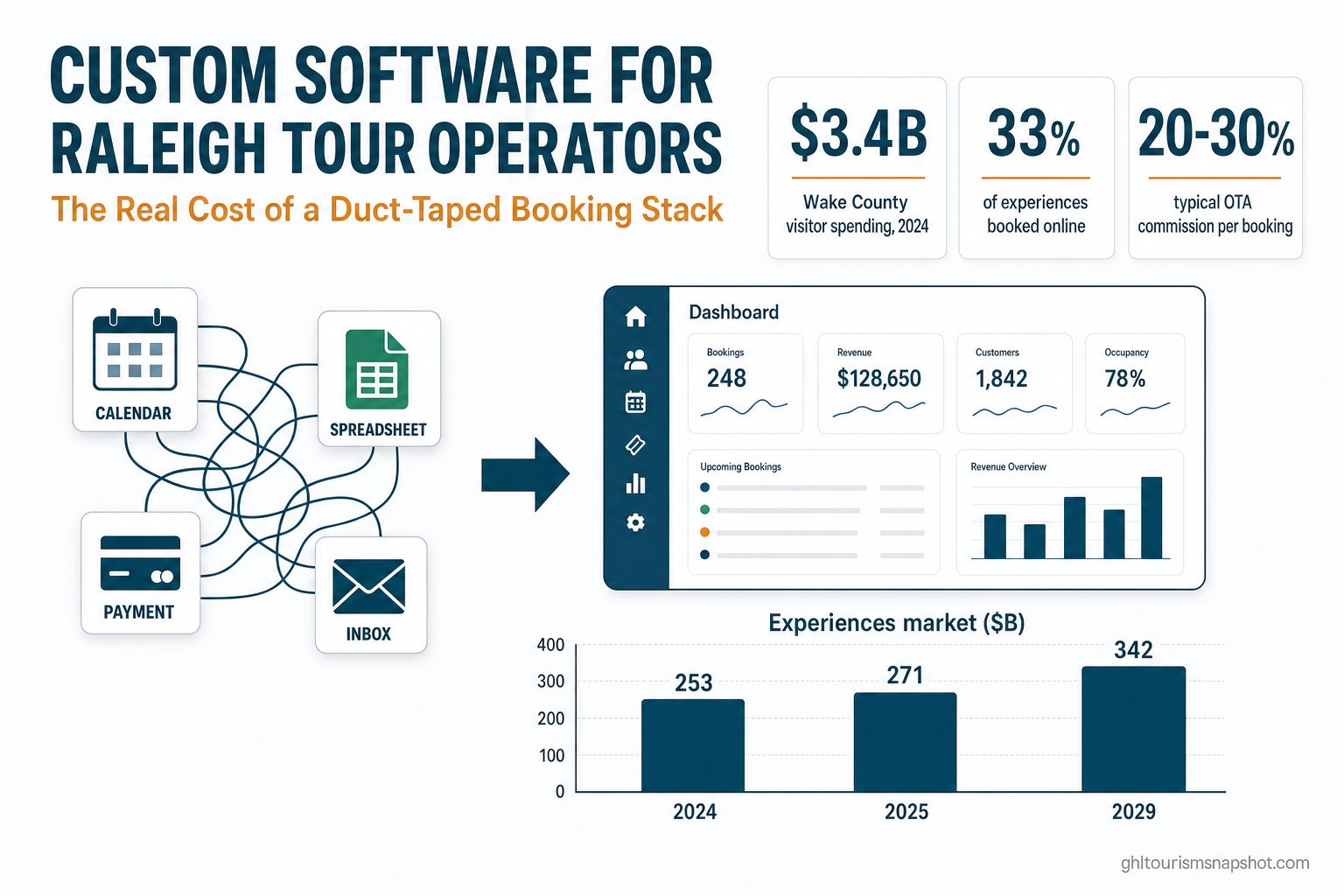
The travelers are already here in record numbers. The question every operator in the Triangle should be asking is whether the system behind the booking button is helping them capture that demand — or quietly bleeding it.
What a duct-taped stack really costs a Raleigh operator
Here is the answer-first version, because you’re busy: a stitched-together stack of off-the-shelf tools costs a growing tour operator in three currencies at once — time (hours a week lost switching between apps and re-keying data), margin (OTA commissions and payment fees stacked on top of each other), and bookings (travelers who abandon a clunky checkout or never get a reply in time). None of these show up as a line on an invoice, which is exactly why they go unfixed for years.
The tools aren’t the problem. FareHarbor, Rezdy, Bokun, Checkfront and Peek Pro are each genuinely good at the one thing they were built for. The problem is that a real tour operation is not one thing. It’s a departure calendar and a manifest and deposits and balances and waivers and guide rosters and a CRM and review requests and rebooking — and no single off-the-shelf product models all of that the way you actually run trips. So you bolt on a second tool, then a third, then a spreadsheet to reconcile them, and the seams between those tools become where your week and your money disappear.
This isn’t an argument that every operator needs custom software tomorrow — we’ve written the honest decision framework for when custom software actually pays off, and plenty of small operators shouldn’t build yet. This is the version for the operator who has already felt the ceiling: the one whose spreadsheet has a spreadsheet, whose “system” only really lives in their own head, and who loses a booking every time they’re out on the water.
The Raleigh context: record demand, dated back office
Greater Raleigh is not a soft market you can coast in. In 2024, Wake County welcomed 19 million visitors — up 2.7% — who spent a record $3.4 billion, a 5.1% jump and an all-time high (Visit Raleigh). Food and beverage alone accounted for $967 million of that, and tourism supported more than 26,000 local jobs. Zoom out to the state and the picture is the same: North Carolina visitors spent a record $36.7 billion in 2024, keeping NC the fifth most-visited state in the country (NC Department of Commerce).
Translation for a Triangle tour operator: the travelers are here, they’re spending, and they’re planning day trips, food-and-brewery crawls, history walks, and outdoor excursions. Demand is not your constraint. Your constraint is whether the machine behind your booking button can capture that demand without you personally touching every step.
And here’s the gap that makes custom systems worth the conversation. The experiences category is one of the fastest-growing corners of travel — global tours, activities and attractions grew to $271 billion in 2025 and are projected to reach $342 billion by 2029, with experience bookings growing 17% in 2024 versus just 6% for travel overall (Arival / Phocuswright). Yet the sector is still shockingly offline: only about a third of experiences are booked online, compared to 64% of travel overall (PhocusWire). That’s the operator’s opportunity and their trap at once — a booming market still running on manual booking.
Pain #1: The toggling tax
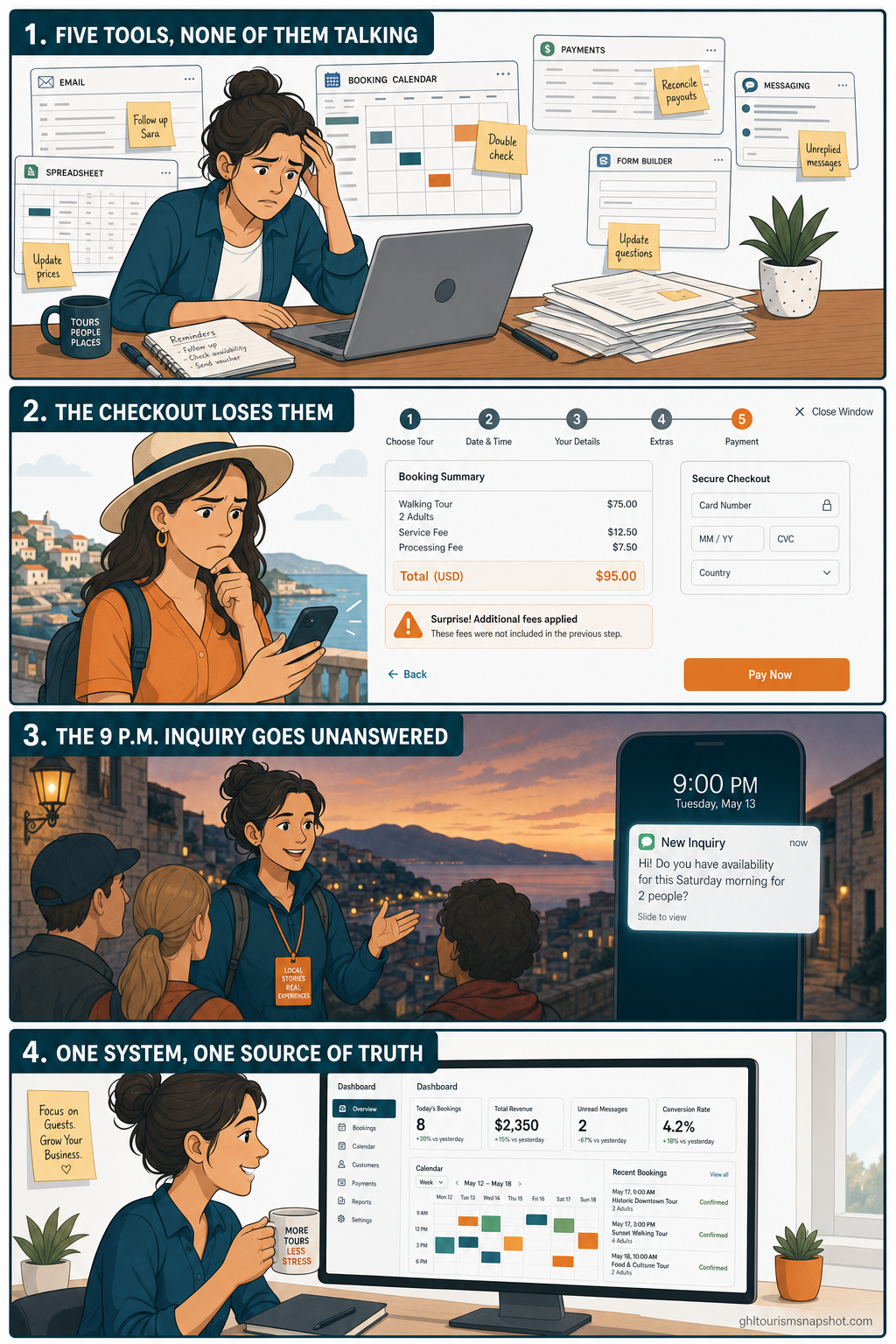
Start with the one you feel every morning. When your bookings live in one tool, your contacts in another, payments in Stripe, waivers in your inbox, and the manifest in a spreadsheet, running a single departure means hopping between five screens and copying the same traveler’s details into each. It feels like “just how it works.” It’s actually one of the most expensive habits in your business.
Harvard Business Review studied this directly and found that employees toggle between different applications and websites nearly 1,200 times a day, and that the drag of re-orienting after each switch adds up to about four hours a week — roughly 9% of the work year (Harvard Business Review). For a two- or three-person tour operation, that’s most of a working day, every week, spent not on selling trips or delighting guests but on being human middleware between tools that don’t talk to each other. Asana’s research on the same problem is even blunter: teams lose around 60% of their time to “work about work” — searching for information, switching apps, chasing status — instead of the skilled work they were hired for (Asana).
The flip side is the number that makes the whole case for consolidation. In Zapier’s 2024 automation research, businesses reported saving a median of 11.5 hours per employee per week once they automated the manual, repetitive workflows that used to bounce between apps (Zapier). That’s not a productivity-guru fantasy; that’s the practical result of one system doing what five tools and a person used to do by hand.
Pain #2: OTA commissions eating your margin
The second cost is the one that hides inside “we’re fully booked.” Online travel agencies — Viator, GetYourGuide, TripAdvisor — are fantastic at putting a Raleigh food tour in front of a traveler from Ohio who’s never heard of you. But that reach is rented, and the rent is steep. Viator commissions typically run 20–30%, and GetYourGuide’s standard rate for many suppliers has climbed to 30% (Arival). List the same tour through FareHarbor’s channel into an OTA and you can stack the OTA’s cut on top of the platform’s own booking and card-processing fees, which run an effective 7–9% per transaction (automate.travel).
Here’s why this matters more every year: the OTAs’ share of the pie is growing. They captured roughly 33% of tour and activity bookings in 2024, up from 24% in 2019 (PhocusWire). If a third of your seats sell at a 25% haircut, that’s a quiet quarter of your marketing budget going out the door on bookings you might have won directly. OTAs will always have a place for discovery — but a growing operator’s real leverage is shifting the repeat traveler, the referral, and the local searcher to a booking channel you own, where the margin stays in Raleigh. That’s the whole thesis behind building direct bookings: use the OTA to get found, then bring the traveler home to your own system.
Pain #3: A clunky checkout is an abandoned booking
You can win the hard part — get a traveler onto your own booking page — and still lose the sale in the last thirty seconds. Across e-commerce, the average documented cart-abandonment rate is 70.19%, aggregated from 49 separate studies (Baymard Institute). Travel is worse than almost any other category: analysis of travel booking flows puts abandonment as high as ~87%, driven by long forms, surprise fees, and clunky multi-step checkouts (SaleCycle). And the single biggest trigger is painfully avoidable — 53% of shoppers abandon when the full price, with all the extras and fees, only appears at the end (SaleCycle).
Now picture the typical off-the-shelf path for your traveler: they bounce from your website to a third-party booking widget that looks nothing like your brand, get asked to create an account, hit a surprise service fee, and are emailed a separate link to sign a waiver later. Every one of those seams is a place to quietly quit. A branded, one-page guest booking portal — where a traveler sees the honest total, pays a deposit, e-signs the waiver, and gets an instant confirmation in a single flow under your name — isn’t a nice-to-have. It’s the difference between the 30% who complete and the 70% who don’t.
Pain #4: Scattered data, no source of truth
The deepest cost is the one you can’t see because it’s an absence: there is no single place that knows the truth about your business. Bookings sit in FareHarbor, contacts in your phone, payments in Stripe, reviews in your inbox, and the real manifest in a spreadsheet only you fully understand. Ask a simple question — how many repeat travelers did we have this season, which guide converts the most add-ons, what’s our real cost per booked seat by source — and there’s no clean way to answer it, because the data lives in five places that were never designed to talk.
Scattered data doesn’t just cost you insight. It’s the thing that makes every other fix impossible. You can’t automate a rebooking campaign if your past-guest list is trapped in a booking tool. You can’t respond to a lead in five minutes — which the classic MIT/InsideSales study found makes you 21 times more likely to qualify it than waiting thirty (MIT / InsideSales) — if the inquiry lands in an inbox nobody’s watching while you’re guiding. The HBR benchmark that the average business takes 42 hours to respond to an inbound lead (Harvard Business Review) isn’t a story about lazy operators; it’s a story about data and alerts living in tools that don’t trigger anything. A unified system — one source of truth for every booking, contact, payment and message — is the foundation that makes fast replies, CRM and workflow automation, and win-back campaigns even possible. Without it, you’re automating on top of sand.
What custom software replaces the stack with
“Custom software” sounds like a six-month, six-figure enterprise project. For a tour operator in 2026, it usually isn’t. It means building a small number of tools shaped around your operation instead of forcing your operation into a template — and, because modern builds are AI-assisted, shipping them in weeks, not quarters. For a Greater Raleigh operator, the highest-leverage pieces are almost always these:
- A custom reservation system and CRM that actually knows what a departure, a manifest, a deposit, a guide roster and a partner split are — with one source of truth for every booking.
- A branded guest booking portal where travelers book in real time, pay deposits and balances, e-sign waivers, and see their trip status, all under your name and in one flow that kills the abandonment seams.
- A custom AI agent — a booking chatbot or an AI voice line — grounded in your real trips, availability and policies, so an inquiry at 9 p.m. gets a genuine answer and a booked seat instead of a 42-hour silence.
- Integrations and two-way sync that stitch the tools you keep — Stripe, QuickBooks, GoHighLevel, Viator — into that single source of truth so nothing has to be re-keyed by hand.
The honest comparison isn’t “custom is always better.” It’s about matching the tool to where you are:
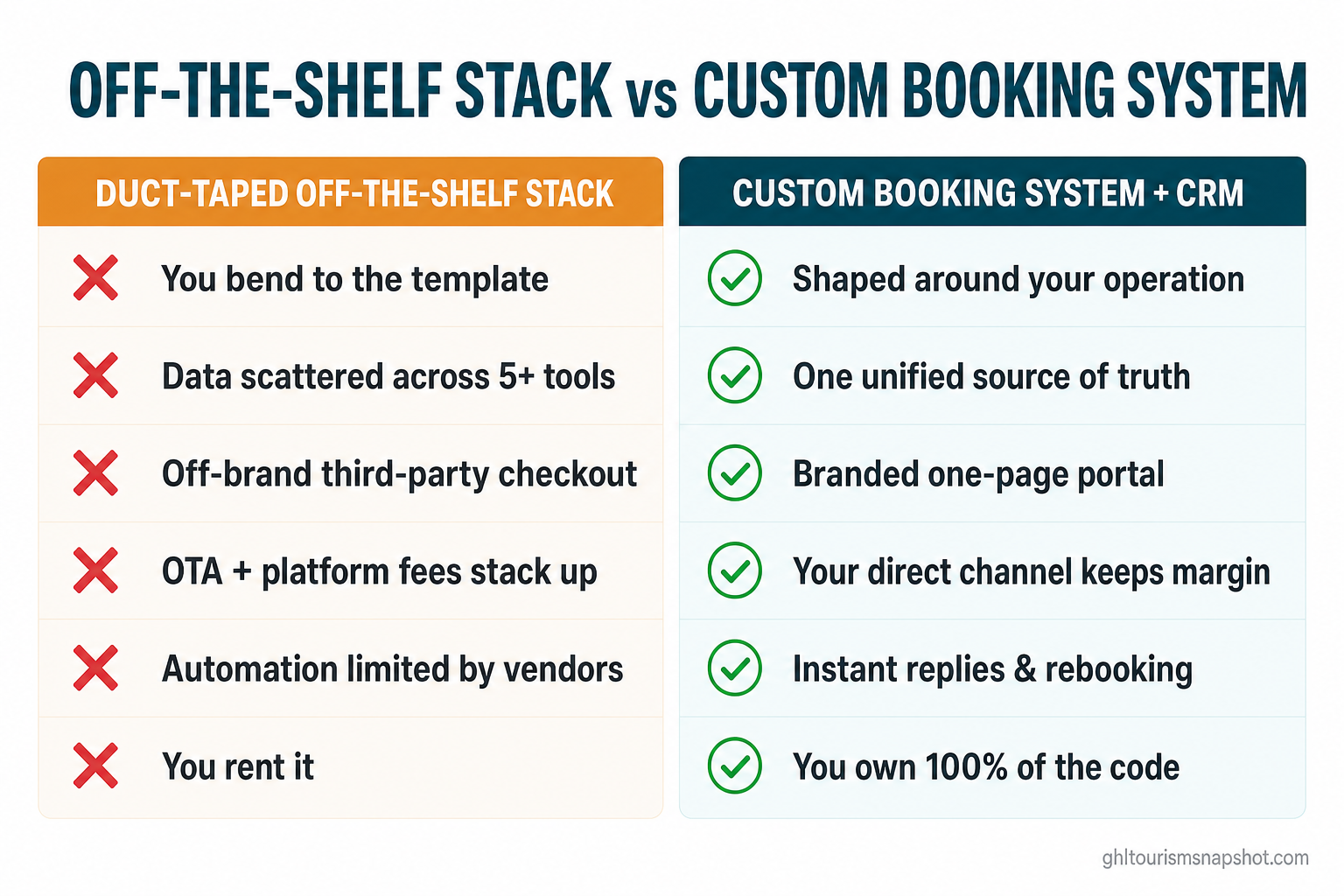
Off-the-shelf stack vs. a custom system for a Raleigh operator
| Plan | Duct-taped off-the-shelf stack | Custom booking system + CRM |
|---|---|---|
| Price | Cheap monthly, expensive weekly | Built once, works for you |
| Feature 1 | Fit: you bend your operation to the template | Fit: software shaped around how you actually run trips |
| Feature 2 | Data: scattered across 5+ tools, no source of truth | Data: one unified source of truth for every booking |
| Feature 3 | Checkout: third-party widget, off-brand, high drop-off | Checkout: branded one-page portal, honest totals, less drop-off |
| Feature 4 | Margin: OTA + platform fees stack up per booking | Margin: your own direct channel keeps the commission |
| Feature 5 | Automation: limited to what each vendor allows | Automation: instant replies, rebooking, reviews on autopilot |
| Feature 6 | Ownership: you rent it; it changes on their roadmap | Ownership: 100% yours — your repo, your accounts, your IP |
If you’re a smaller operator not ready for a full custom build, the middle path is real: a done-for-you GoHighLevel snapshot consolidates the CRM, booking calendar, reviews and automations into one system first, and you can layer custom pieces on later. The Charlotte operators we walked through migrating a fragmented stack into GoHighLevel took exactly that route. The point isn’t the specific product — it’s getting off the duct tape and onto one system that owns your data.
What it costs vs. what the pain costs
The instinct is to compare a custom build against your current software bill — a few hundred dollars a month — and conclude custom is expensive. That’s the wrong denominator. The right comparison is against what the duct tape already costs you, in numbers you now have: four-plus hours a week lost to app-switching, a quarter of your bookings taxed at 20–30% by OTAs, a checkout that loses well over half the travelers who reach it, and the rebooking and referral revenue you never capture because your past-guest data is trapped. Put a dollar figure on one season of that, and a system that recovers even a slice of it stops looking like a cost and starts looking like the highest-ROI thing on your list.
Because modern builds are AI-assisted, the timelines and price tags are also far smaller than the “six months, six figures” reputation: a booking agent or automation in 2–3 weeks, a guest portal in 5–7 weeks, a full reservation dashboard in 6–12 weeks — with the code, and the IP, belonging entirely to you. That’s the real decision in front of a growing Raleigh operator: keep paying the invisible tax, or own the machine.
Frequently asked questions
Do Raleigh tour operators really need custom software, or is off-the-shelf enough?
Most operators should start with off-the-shelf tools, and many should stay there. Custom software earns its keep once you've hit the ceiling — when your itineraries, deposits or partner splits don't fit any template, when your data is scattered across five tools with no source of truth, and when you're personally re-keying the same booking into multiple systems every week. If that's you, the duct-taped stack is already costing more in lost hours, OTA commissions and abandoned bookings than a custom system would. If you're a smaller operator, a consolidated GoHighLevel snapshot is usually the right first step before a full custom build.
How much does custom tour software cost and how long does it take?
Because modern builds are AI-assisted with tools like Claude Code, timelines and budgets are a fraction of the traditional dev-shop reputation. Simple agents and automations ship in about 2–3 weeks, AI voice lines in 2–4 weeks, a branded guest booking portal in 5–7 weeks, and a full reservation system or ops dashboard in 6–12 weeks. You own 100% of the code and IP. The honest way to size it is a free discovery call: describe your operation and you'll get what's possible, what it costs, and how long it takes.
Will a custom system replace FareHarbor, Rezdy or Bokun completely?
It can, but it doesn't have to. Many operators keep one tool they like for a specific job and use custom integrations to sync it into a single source of truth, so nothing is re-keyed by hand. Others replace the whole stack with one reservation system and CRM shaped around their operation. The right answer depends on which seams are actually costing you — the goal is one system that owns your data, not change for its own sake.
How does a guest booking portal reduce no-shows and abandoned bookings?
A branded, one-page portal removes the seams where travelers quit — the off-brand third-party widget, the surprise fee at the end, the separate waiver email. Travelers see the honest total, pay a deposit, e-sign the waiver and get an instant confirmation in a single flow under your name. Since 53% of shoppers abandon when full pricing only appears at checkout, and travel abandonment runs near 87%, closing those gaps directly recovers bookings you're currently losing in the last thirty seconds.
We're a small Raleigh operator. What's the fastest first step to get off the duct tape?
Consolidate before you customize. Getting your CRM, booking calendar, payments, reviews and automations into one system — such as a done-for-you GoHighLevel snapshot — gives you a single source of truth in about 24 hours and stops the daily app-switching and data re-keying immediately. From there, you can add custom pieces like a guest portal or an AI booking agent once you know exactly where the remaining friction is.
Related reading
- Custom Software for Tour Operators: When Off-the-Shelf Booking Tools Stop Fitting Your Business
- GoHighLevel Integration for Charlotte Tour Operators: One System, Not Five
- Online Booking for Phoenix Tour Operators: What Manual Booking Really Costs You
- Speed to Lead for Tour Operators: Why the First 5 Minutes Decide the Booking