For a Philadelphia tour operator, what actually fills departures on social media isn’t a prettier grid — it’s consistent short-form video across the handful of channels travelers already scroll, paired with replies fast enough to book the seat before the visitor moves on. Reels, TikToks, and Shorts are what put your Old City ghost tour or Reading Terminal food crawl in front of someone who’s never heard of you; an instant answer to “any spots this weekend?” is what turns that view into a paid booking. Everything else is decoration.
This is a straight, data-driven guide for tour, activity, and travel operators in Philadelphia and across the Delaware Valley. We’ll look at where travelers actually discover experiences now, which of the nine channels earn a tour operator’s time, why short-form video is the reach engine, and the one operational habit — fast replies — that separates feeds that fill buses from feeds that just collect likes.
Why social media decides bookings for Philadelphia operators
Travelers don’t research tours the way they research a mortgage. A visitor standing in Rittenhouse Square with a free afternoon opens their phone, taps through a few options, and books the experience that looks credible and answers fast. That whole decision happens in the feed — and increasingly, before they’ve ever visited your website.
That shift is why “we have a Facebook page” is no longer a strategy. Social media is now a primary discovery surface for travel, not a billboard you post to occasionally. The operator whose short video made tomorrow’s tour look unmissable gets the 9 p.m. “is there still space?” message. The operator whose last post was three weeks ago gets skipped — travelers reasonably assume a quiet feed means a quiet business, or one that isn’t running trips right now.
For Philadelphia specifically, the upside is unusually large, because the demand is enormous and the competition for attention is fierce. Getting social right isn’t a nice-to-have here; it’s how you claim a slice of a market that’s actively scrolling for something to do.
The Philadelphia context: a full market, scrolling before it books
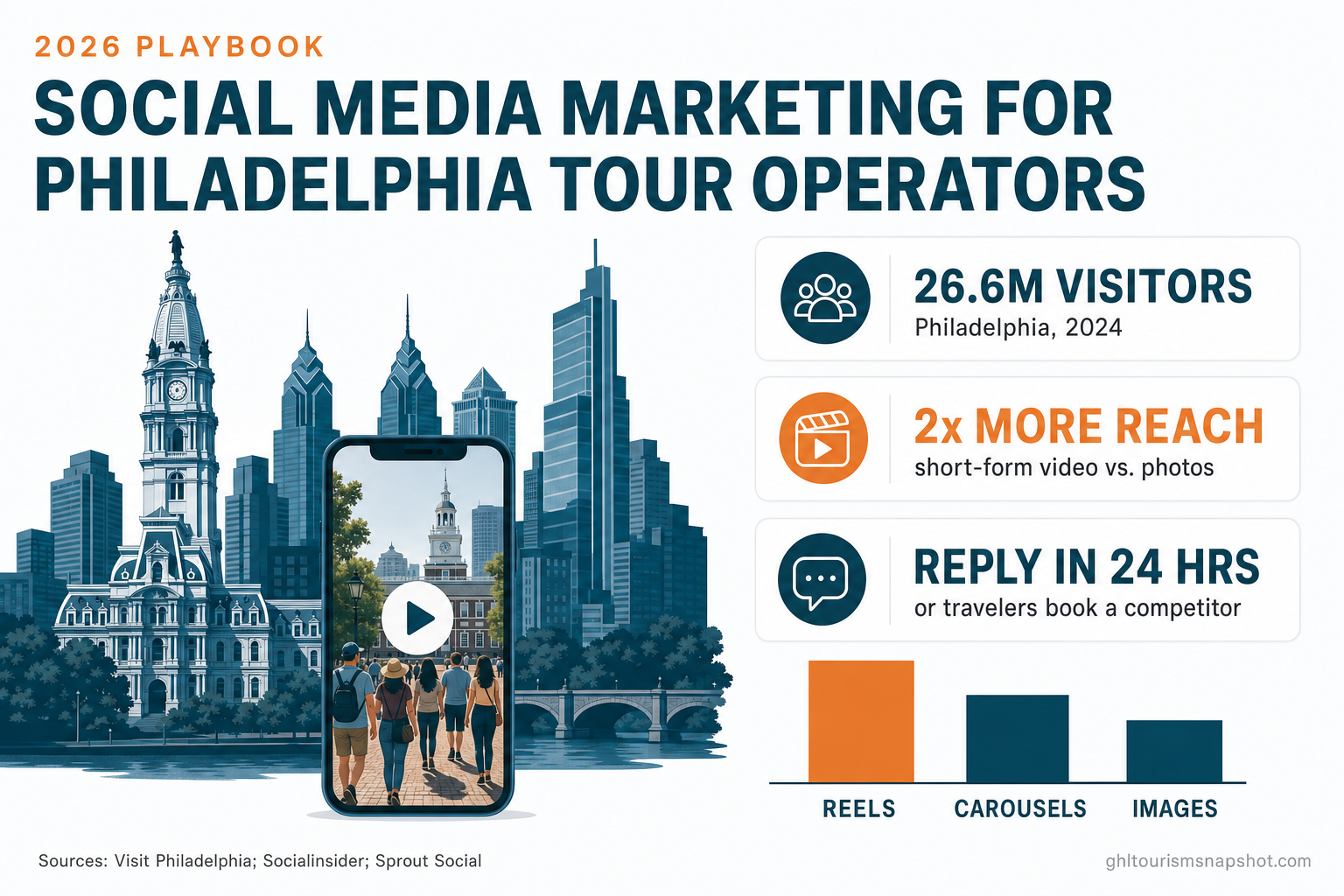
Philadelphia is one of the most-visited cities in the United States, and 2024 was a record year. The city welcomed 26.6 million visitors, who spent a record $4.5 billion — with overnight visitation up 4% year over year (Visit Philadelphia / PHLCVB). Zoom out to the state and tourism generated nearly $84 billion in economic impact and supported more than 500,000 jobs in 2024 (PA Department of Community & Economic Development).
Those are the travelers scrolling for a ghost tour of Old City, a mural arts walk, a cheesesteak-and-history crawl, or a day trip to Valley Forge. The demand is already there. The only question is which operator’s content they see, trust, and message first.
Sources: Visit Philadelphia / PHLCVB, 2024; PA DCED, 2024.
Where travelers actually discover tours now
Trip inspiration has moved into the feed, and travelers act on what they see there. Phocuswright’s Scroll, Heart, Fly study of U.S. leisure travelers found that 62% of those who use social media for trip planning made a specific trip decision after viewing social content (Phocuswright) — and most of that influence lands close to the booking window. Gen Z and Millennial travelers in particular now expect to see an experience — the actual moment, filmed on a phone — before they’ll book it.
That’s a gift for tour operators, because your product is inherently visual and social-native. You don’t have to manufacture content; you’re standing in front of it every departure. The breach of light through Elfreth’s Alley, the first bite on the food tour, a guest’s face at the top of the City Hall tower — those are the clips that stop a scroll. The job is to capture them consistently and put them where travelers are already looking.
The 9 channels — and what each does for a tour operator
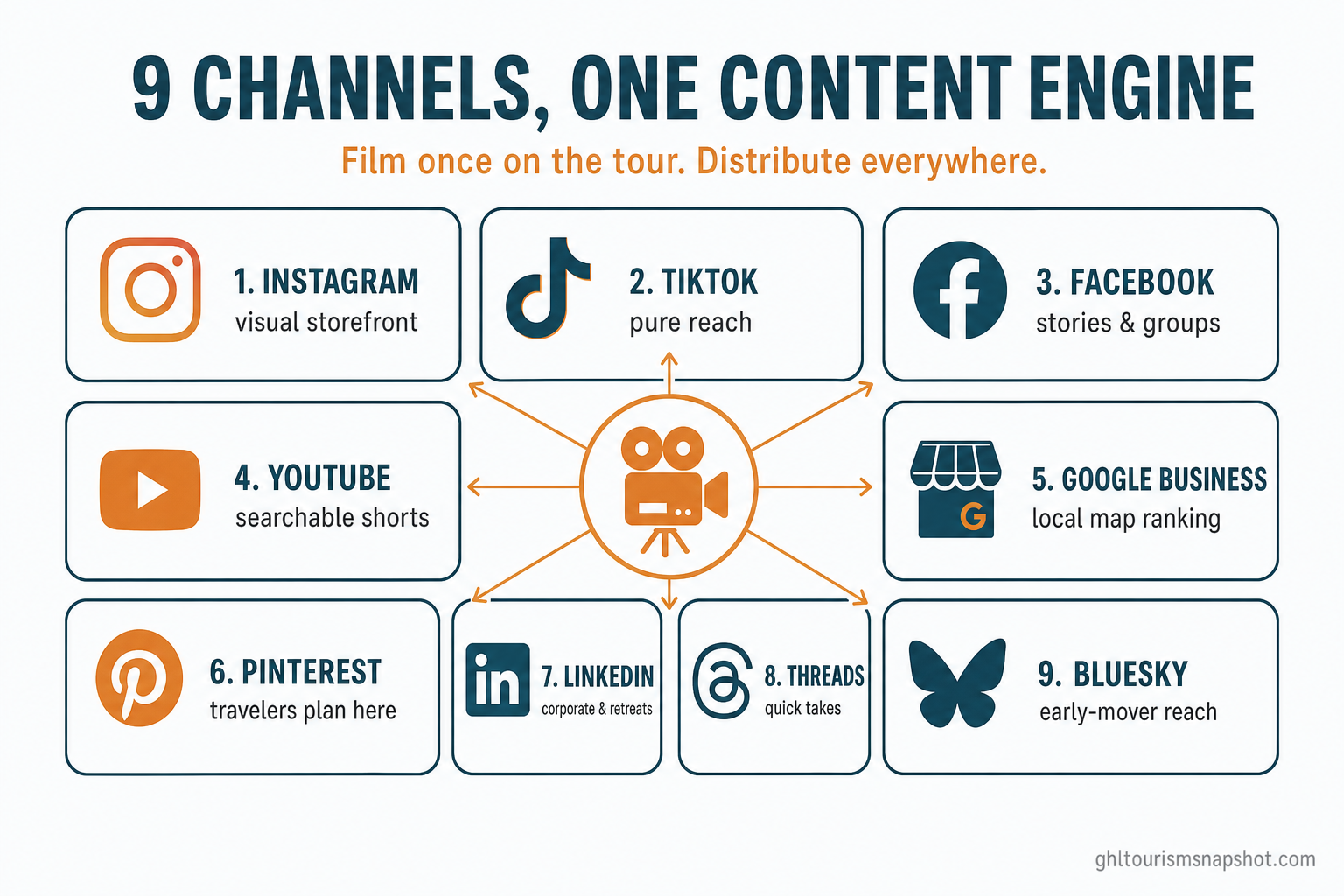
You don’t need to be brilliant on every platform. You need the right content on the channels where your travelers actually are, formatted for each. Here’s the honest breakdown of the nine that matter for a tour operator, and the job each one does:
| Channel | What it does for a tour operator |
|---|---|
| Your visual storefront. Reels for discovery, carousels for mini-guides, Stories for “spots left this weekend.” | |
| TikTok | The pure reach play — short trip clips engineered to get pushed to travelers who’ve never heard of you. |
| Traveler stories, departure announcements, and local event tie-ins; still strong for 30-plus and group travel. | |
| YouTube (Shorts) | Itinerary teasers and destination tips; also a searchable, evergreen library that ranks in Google. |
| Google Business Profile | The most underrated. Posts + photos here feed your local map ranking and sit right next to your reviews. |
| Travelers plan here — itineraries and guides get saved months before a trip and drive booking-intent traffic. | |
| Corporate outings, retreats, and DMC/partner reach — higher-value group bookings. | |
| Threads | Quick destination takes and conversational reach as the audience grows. |
| Bluesky | An early-mover travel audience for evergreen tips and low-competition reach. |
The mistake most operators make isn’t picking the wrong channel — it’s trying to run all nine by hand and burning out by July. One clip from a single departure can be cut into a Reel, a TikTok, a Short, a Facebook post, and a Pinterest pin. The winning move is to film once and distribute everywhere, which is exactly what a systemized content engine does.
Short-form video: the reach engine you can’t skip
If you only have time for one format, make it short vertical video. The data is one-sided. On Instagram, Reels reach an average of ~30.8% of an account’s audience — more than double carousels (~14.5%) and static images (~13.1%) (Socialinsider). Crucially, a large share of Reel views come from non-followers — which is precisely the new-traveler audience a Philadelphia operator needs to grow.
Reach is only half the story. Short-form video is also the format marketers rank #1 for return on investment in HubSpot’s 2026 report — ahead of long-form video, images, and every other content type (HubSpot). And it closes: 85% of people say watching a video has convinced them to buy a product or service (Wyzowl). For a tour, where the buyer is deciding whether tomorrow’s experience is worth it, showing 20 seconds of the real thing is the most persuasive thing you can do.
You don’t need a videographer. Film vertically on your phone during real departures, open with the payoff in the first two seconds, add on-screen captions, and end with one clear call to action — “DM us your dates.” Authentic guide-shot clips routinely outperform polished agency footage because they look like the experience the traveler will actually get. This is the same discovery logic we break down channel-by-channel in Instagram Reels for tour operators, TikTok marketing for tour operators, and YouTube for tour operators.
The mistake that kills it: posting without replying
Here’s the uncomfortable truth that separates content that fills departures from content that just racks up views: the reach is worthless if the reply is slow. A traveler who comments “dates?” or DMs “any spots Saturday?” is a booking with a short shelf life. If you’re out leading a tour and don’t see it until that night, they’ve already booked the operator who answered in ten minutes.
The data is blunt. Sprout Social’s 2025 Index found that 73% of consumers will buy from a competitor if a brand doesn’t respond on social media, and the majority expect a response within 24 hours — with practical benchmarks for Instagram and Facebook DMs measured in minutes, not hours (Sprout Social). In a fast-moving, high-intent market like Philadelphia travel, “I’ll reply tonight” is a booking handed to a competitor.
Sources: HubSpot 2026, Wyzowl 2026, Sprout Social 2025 Index.
This is why the smartest operators pair their content engine with automation that answers instantly. An AI comment-and-DM agent replies to “any spots this weekend?” in seconds, qualifies the traveler, collects their dates and group size, and books the reservation onto the calendar — 24/7, in your brand voice — so a video that pops at midnight doesn’t go cold by morning. We go deep on the comment side in comment automation for tour operators and on the DM side in Instagram DM automation for tour operators, and on the broader principle in speed to lead for tour operators.
Consistency beats intensity: the cadence that compounds
The operator who posts five times in one week and then vanishes for a month loses to the operator who posts steadily. The algorithms reward accounts they read as active, and consistency gives you more shots at the one clip that breaks out. A realistic, sustainable rhythm for a tour operator looks like this, five days a week:
- 1 short video / Reel (≤30s) — the reach play, from real trip footage.
- 2 carousel posts — swipeable mini-guides (“5 stops on the food tour,” “What to wear for the ghost tour”).
- 1 image post — a branded departure highlight or seasonal offer.
- 1 text / Q&A post — answering a real traveler question, the format that drives saves and booking DMs.
The point isn’t the exact mix — it’s that a steady drumbeat across a season gives you dozens of chances at a breakout, while burst-posting resets your momentum each time you go quiet. The catch, of course, is that “post five days a week across nine channels and reply to every DM in minutes” is a real job — one that quietly falls apart in peak season, exactly when demand is highest and you have the least time.
Own your channels, or rent bookings from the OTAs
There’s a bigger reason to build your own social presence than vanity reach: it’s how you keep the booking — and the margin — instead of handing it to an online travel agency. And that margin is under pressure. Arival’s data shows OTAs captured 37% of experience bookings in 2025, up from 33% in 2024 and 28% in 2023, while operators’ own websites slipped from 29% to 25% (Arival).
Social is your antidote to that drift. When you create the discovery moment, you answer the DM, and you own the booking page, you keep the margin an OTA would have taken. That’s the whole logic behind direct bookings for tour operators and local SEO for tour operators — social feeds the top of your own funnel, and your own funnel keeps the sale.
When to hand it off (and what that costs)
Everything above is doable yourself, and plenty of Philadelphia operators run it well. But there’s a reason it quietly collapses in July: the content that fills September gets filmed in your spare time, which in peak season doesn’t exist. So the feed goes quiet exactly when demand peaks, and the AI replies you meant to set up never get built.
That’s the gap a done-for-you service closes. Instead of you finding time to film, edit, caption, schedule, and reply, a team turns your raw trip clips into a steady stream of videos and carousels, publishes them five days a week across all nine channels, and runs the AI agents that answer comments, DMs, and website chat — booking travelers straight onto your calendar while you’re out on the tour.
Frequently asked questions
Which social media platform matters most for a Philadelphia tour operator?
Instagram and TikTok for discovery (short vertical video reaches non-followers, which is how you grow), and Google Business Profile for local intent (it feeds your map ranking and sits next to your reviews). If you can only run three, run those. Facebook still matters for group and 30-plus travel, and Pinterest quietly drives booking-intent traffic because travelers save itineraries there months ahead. The right answer is film once and distribute across all of them, formatted per platform.
How often should I post to fill departures?
Aim for about five days a week, weighted toward short video. A sustainable mix is one Reel/short, two carousels, one image, and one Q&A/text post per week, repeated consistently. Consistency beats intensity: the algorithms reward accounts they read as active, and a steady drumbeat across a season gives you dozens of chances at a breakout clip. Burst-posting and going quiet resets your momentum every time.
Does short-form video really outperform photos for tours?
Yes, decisively. Socialinsider's 2026 Instagram benchmarks show Reels reach about 30.8% of an account's audience on average, versus roughly 14.5% for carousels and 13.1% for static images — and a large share of Reel views come from non-followers. Short-form video also ranks #1 for marketing ROI in HubSpot's 2026 report, and 85% of people say a video has convinced them to buy (Wyzowl). For a visual product like a tour, 20 seconds of the real experience is the most persuasive asset you have.
How fast do I need to reply to comments and DMs?
Fast — ideally within minutes, and no later than a few hours. Sprout Social's 2025 Index found 73% of consumers will buy from a competitor if a brand doesn't respond on social, and most expect a reply within 24 hours, with DM expectations often measured in minutes. In a high-intent market like Philadelphia, a viral video with a cold inbox just sends travelers to whoever answers first. Pairing content with an AI comment/DM agent that replies instantly and books the seat is how you avoid handing bookings away.
Is this only for Philadelphia tour operators?
No — the strategy works for any tour, activity, or travel operator in the USA. We framed it for Philadelphia because it's a high-volume, high-competition visual market where consistent video and fast replies make an outsized difference. The same channel mix, cadence, and speed-to-reply principles apply whether you run tours in Philadelphia, Pittsburgh, or anywhere your travelers are scrolling.
Can you run my social media for me?
Yes. Our done-for-you social media service publishes five days a week across all nine channels — videos, carousels, image posts, and Q&A content in your brand voice — and includes three AI agents that answer comments, Facebook and Instagram DMs, and website chat, booking travelers straight onto your calendar. It starts at $397/mo, is 100% white-label, and needs no account passwords. See the Social Media page for details and pricing.
About the author
Desmond Clarke is a GHL Agency Strategist based in Savannah, Georgia. He runs a boutique GoHighLevel agency serving travel and hospitality clients, from harbor cruise companies to multi-day expedition outfitters, and came up through paid media and conversion copywriting — so he looks at every channel through the lens of cost-per-booked-seat. On the blog he translates agency tactics into plain language any operator can act on.
Editorial note: GHL Tourism Snapshot is a GoHighLevel automation and services product, not a travel agency. We don’t sell, book, or guarantee any tour. Statistics are drawn from the cited sources and reflect industry or study averages; your results will vary with your offer, market, content, and audience.
Related posts
- Instagram Reels for Tour Operators — the step-by-step playbook for the highest-reach format.
- TikTok Marketing for Tour Operators — how short clips get pushed to brand-new travelers.
- Comment Automation for Tour Operators — reply to every comment in seconds so no booking goes cold.
- Speed to Lead for Tour Operators — why the first five minutes after a message decide the booking.
- Direct Bookings for Tour Operators — keep the margin OTAs would take by owning your funnel.
Ready to keep your feed full while you’re out running trips? See done-for-you Social Media from $397/mo, explore the full Tourism Snapshot pricing, or talk to a real person about your Philadelphia tours.