
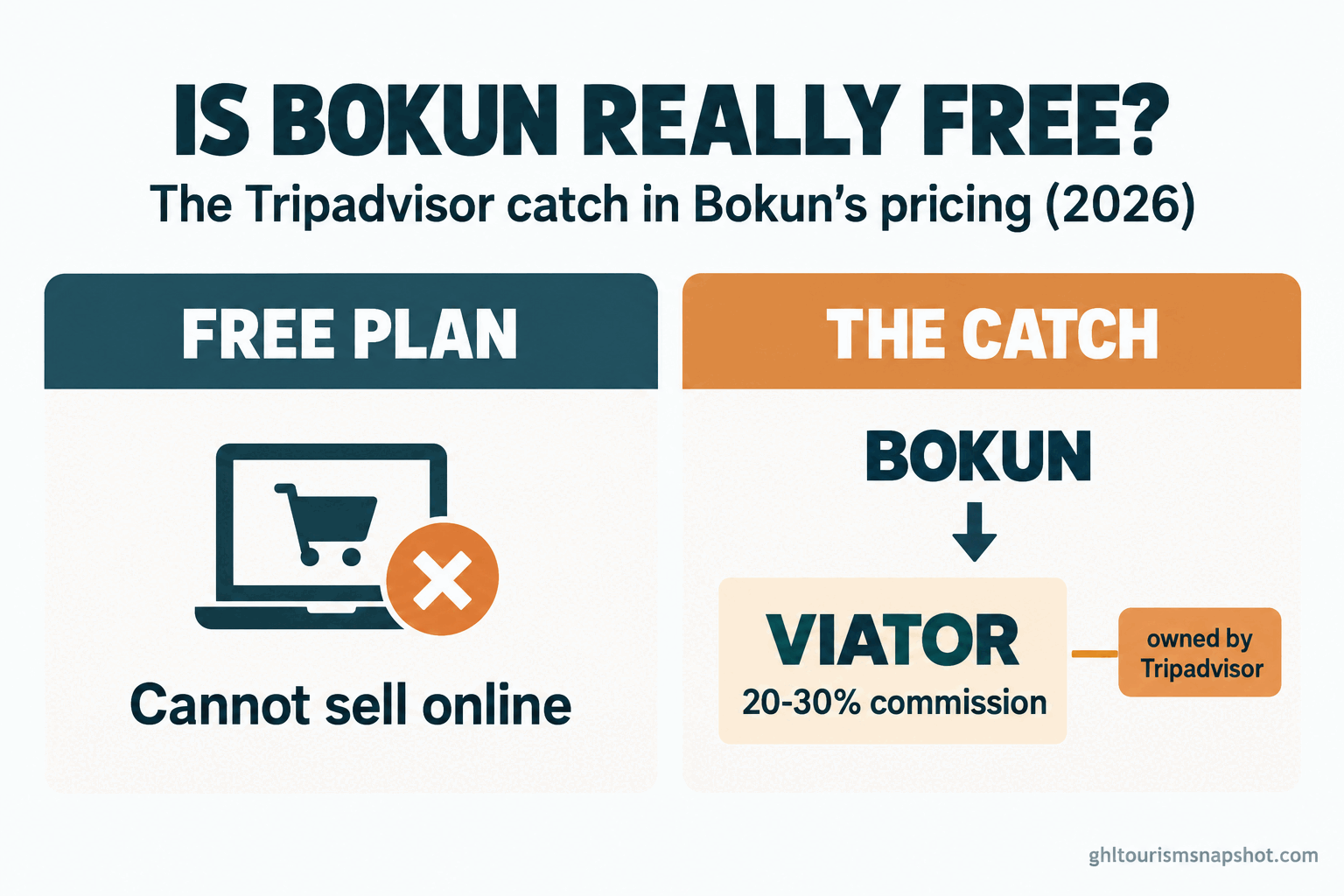
You found Bokun, saw the word “free,” and thought you had dodged the booking-software bill. The free plan is real. It is also the one plan that cannot take a single online booking. To sell a tour from your own website you pay $49 to $499 a month plus a fee. And the headline that pulls operators in, 0% fees on Viator bookings, is the quiet part of the deal: Bokun and Viator share the same owner, and the model is built to push bookings into a marketplace that takes 20% to 30% and keeps your customer. Here is what Bokun really costs in 2026.
Is Bokun free? The short answer
Yes and no, and the “no” is the part that costs you money. Bokun does offer a plan that costs nothing and never expires. On it you book by hand, keep one user, and pay zero Viator fees. It is a real free product, not a trial. (Bokun pricing)
Here is the catch most operators miss until they are set up: the free plan cannot sell a booking on your own website. Online selling through a widget, connections to other online travel agencies, and availability sync all live on the paid plans. So the moment you want a traveler to book a kayak trip from your site at 11pm, you are paying $49 to $499 a month plus a fee. You are not choosing between free and paid. You are choosing which paid plan, and how much of your business you route through Viator to keep the fee at zero.
What the free plan really includes (and what it quietly leaves out)
Let me lay it out honestly, because the marketing does not. For $0 you get: booking management for reservations you enter yourself, manual offline bookings with zero fee, zero fees on Viator bookings, and one user.
What you do not get until you pay:
- Selling online through a booking widget on your own site.
- Connections to online travel agencies and marketplaces beyond the basics.
- Automatic availability sync across your sales channels.
- The option to pass the booking fee to the customer.
- Resource management, payment links, gift cards, and point of sale.
Read that second list again. A tour operator’s most valuable feature is a stranger booking a seat from your website without you. The free plan does not have it. It is a back-office tool, not a booking engine.
The Bokun paid tiers, line by line
Once you need to sell online, here is the menu: three plans, each with a lower booking fee as the monthly price climbs. (Bokun pricing)
| Plan | Monthly price | Bokun booking fee | Users |
|---|---|---|---|
| FREE | $0 | None (no online selling) | 1 |
| START | $49/mo | +1.5% per booking | up to 5 |
| PLUS | $149/mo | +1.25% per booking | up to 10 |
| PREMIUM | $499/mo | +1% per booking | unlimited |
A few things worth saying plainly. The booking fees are genuinely low. At 1% to 1.5%, Bokun’s cut is one of the cheapest around, next to a fee reported as high as 6% at the demo-gated giants. On fees alone, Bokun wins, which is why Viator matters so much. You can also pass the fee to the customer on any paid plan. And the 0% lines are the headline: offline bookings are free on every plan, and Viator bookings carry no Bokun fee. (Bokun pricing)
Here is Bokun’s own fee on one $150 seat, next to the 0% lines and a reported rate at a hidden-price competitor.
That chart is the trap: it measures the one cost that is small and ignores the one that is huge.
The Viator catch nobody explains at signup
Here is the sentence that changes how you read the whole price list. Bokun says it plainly on its own site: “Bókun and Viator are complementary solutions, and are both part of the Tripadvisor group.” (Bokun)
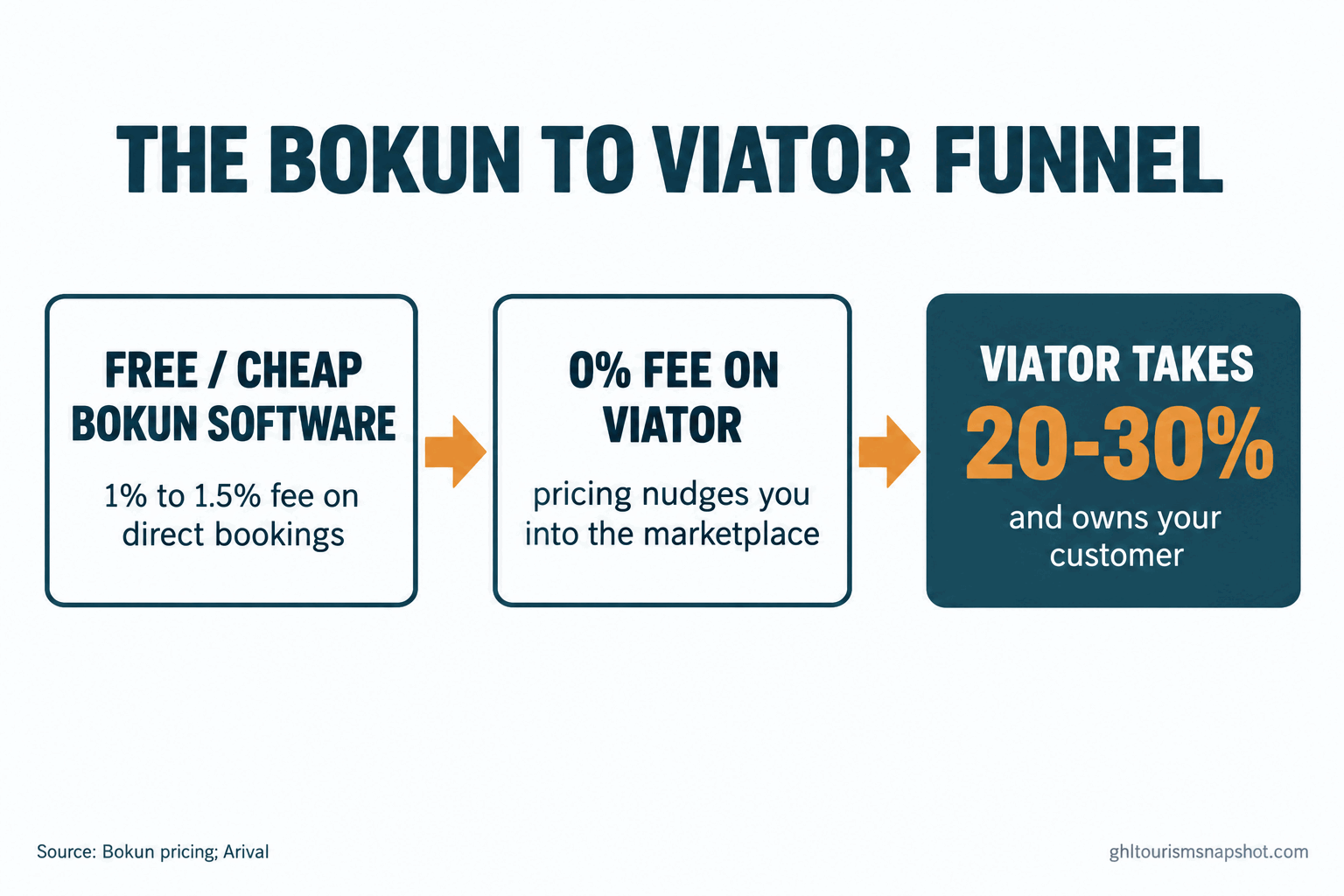
So the company that gives you free software and 0% Viator fees is the same company that owns Viator. That is not a conspiracy, it is a smart model: the booking tool is the cheap on-ramp, and the marketplace is where the money is made. Every plan charges a small fee on bookings you bring in yourself, while Viator bookings cost you zero. The structure rewards you for pushing volume into Viator.
And what does a Viator booking actually cost? Not zero. Viator takes a commission on every sale, commonly 20% to 30% and higher under its “Accelerate” program, where operators bid extra commission to rank above rivals, with reports “everywhere from 28% to the high 40s.” (Arival) Viator does not publish one official rate, so treat exact numbers as reported. But the direction is not in doubt: a Viator sale costs you a fifth to a third of the ticket.
Do the math on “zero fee.” A $150 seat on your own website on Bokun START costs $2.25 in fees. The same seat through Viator costs $0 in Bokun fees and roughly $37.50 in Viator commission at 25%. The “0% fee” plan is the expensive one.
There is a second cost that never shows up as a number. On a Viator booking, Viator owns the customer. You get a name and a trip to run, often not a real email you can market to and not the repeat booking next year. You rented that traveler. Our look at cutting OTA dependence and winning direct bookings covers why that gap is the real price, and the OTA commission break-even calculator shows where a direct booking beats a marketplace sale. None of this makes Bokun a bad tool. It makes “free” and “0%” misleading. The right question is not “what does Bokun charge,” it is “how much of my business does its pricing push into a 25% channel that keeps my customers.”
Three scenarios: solo, mid-size, large
A percentage feels small on one booking and huge across a year. Below are three illustrative operators at a $120 ticket, Bokun’s direct cost modeled as subscription plus fee on direct sales. Swap in your own numbers.
The solo operator. A single kayak route, 500 bookings a year at $120. On START at $49 a month, that is $588 a year plus 1.5% of roughly $60,000 in sales, about $900, for a total near $1,488 a year. Pass the fee to the customer and your side is close to the subscription alone. At this size Bokun is genuinely affordable.
The mid-size shop. Three guides, 3,000 bookings a year, about $360,000 in sales. On PLUS at $149 a month, that is $1,788 plus 1.25%, roughly $4,500, for about $6,288 a year. Still cheap on fees. The danger is not the bill, it is leaning on Viator for fill. Route a third of that volume through Viator at 25% and you have handed over $30,000 in commission to save a few hundred.
The large operator. Multiple locations, 12,000 bookings a year, about $1.44 million in sales. On PREMIUM at $499 a month, that is $5,988 plus 1%, roughly $14,400, for about $20,388 a year. To run the whole engine, that is cheap. The same sales through Viator at 25% would be $360,000 a year in commission. That gap is the biggest lever on your profit, and the pricing hides which side you are on.
Bokun against the field
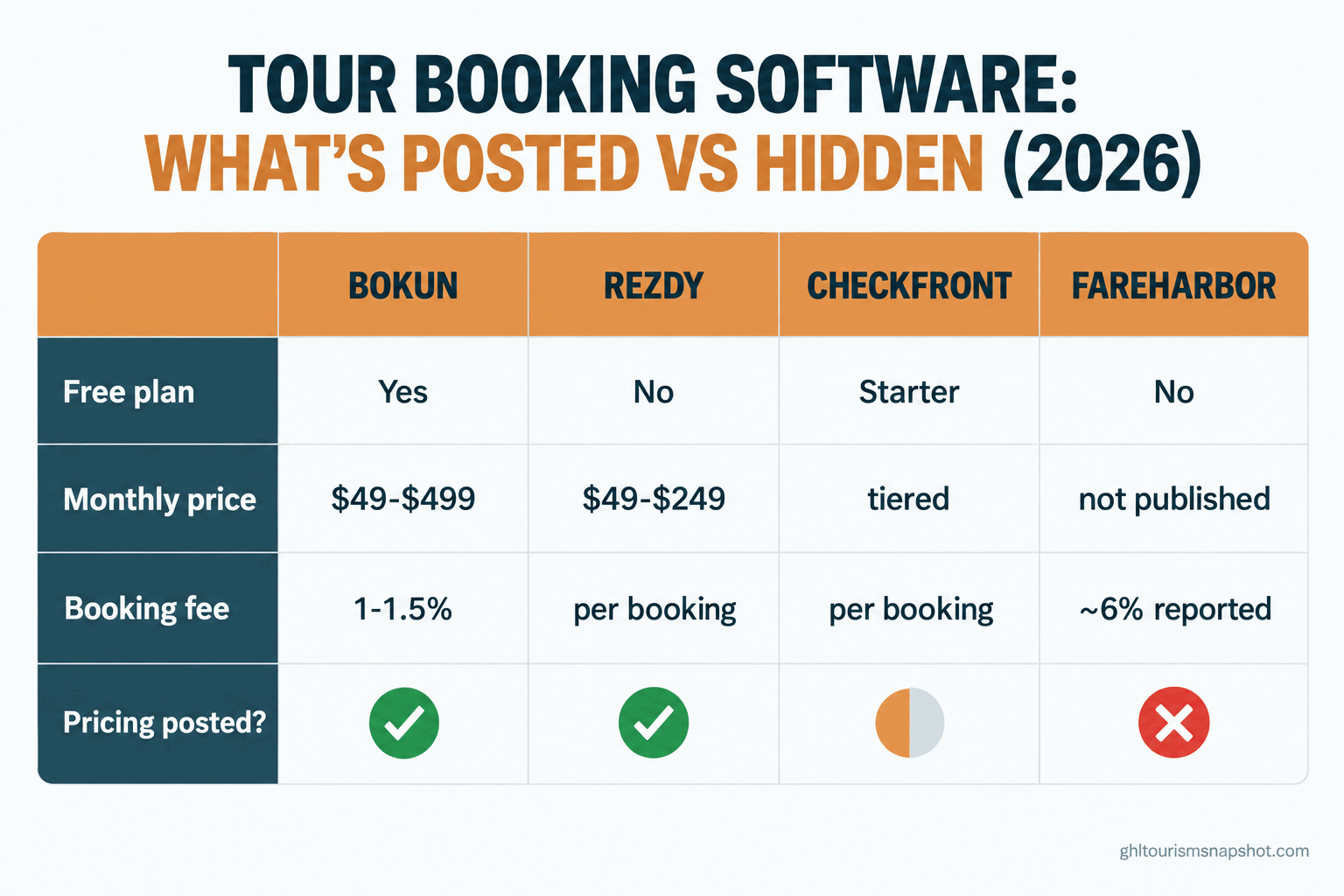
Bokun sits at one end of a spectrum: cheap, transparent fees, married to a marketplace. Here is how it lines up against the platforms operators shortlist.
| Platform | Free plan? | Monthly price | Booking fee | Pricing posted? |
|---|---|---|---|---|
| Bokun | Yes (no online selling) | $49 / $149 / $499 | 1% to 1.5%; 0% Viator and offline | Yes, in full |
| Rezdy | No | $49 / $99 / $249 | Per-booking fee (verify current rate) | Tiers posted |
| Checkfront | Starter tier | Tiered, varies by source | Per-booking fee (verify current rate) | Partly |
| FareHarbor | No | Not published | Reported up to ~6%, customer-paid | No, demo first |
A few honest caveats. Rezdy publishes tiers at $49, $99, and $249, but I could not confirm a specific online fee from its own page, so verify that with Rezdy. (Rezdy on Capterra) Checkfront’s structure differs across trackers, so check checkfront.com directly. FareHarbor publishes no price and sells through a demo, and its repeated ~6% customer-paid fee is third-party reported, never confirmed. (CaptainBook) For the full field, see our tour booking software pricing teardown and the deep dive on why Peek Pro hides its price. On posted fees, Bokun is the cheapest honest option here. On strategic cost, it is the one that most wants you inside a marketplace.
Where the Bokun model bites
Every pricing model has a shape that tells you where it hurts.
It bites when “free” lulls you into the wrong plan. Operators adopt the free tier, build manual habits, then upgrade reluctantly when a customer asks why they can’t book online. Treat the free plan as a demo, not a destination.
It bites every time you choose the 0% path. The pricing makes Viator feel free and your own website feel costly, which is backwards. Track monthly what share of bookings came through Viator, and treat a rising share as a cost even when the Bokun fee reads zero.
It bites when you can’t get your customers back. Because Viator owns the relationship on its bookings, your repeat engine starves. Capture contact details at the trip, with a QR code at check-in or a post-trip text, so the next booking comes straight to you.
It bites on exit. Your calendar, products, and history all live in Bokun. Ask exactly how you export your customer list and future bookings if you leave. A tool that makes leaving hard is telling you how it plans to keep you.
Steal this: the “is Bokun right for me” test
Before you build your booking flow on any platform, run it through these questions.
That third question matters most. An operator who tracks only the subscription thinks Bokun is nearly free; one who adds the Viator commission line sees the real cost.
Who Bokun is actually right for
There is a real operator for whom Bokun is excellent, and one for whom it is a slow mistake.
Bokun fits best when you already rely on Viator and want to run on it cheaply. If a large chunk of your travelers find you through Viator anyway, Bokun gives you a free-to-cheap back office with 0% fees on those bookings and a low fee on the direct sales you pick up. In a high-traffic destination where the marketplace delivers travelers you could never reach alone, that trade can be smart. It also fits a new or seasonal operator who starts manual on the free plan and upgrades when online selling pays for itself.
Bokun is the wrong tool when your plan is to build a direct-booking business. If your goal is to own your customers and rebook last season’s travelers at near-zero cost, a platform whose cheapest path runs through its parent marketplace is pulling against you. You can use Bokun and sell direct, but you fight the pricing’s gravity, not float along with it.
Protect your margin, whatever you run on
Here is the part the booking-software debate always skips. The platform matters far less than whether you own the traveler afterward. A 1% Bokun fee and a 6% hidden-giant fee are both rounding errors next to a 25% marketplace commission you pay again on every repeat you never captured. The operators who keep the most margin treat every booking tool as a checkout, not a customer relationship. They capture contact details at the trip, ask for the review the same day, and bring the next booking home through a channel they own. Bokun’s free plan and 0% Viator fee are not the prize. The prize is a list of past travelers you can reach for free.
Objections, answered straight
“Bokun is free, so why would I pay anything?” Because the free plan cannot sell online. The second you want a booking widget, OTA connections, or sync, you are on a paid plan from $49 a month. (Bokun pricing)
“But 0% fees on Viator means my bookings are free, right?” Only the Bokun fee is zero. Viator still takes its commission, commonly 20% to 30%. A 0% Bokun fee on a 25% Viator booking is the most expensive booking you take. (Arival)
“Isn’t Bokun’s 1% fee just cheaper than everyone, so it wins?” On fees alone, yes, and that is genuinely in its favor. But fees are the small cost. The channel the pricing steers you toward, Viator, is the large one. Judge the platform on your whole cost stack.
“I already run on Bokun. Should I switch?” Not on a whim. Do two things this quarter: calculate what you actually paid Viator versus Bokun, and start capturing traveler contact details so repeats come back direct. Keeping Bokun but starving the marketplace often beats switching.
FAQ
Bokun pricing questions operators ask
Is Bokun actually free?
Bokun has a real free plan that costs nothing and does not expire, but it cannot sell online. It covers manual bookings, one user, and zero fees on Viator. Online widgets, OTA connections, and availability sync only start on the paid plans from $49 a month, so to take bookings from your website you will be on a paid plan.
How much does Bokun cost per month?
Bokun's paid plans are START at $49, PLUS at $149, and PREMIUM at $499 a month, with per-booking fees of 1.5%, 1.25%, and 1%. All plans charge 0% on offline and Viator bookings, and you can pass the fee to the customer on any paid plan.
Why does Bokun charge 0% on Viator bookings?
Because Bokun and Viator are both part of the Tripadvisor group. The 0% Viator fee is an incentive to route bookings through Viator, where you then pay a commission commonly in the 20% to 30% range. The Bokun fee is zero on those bookings, but the Viator commission is not.
Does Bokun or the customer pay the booking fee?
On any paid plan you can absorb the 1% to 1.5% fee or pass it to the customer as a checkout surcharge. Passing it on makes the fee near-zero for you, as long as the surcharge does not hurt conversion on price-sensitive tours.
What is the catch with Bokun's free plan?
Two. First, the free plan cannot take an online booking, so most operators have to upgrade to sell. Second, the cheapest path, 0% Viator fees, funnels your bookings into a marketplace owned by Bokun's parent that charges a large commission and keeps your customer. The software is cheap; the dependency is the real cost.
Pricing here is from Bokun’s own pages; competitor figures come from third-party trackers and are flagged where unverified, so confirm current rates with each vendor. For context, the U.S. Bureau of Labor Statistics reports 62,200 tour and travel guide jobs in 2025 at a $38,120 median with projected 6% growth through 2035, while travel agents, at 61,500 jobs and a $50,160 median, face 0% projected change over the same decade. (BLS: tour and travel guides, BLS: travel agents) The guided business is growing while the old agency model flatlines, which is exactly why owning your travelers, not renting them, is the margin decision that matters most.