
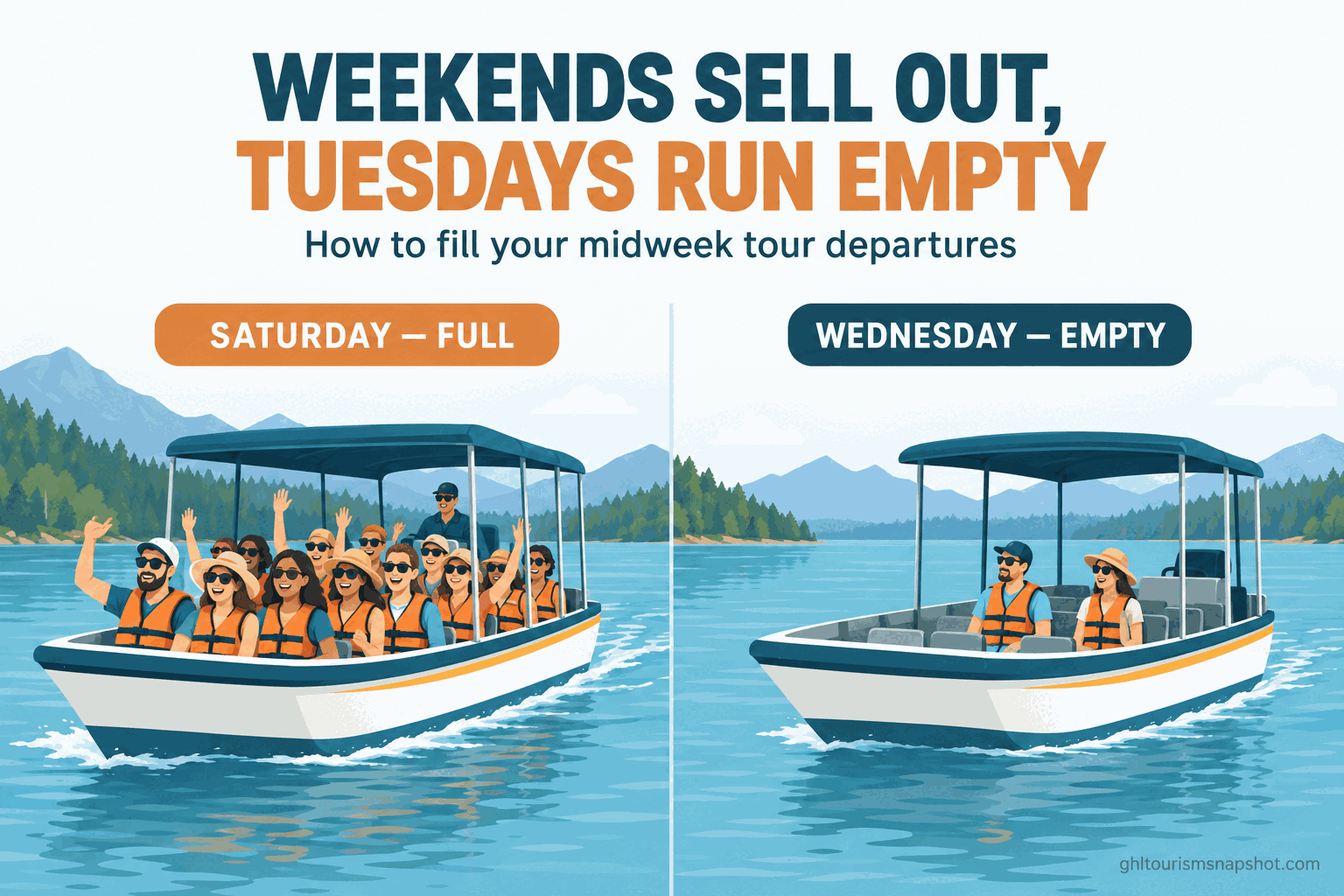
It is Wednesday at 9:40am and your 10 o’clock kayak tour has two people booked on a boat that seats twelve. The guide is already paid. The van still has to roll. Meanwhile your Saturday has a waitlist. You are not short on demand, you are short on demand on the right days. The empty midweek seat is the most fixable profit leak in a tour business, because the cost is already sunk and every seat you add is close to pure margin. This is the system operators use to fill those weekday departures, with the exact messages to steal and the places it goes wrong.
What an empty Wednesday actually costs you
Most operators treat a slow midweek departure as bad luck and move on. That is the mistake. The empty seat is not random; it is the most recoverable chunk of profit you have.
Your costs on a tour are mostly fixed. The guide gets paid the same for two guests or ten, and the boat, fuel, insurance, and permit do not change with one more person aboard. So the eleventh seat on a slow Wednesday is almost all margin. That is why a 20% discount to fill a dead departure can be your most profitable sale of the week, while the same discount on a sold-out Saturday is money you set on fire.
The demand is real and growing. The US Bureau of Labor Statistics counts 62,200 tour and travel guide jobs and projects the field to grow 6% through 2035, faster than the average job. (BLS) The travelers are there, they all just want Saturday at 10am. Three empty midweek departures a week, each able to carry six more guests at $65, is $1,170 of margin walking past your dock, all season long.
Why weekends sell and midweek doesn’t
Your weekend buyer is an out-of-town visitor: in town Friday to Sunday, booked weeks ago, paying full price. That buyer does not exist on Wednesday, so the midweek seat has to come from a different buyer. There are four:
- The local. Lives twenty minutes away, has driven past your sign for years, and will come on a random Wednesday given a nudge and a reason.
- The past guest. Already came, already loved it, costs nothing to reach, and would return on a slow day for a returning-guest rate.
- The last-minute traveler. In town now, deciding today what to do tomorrow. Research finds roughly two in five tours and activities are booked within two days of the trip. (Phocuswright, via TrekkSoft)
- The partner’s guest. The people checked into the hotel down the street, or the group a concierge needs to keep busy on a quiet weekday.
None of them responds to your weekend marketing, and that is the real reason midweek stays empty: you run one machine aimed at one buyer, and the slow-day seat belongs to four people you never talk to.
The six levers that fill a weekday
You do not need all six at once. Start with one and add the next. Together they turn the midweek hole into a slot you fill on purpose.
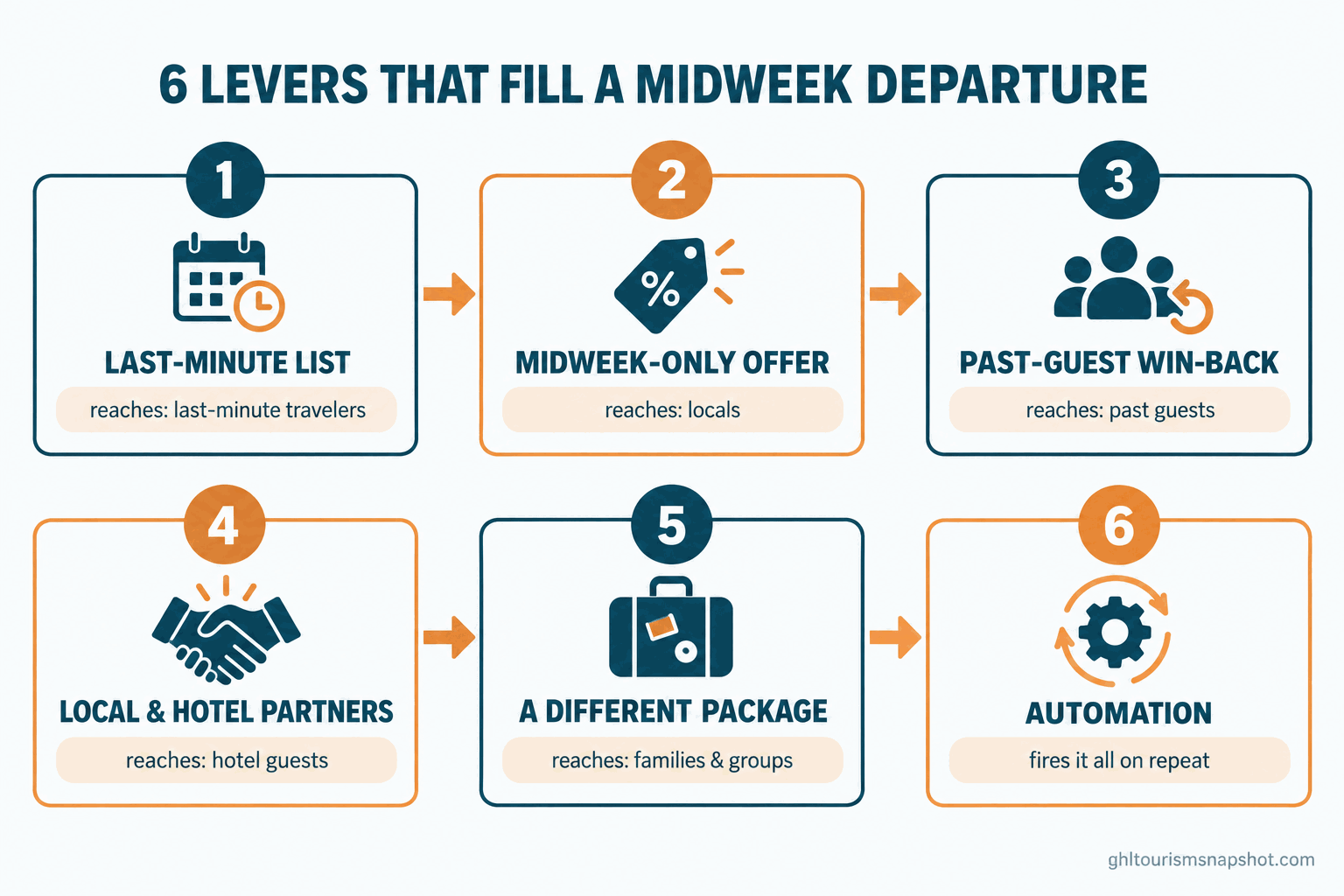
| Lever | Who it reaches | How fast it fills |
|---|---|---|
| Standing last-minute list | Last-minute travelers | Same week |
| Midweek-only offer | Locals and price-sensitive travelers | Days to weeks |
| Past-guest win-back | People who already love you | Weeks |
| Local and hotel partners | Residents and hotel guests | Builds over a season |
| A different midweek package | Families, couples, groups | Builds over a season |
| Automation that fires it all | Every buyer above, on repeat | Set up once, runs forever |
The booking window is on your side: tours get booked late, with mobile and last-minute channels closest to the date, exactly where a next-day midweek seat lives.
Lever 1: A standing last-minute list
This is the fastest seat-filler you will set up, and it is the opposite of a waitlist. A waitlist catches people when you are sold out; a last-minute list catches people who asked to be told when a departure needs bodies.
The setup. Add a signup anywhere you already have attention: your website, a counter sticker, your Instagram bio, a checkout box that says “text me last-minute deals.” Tag every signup, and when a departure looks thin, send one text with the date, the deal, and a deadline.
Where it breaks. No deadline, and you field replies at 10pm holding seats for people who never pay, so always set a reply-by time. Send it to everyone, and your weekend buyers learn to wait for the cheap seat, so keep this list separate and save it for slow days.
Lever 2: A midweek-only reason to come
Some seats need a standing reason that midweek is the better day. The key word is only: the offer has to be impossible to use on a Saturday, or you have just discounted your busiest day.
The setup. Pick a midweek-only hook and make it structural: a “locals’ Wednesday” rate that needs a resident signup; a bundle (bring a friend for half price Tuesday to Thursday); or a quieter experience you can only promise on a slow day. Promote it where locals look: your Google Business Profile, a pinned social post, every booking confirmation. Google lets you post offers right on your profile. (Google)
Where it breaks. The classic failure is an offer so good it cannibalizes full-price demand. If a visitor can shift a Saturday booking to Wednesday to save 20%, some will. Fence it with a resident code or a “new bookings only” rule. The other failure is posting it once: a standing offer has to live somewhere permanent.
Lever 3: Your past guests, aimed at slow days
The cheapest booking you will make is from someone who already came and loved it. Yet most operators never contact a past guest again, then pay an online travel agency a fifth of the next sale to rent back a customer they already had. For midweek, past guests are gold: they are often locals or repeat visitors with flexible schedules.
The setup. This only works if you own your guest list, which means capturing the contact on every booking, not leaving it locked inside an OTA. Tag every past guest by trip and date, then fire a short message on a trigger, the trip anniversary or the start of a season, pointed at a midweek seat. For the deeper version, see repeat bookings for tour operators and winning more direct bookings.
Where it breaks. You cannot win back a guest whose details you never captured, so this lever depends on owning the contact at booking. If an OTA booked them, you may have a first name and nothing else. The other trap is blasting the whole list for every slow day: segment by who is nearby, and keep the touches rare enough that they feel like an invitation, not spam.
Lever 4: Locals, hotels, and concierges
This lever builds slower but becomes your most reliable midweek base, because it is not one booking, it is a channel. Hotels, rental hosts, concierges, and visitor centers all have guests who need something to do on a quiet weekday.
The setup. List every hotel, B&B, and rental manager within a reasonable radius. Walk in with a simple offer: a referral fee for every guest they send, cards for the desk, and a link to book, not a phone call. Give partners a dedicated weekday rate, and keep the link trackable so you know who sends people.
Where it breaks. Partners forget you the moment you leave, so make it stupidly easy (one link, one rate) and check back. And watch referral fees: a 15% fee on a seat that would have been empty is pure upside; the same fee on a seat that would have sold anyway is a leak.
Lever 5: A different package for a different buyer
Sometimes the midweek seat stays empty because you are selling the same tour you sell on Saturday, to people who do not want the Saturday experience. Reshape the product and the seat fills itself.
The setup. Build for who is around on a weekday: a family package with a kids’ rate for parents on a school break; a “date morning” couples package; a slower photography tour; a corporate outing for companies that want a weekday off-site. Each is the same boat and guide, repackaged so a midweek buyer sees a reason to pick a Tuesday. Corporate and group bookings love weekdays and book bigger, so it is worth a dedicated path, covered in winning more group and private tour bookings.
Where it breaks. The temptation is to build ten packages and promote none well, so pick one, name it, price it, and sell it hard before adding a second. The other failure is pricing a group so low that a 15-person weekday booking earns less than three weekend walk-ins would have, so do the math before you discount for volume.
Lever 6: Make it fire without you
The first five levers take time you do not have, which is why most operators do them once, see it work, then stop the week they get busy. The only version that lasts runs itself.
The setup. Three things run automatically. Capture: every inquiry, booking, and walk-up gets tagged into the right list (last-minute, local, past guest, partner) without you sorting by hand. Trigger: when a departure is a few days out and under a seat threshold, the fill sequence fires to the right list on its own. Follow-through: the booking, deposit, confirmation, and reminder happen without you touching them. Most operators run this on GoHighLevel, which ties texting, lists, the booking calendar, and triggers together, but the principle holds on any CRM that can tag a contact and fire a scheduled message. For the full picture, read how to automate your tour business.
Where it breaks. The failure is automating a mess. If your contacts are scattered across a booking tool, a phone, and three spreadsheets, no automation fires cleanly because it cannot tell a local from a past guest, so get the capture clean first. If you are unsure where to start, the fastest win is Lever 1’s last-minute list.
Three scenarios: solo, small shop, large
The six levers apply to everyone, but what you build first depends on your size.
The solo operator. A single-kayak guide, a one-van food tour, or a contractor under a host agency. You guide and sell at the same time, so start with the last-minute list and the past-guest win-back: both reduce to one saved message you send when a weekday looks thin. Your goal is one slow seat filled a week with ten minutes of effort.
The small shop (one to three staff). A couple of guides and a seasonal crew, with bookings routing through you or a front desk. This is where the system starts paying a guide’s wages. Put the capture and tagging in place so your list stops living in your head, stand up the midweek offer and the last-minute list, and start the hotel outreach. The automation in Lever 6 matters most here, where the handoffs are.
The large operator. Multiple departures a day, several locations, a team. Your problem is consistency and margin control across a lot of inventory, so lean on the partner channel and the packaged products, which scale as a system and fill bigger blocks of seats. Watch discounting hardest at your scale: a rate that leaks into weekend demand costs far more across fifty departures than across five. Owning your guest data instead of renting it from OTAs also compounds most here, a theme in the off-season cash-flow playbook.
Keep the offers and texts legal
The moment you start texting deals and advertising discounts, a few real rules kick in. None of this is legal advice, so check your own state.
Texting consent. You need permission before you text a marketing offer, and a booking alone does not grant it. Collect a clear opt-in at signup, honor STOP and HELP automatically, and in the US register business texting through A2P 10DLC or carriers block you. The TCPA allows damages of $500 to $1,500 per unsolicited message. (FCC) The full version is in our SMS marketing playbook.
Advertising your discounts. If your state regulates sellers of travel, your registration number may have to appear in your advertising, including midweek offers. Florida requires sellers of travel to register. (FDACS) California requires it too, with the number shown in all advertising. (California DOJ) Our seller of travel registration guide walks through who needs it.
Objections, answered straight
“Won’t discounting the midweek seat cheapen my brand?” Only if you do it wrong. The system fences the discount so your full-price weekend buyer never sees it. A locals’ rate tied to a resident signup is a different price for a different buyer on a day that was going to be empty anyway. Airlines, hotels, and gyms have priced this way for decades.
“My midweek is dead because my town is dead midweek.” Then the partner and local levers matter more, not less. The locals are there, they have just never had a reason to come on a Tuesday. If you genuinely have zero midweek demand, you may be better off running fewer, fuller departures, which the fill empty departures playbook covers.
“I already pay for FareHarbor or Peek Pro. Doesn’t that do this?” Your booking software is the checkout: it holds the calendar and takes the payment. What it does not do is reach a local who has never booked, win back a past guest, or fire a last-minute text to a tagged list on a slow Wednesday. That is lifecycle work, and it lives in a CRM, not a booking widget.
FAQ
Filling midweek tours: questions operators ask
How do I fill empty midweek tour departures without discounting my whole business?
Fence the discount so it only reaches the midweek buyer: a locals' rate tied to a resident signup, a last-minute seat that only exists the night before, or a midweek-only package. Keep those offers off your weekend marketing.
What's the fastest way to fill a slow weekday this week?
A standing last-minute list. When a departure looks thin, send one text to people who opted in, with the date, the rate, and a booking deadline. Tours get booked late, so a next-day seat is very fillable.
How late do people actually book tours and activities?
Late. Research found roughly two in five tours and activities are booked within two days of the trip, and mobile and direct channels have the shortest lead times. A midweek seat two days out is still very much in play.
Do I need special software to fill midweek seats?
No single tool is mandatory, but you need one place that can tag a contact as a local, past guest, or last-minute lead and fire a message on a trigger. A booking tool alone cannot do that, which is why many operators run it on GoHighLevel.
Is it legal to text customers last-minute deals?
Yes, with consent. You need a clear opt-in, you must honor STOP and HELP automatically, and in the US you must register business texting through A2P 10DLC or carriers block you. The TCPA allows $500 to $1,500 per non-compliant message.
It is Wednesday at 9:40am again, and your 10 o’clock has eleven paddlers on it. Four came off the last-minute list you texted last night, three are locals using the HOMETOWN rate, two are a returning couple who got the anniversary note, and the hotel down the street sent the last pair. You did not make a single call. The system did, while you loaded boats. For the wider picture, read how to automate your tour business, or see what the Tourism Snapshot installs for you.