
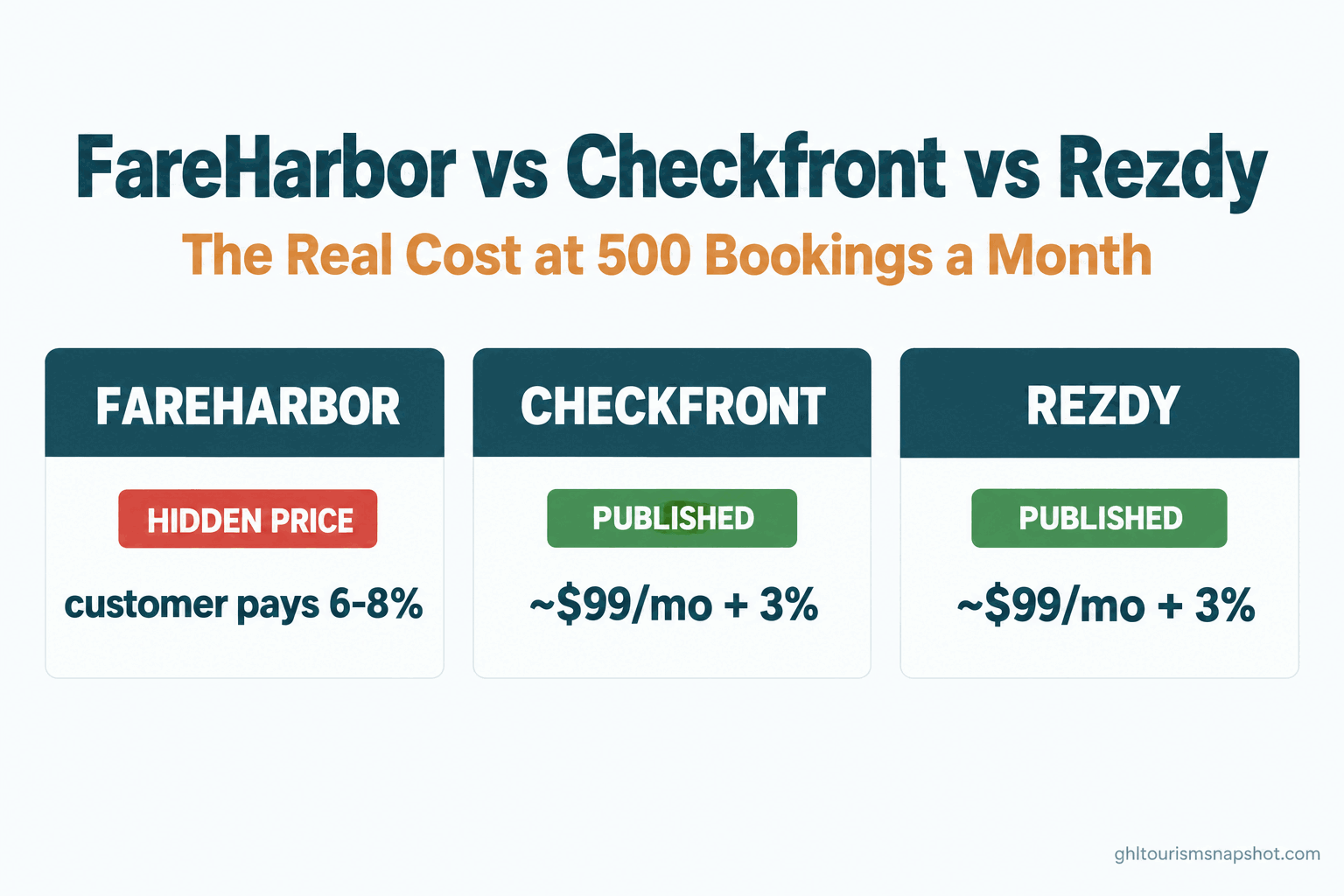
It is a slow Tuesday in the off-season. You finally have an hour to sort out your booking software, so you open three tabs: FareHarbor, Checkfront and Rezdy. Two of them show you a price. FareHarbor shows you a button that says “Book a demo.” You know how that call goes: a friendly rep, a slick screen-share, and a number that never lands in writing until you are halfway to signing.
Here is the short answer. At 500 bookings a month, the cheapest tool on paper is not the cheapest in real life, because the three price their booking fee in completely different ways. FareHarbor charges no subscription and instead adds a reported 6 to 8 percent fee to your customer at checkout. Checkfront and Rezdy charge a published subscription near $99 a month plus about a 3 percent fee that you usually pay. So the real question is not “which is cheapest,” it is “who pays the fee, and how much does a percentage hurt at my ticket price.” This post runs the math so you walk into any demo with a ceiling instead of walking out with a quote.
The setup: one operator, 500 bookings a month
To compare three tools honestly you hold everything else still, so here is our operator: a small shop doing 500 bookings a month, which is 6,000 a year. Think a food-tour company with a few guides, a kayak operation in a summer town, or a brewery-crawl business that runs most nights in season.
We test them at three ticket prices, because that is the number that actually changes the answer. A percentage fee rises with every dollar you charge, so a $45 seat and a $300 charter berth pay the same subscription but wildly different fees. One note: card processing of roughly 2.9 percent plus $0.30 lands on you whichever platform you run, so it is a wash and we leave it out. What we compare is the software cost on top.
The three prices, side by side
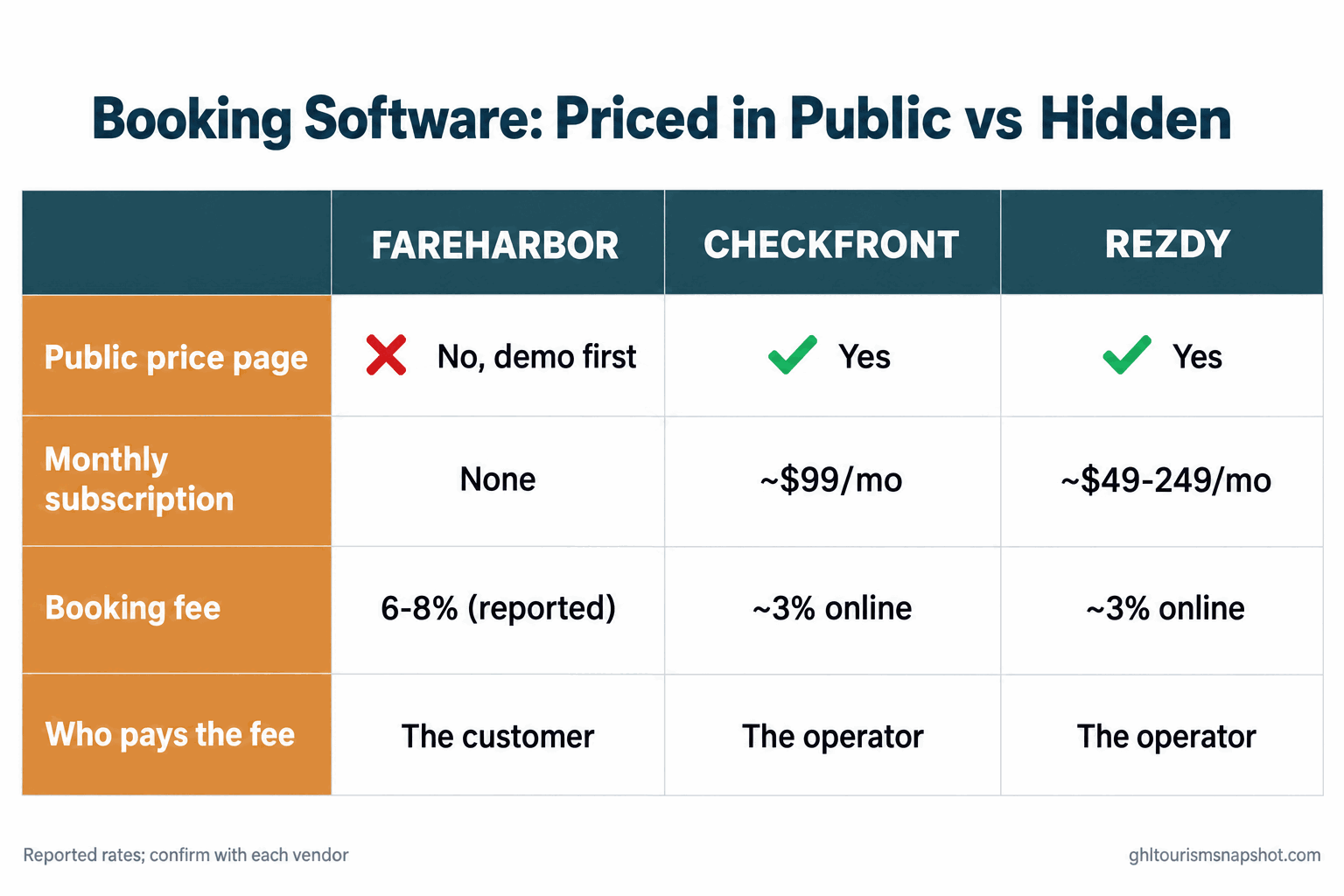
Here is what each company will tell you before you give them your phone number.
| Platform | Public price page? | Monthly subscription | Booking fee (reported) | Who pays the fee by default |
|---|---|---|---|---|
| FareHarbor | No, demo first | None advertised | ~6 to 8 percent per booking | The customer, added at checkout |
| Checkfront | Yes | ~$99/mo on the main plan | ~3 percent online, 0 percent offline | The operator |
| Rezdy | Yes | ~$49 / $99 / $249 a month | ~3 percent online | The operator |
A few caveats, because these numbers move. FareHarbor’s demo page describes a per-booking fee with “no large upfront license or mandatory monthly platform fee.” (FareHarbor) The 6 to 8 percent band comes from third-party guides, not FareHarbor, so treat it as a planning figure. (CaptainBook) Checkfront’s main tier shows near $99 a month with a 3 percent online fee and no fee offline, though one aggregator lists higher plans. (TrekkSoft, FindStack) Rezdy publishes tiers from around $49 a month with a roughly 3 percent fee, and reviewers warn some accounts get moved onto a marketplace-style plan that charges the percentage offline too. (TrekkSoft, GetApp)
The pattern is already visible: the two tools that publish a price charge roughly half the booking fee of the one that hides it.
Who actually pays the booking fee, and why it matters
This is the part the comparison blogs skip. On FareHarbor, the default is that your customer pays. A $120 seat shows up at checkout as roughly $128, and that extra $8 is a separate line the traveler sees. To you, FareHarbor feels almost free, because the money never leaves your payout, which is why it is such an easy “yes” on the demo call. On Checkfront and Rezdy, the default is that you pay: a $120 seat stays $120 at checkout, and roughly $3.60 comes out of your payout. You can pass it on, but by default it sits with you.
So this is not apples to apples unless you decide one thing first: do you absorb the fee, or pass it to the traveler? That choice flips which tool looks cheapest, and most operators never make it on purpose. If you pass fees either way, it comes down to “add 6 to 8 percent to my price, or 3 percent plus a small subscription,” and the published tools win.
The annual math at a $120 ticket
At a $120 average ticket, 6,000 bookings a year is $720,000 gross. Booking fee only, across a full year: FareHarbor’s reported 7 percent is about $50,400, and a 3 percent fee on Checkfront or Rezdy is about $21,600.
Read those carefully. FareHarbor’s $50,400 is money your customers hand over; the $21,600 is out of your payout if you absorb it. The total fee the market pays on your bookings is more than twice as high on FareHarbor, even though your personal share is lower. You are not saving that money, you are moving it onto the traveler and inflating your price. Add the roughly $1,188 subscription and it barely registers: at this volume the subscription is never the thing that matters. The percentage is.
Three scenarios: the answer changes with your ticket price
Here is why a single “winner” is a lie. Hold volume at 500 bookings a month and change only the ticket price. A percentage fee is painless on a cheap seat and savage on an expensive one.
The low-ticket operator: a $45 kayak seat or escape-room spot. At 6,000 bookings, that is $270,000 gross. FareHarbor’s 7 percent is about $18,900 a year on your customers; a 3 percent fee is about $8,100. The fee is survivable and the $1,188 subscription is a meaningful slice of a lean business, so the “no subscription” pitch is genuinely attractive. A free tier like Bokun’s can matter too; our breakdown of the Bokun free plan walks through the catch. Low ticket is the only band where FareHarbor’s model is close to defensible.
The mid-ticket operator: a $120 food, brewery or ATV tour. The $720,000 operator from above. FareHarbor’s 7 percent is about $50,400; a 3 percent fee is about $21,600. The gap is $28,800 a year, a part-time guide’s wages. This is the band where operators quietly bleed: they adopted FareHarbor when they were tiny and the fee grew with them without becoming a bill they dread.
The high-ticket operator: a $300 private charter or premium expedition. At 6,000 bookings, $1.8 million gross. FareHarbor’s 7 percent is about $126,000 a year; a 3 percent fee is about $54,000. The gap is $72,000 on the same volume. Here a percentage fee is one of the largest costs in your business. No high-ticket operator should run a passed-through 6 to 8 percent fee without hard-negotiating it.
The rule of thumb: the higher your ticket, the more a published subscription plus 3 percent beats a high-percentage model. Run your average ticket times 6,000 times the fee before any demo, and the number decides it.
What each tool is actually good at (beyond price)
Price is not the only axis. FareHarbor sells convenience: setup done for you, a clean checkout, a real support reputation, and a brand travelers recognize. Checkfront sells flexible inventory control, handling rentals and tours in one system with published pricing. Rezdy sells distribution, with a channel manager that pushes your availability out to resellers, OTAs and concierge desks.
None of the three, by design, helps you turn a one-time guest into a repeat booking you own. That gap is the real money.
The migration cost nobody puts in the quote
Switching is not free, and an honest comparison prices the move. Three things cost real time.
Your live calendar. Every tour, capacity rule and seasonal schedule has to be rebuilt and tested: an afternoon for a simple operation, a week for a shop with multiple routes and blackout dates.
Your past-customer list. The asset that matters most and the easiest to lose. Before you sign anywhere, ask exactly how you export your customer records and future bookings if you leave.
Gift cards, deposits and every embed. Those gift cards and deposits are live liabilities the new system has to honor, and your website buttons, Google listing and link-in-bio all point at the old checkout. Map them and plan a single cutover day.
A $28,800 annual saving pays for a week of setup many times over, so do not let “switching sounds like a hassle” cost you five figures a year.
Where each pricing model breaks
Every model has a shape that tells you where it will hurt.
FareHarbor breaks when your ticket or volume climbs. The percentage grows with your best season and quietly makes your advertised price less competitive. The failure is slow and invisible: you never see the fee as a bill, so you never renegotiate it. Calculate your effective rate from your payout data every quarter and push for a written, volume-based rate.
Checkfront breaks when you treat the 3 percent as invisible. It is operator-paid by default, so it comes out of your margin on every online booking. If you never decide whether to absorb or pass it, you just eat it forever. Choose on purpose.
Rezdy breaks on the plan name. Reviewers report being moved onto a marketplace-style plan that applies the percentage to offline and phone bookings too, doubling the fee base you expected. (TrekkSoft) Confirm in writing which bookings the fee applies to before you sign.
All three break on the same deeper flaw. You pay the fee again on every repeat and referral. A guest who loved last year’s trip and books again through the same checkout costs you the same cut as a brand-new stranger. That is the leak worth sealing, whichever tool you choose.
Steal this: the demo script that forces the real price out
You do not get a real number by asking “how much is it.” You get one by asking closed questions that are awkward to dodge. Walk into any quote-gated demo with this list and do not leave until every line has a figure.
That last line matters most. A verbal rate in a demo is a vibe, not a price. If a rep will not put the all-in cost in an email, you have your answer.
And when you do switch, do it in the off-season: export your full customer list first, rebuild and test one real booking end to end, map every gift card and deposit, then update every place your old booking link lives on one cutover day and keep the old links redirecting for 30 days.
Who each one is actually right for
The right pick follows from your numbers, not the brochure.
FareHarbor is right for you when your ticket is low to moderate, you value a done-for-you setup, and you are fine with your customer carrying a 6 to 8 percent fee. It is the wrong tool when your ticket is high or your volume is large, because the passed-through percentage becomes the biggest line in your business and you never renegotiate it.
Checkfront is right for you when you want published pricing, you run rentals or classes alongside tours, and you want to control the fee decision yourself. It is less ideal if your growth depends on resellers and OTAs.
Rezdy is right for you when wholesale and reseller distribution is part of how you sell. It is overkill if you sell almost entirely direct.
There is a fourth answer the three vendors will never give you: treat the booking tool as a checkout and build the customer relationship somewhere you own, so a repeat guest who books direct next season carries card processing and nothing else, no 7 percent, no 3 percent, no marketplace cut. The deeper playbook is in our guide to winning more direct bookings, and the OTA commission break-even calculator shows when a direct booking beats a marketplace sale. For the full field, including Bokun, Xola and Peek Pro, see our tour booking software pricing teardown, and if you want off FareHarbor specifically, the best FareHarbor alternatives for small operators.
Objections, answered straight
“FareHarbor has no subscription, so isn’t it just cheaper?” Only if you ignore where the fee goes. FareHarbor funds itself by adding 6 to 8 percent to your customer’s bill, more than double the published 3 percent on Checkfront or Rezdy. On total cost per booking, FareHarbor is usually the most expensive of the three.
“Everyone passes the fee to the customer anyway, so who cares?” A checkout surcharge quietly lowers your conversion and makes your price less competitive than the operator who absorbed a smaller fee. A customer paying the fee is not the same as the fee being harmless.
“I already run on FareHarbor and switching sounds brutal.” Do two things this quarter: calculate your true effective rate from your payout data, and ask your rep, in writing, to match a published 3 percent competitor at your volume. If they will not budge and the gap is five figures, migration pays for itself.
“Isn’t the cheap published tool just worse software?” Checkfront and Rezdy are mature platforms used by serious operators. “Hides its price” and “best product” are not the same claim, especially when the hidden option is also the most expensive.
FAQ
FareHarbor vs Checkfront vs Rezdy, the questions operators ask
Which is cheapest: FareHarbor, Checkfront, or Rezdy?
It depends on who pays the fee and your ticket price. If you absorb fees, FareHarbor can look cheapest to you because its fee is charged to your customer. But on total cost per booking, FareHarbor's reported 6 to 8 percent is more than double the published 3 percent on Checkfront and Rezdy, so at a high ticket the published tools win clearly.
Does FareHarbor really have no monthly fee?
That is the model FareHarbor describes on its demo page: a per-booking fee rather than a monthly platform fee. The trade is that the fee is reported at 6 to 8 percent and usually added to your customer at checkout, so your sticker price goes up.
How much is the booking fee on each platform?
FareHarbor's is third-party reported at roughly 6 to 8 percent, passed to the customer by default. Checkfront and Rezdy both run near 3 percent on online bookings, charged to the operator by default. Card processing of about 2.9 percent plus $0.30 applies on all three.
Is it worth switching booking software to save on fees?
Run the annual number first. At 500 bookings a month and a $120 ticket, the gap between a 7 percent and a 3 percent fee is roughly $28,800 a year, which pays for a week of migration many times over. At a $300 ticket it is around $72,000.
What about owning my repeat customers instead of paying the fee again?
That is the biggest saving of all. Whatever booking tool you use, you pay the fee on every repeat and referral unless you bring that guest back through a channel you own. Capturing contact details and running a win-back sequence turns a one-time booking into a direct repeat that carries only card processing.
Pricing here is drawn from vendor pages, independent trackers and competitor guides as cited; the reported FareHarbor figures are not officially published, so confirm the current rate with each vendor. For context, the U.S. Bureau of Labor Statistics projects employment of tour and travel guides to grow 6 percent from 2025 to 2035, faster than average, while travel agent employment shows little or no change. (BLS, tour and travel guides, BLS, travel agents) Demand for well-run experiences is rising, which makes the fee underneath them worth getting right.